Cryptography · Study deck

Cryptography Route Map

Picture a health reading leaving a wearable, crossing a home bridge, and entering a clinical service.

Shield Shelly is your guide for this deck.

route
Shield Shelly, the module guide, in a scene from this chapter.
iotclass.org

After studying this chapter

Learning objectives

You will be able to:

  • choose a learning path through confidentiality, integrity, identity, freshness, and key lifecycle topics;
  • route an IoT security claim to the right chapter group without confusing link, transport, object, and key-renewal layers;
  • identify which chapters provide implementation practice and which chapters provide release-review evidence;
  • assemble a lightweight evidence checklist for cryptography decisions before reading the detailed chapters.
iotclass.org

Major section

In 60 Seconds

Encrypting one link is not enough if an unnamed reader can copy or change the record at the next boundary.

  • A protocol is a shared set of rules for exchanging data.
  • An API is a named software entry point used by another program.
  • A gateway is the device or service that joins two system paths.

Key terms

Firmware
Firmware is the stored device code and its version.
iotclass.org

Major section

In 60 Seconds (continued)

Firmware is the stored device code and its version.

  • This runway does not choose one cipher or key system.
  • The deeper route map connects security goals, primitives, identity, key life, protected transport, protected messages, and release evidence.
  • This book is the cryptography and encryption route map for IoT systems.
iotclass.org

Major section

How to Use This Book
Cryptography fails most often at the boundary around the primitive: the wrong data is protected, the wrong endpoint is trusted, a key outlives its purpose, or evidence proves only the happy path.

  • This book is organized to keep those decisions visible.
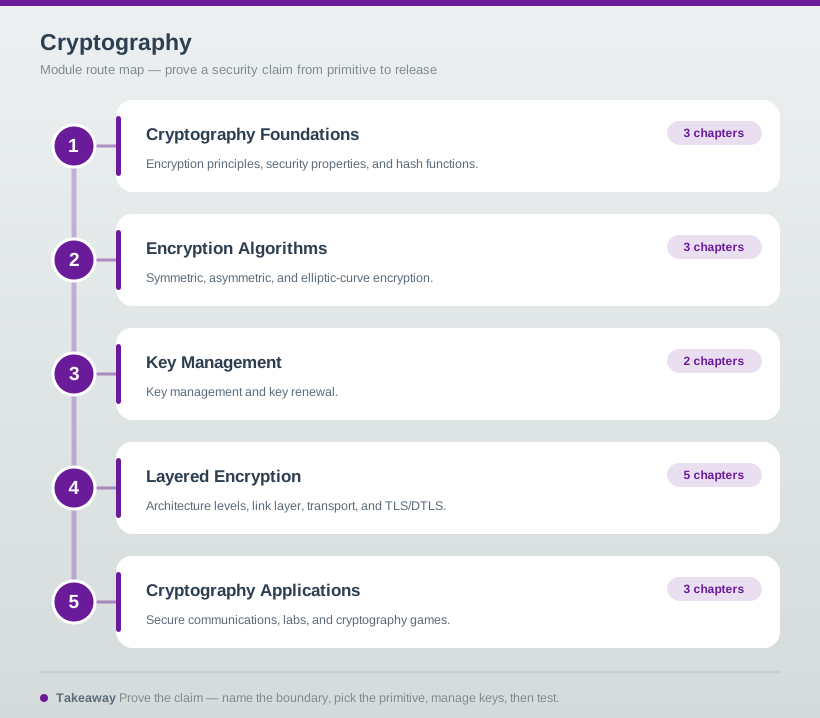
Cryptography module route map: five numbered stages from cryptography foundations through encryption algorithms, key management, layered encryption, and cryptography applications, each labeled with its chapter count.
iotclass.org

Major section

Evidence Loop

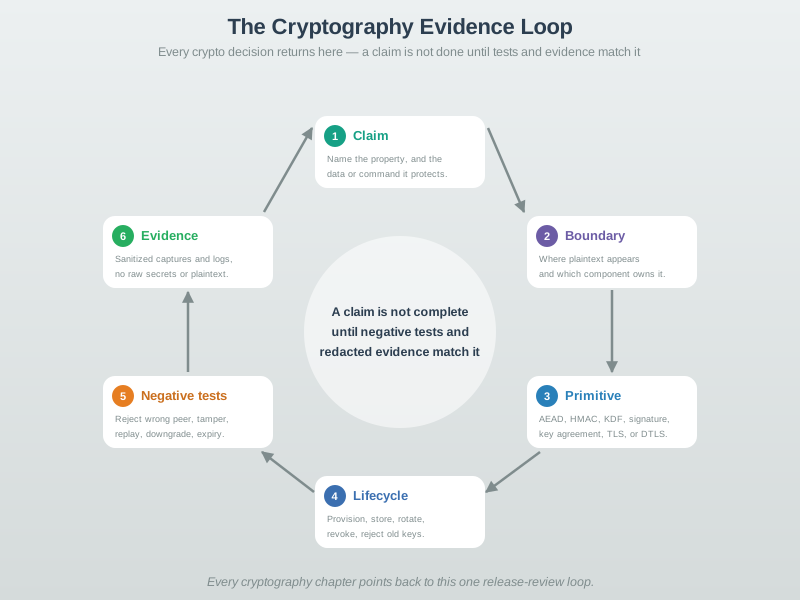
Every chapter in this book points back to the same release-review loop: name the claim, place the boundary, choose the primitive or protocol, prove key lifecycle, run negative tests, and keep evidence without leaking secrets.

  • Evidence then returns to the claim; a mismatch reopens the design instead of being filed as a pass.
A cryptography decision is not complete until the negative tests and redacted evidence match the claim — every crypto chapter returns to this one loop.
iotclass.org

Major section

Property-to-Primitive Review Map

Cryptography is a toolbox, not one universal control.

  • The first review move is to name the property required by the claim, then pick the primitive or protocol that actually proves that property.
  • A nonce does not prove integrity unless it is bound into an authenticated protocol.
  • In an IoT review, the property should be written as a testable claim. "Telemetry is encrypted" is not enough.
iotclass.org

Major section

Hybrid Protocol Pattern

Asymmetric mechanisms such as ECDH, signatures, and certificates solve key agreement and identity problems, but they are not the right tool for bulk telemetry.

  • Symmetric AEAD modes such as AES-GCM and ChaCha20-Poly1305 protect most records after the protocol has established session keys.
  • TLS 1.3 is the familiar hybrid pattern: authenticated key agreement establishes fresh secrets, a KDF derives traffic keys, and symmetric record protection carries the data.
  • DTLS 1.3 adds datagram-specific evidence for loss, reordering, retransmission, and replay windows.
iotclass.org

Major section

Hashes, Keys, and Failure Behavior

Anyone who can edit a message can compute a new digest.

  • Modern reviews should also reject broken or misplaced hashes.
  • MD5 and SHA-1 are broken for collision resistance and should not be used where collision resistance matters.
  • Key lifecycle is the operational part of cryptography.
iotclass.org

Deck summary

Key takeaways

Encrypting one link is not enough if an unnamed reader can copy or change the record at the next boundary.

  • Firmware is the stored device code and its version.
  • Cryptography fails most often at the boundary around the primitive: the wrong data is protected, the wrong endpoint is trusted, a key outlives its purpose, or evidence proves only the happy path.
  • Every chapter in this book points back to the same release-review loop: name the claim, place the boundary, choose the primitive or protocol, prove key lifecycle, run negative tests, and keep evidence without leaking secrets.
  • Cryptography is a toolbox, not one universal control.
iotclass.org

Retrieval practice

Recall check 1 of 5

Shield Shelly says: answer from memory, then check your reasoning.

Q1A message must prove it was not altered and came from the expected sender, but secrecy is not required. Which primitive fits?

AA MAC or digital signature
BEncryption alone without authentication
CCompression before every packet
DA nonce stored without a tag
Show answer

Answer: A Integrity and origin evidence come from a MAC or signature; encryption is not required for this claim.

iotclass.org

Retrieval practice

Recall check 2 of 5

Shield Shelly says: answer from memory, then check your reasoning.

Q2A fleet uses AES-256 correctly but hard-codes one shared key into every device. What is the main risk?

AOne extracted device key can expose the whole fleet
BAES-256 becomes too small for IoT messages
CHashing the shared key makes reuse safe
DNo rotation plan is needed with strong ciphers
Show answer

Answer: A The cipher can be strong while key scope, storage, and revocation make the deployment unsafe.

iotclass.org

Retrieval practice

Recall check 3 of 5

Shield Shelly says: answer from memory, then check your reasoning.

Q3A team says a gateway may decrypt device messages before forwarding them to a cloud service, but the product page claims end-to-end confidentiality. Which chapter should they read first?

AEncryption: Architecture and Levels
BCipher Challenge Game, because practice ciphers decide the production boundary
CInteractive Cryptography Tools, because a calculator can approve the claim
DEncryption Review Quiz only, because a quiz can replace the design review
Show answer

Answer: A The first issue is the claim boundary: who can see plaintext and where the protected layer ends.

iotclass.org

Retrieval practice

Recall check 4 of 5

Shield Shelly says: answer from memory, then check your reasoning.

Q4A device fleet uses a shared key and has no way to revoke a single device. Which chapter group should be prioritized?

AKey management and renewal
BOnly Cipher Challenge Game
COnly the module introduction
DOnly a user-interface chapter
Show answer

Answer: A Shared-key blast radius and revocation are lifecycle problems before they are protocol problems; the issue is key scope, containment, revocation, and old-key rejection.

iotclass.org

Retrieval practice

Recall check 5 of 5

Shield Shelly says: answer from memory, then check your reasoning.

Q5A datagram-based protocol needs encrypted communication without changing its transport behavior. Which route is most useful?

ADTLS plus transport-boundary checks
BUse link-layer encryption only and skip transport identity
CUse a hash function alone for confidentiality
DRoute directly to privacy regulations
Show answer

Answer: A DTLS handles datagram transport, while E3-E4 clarifies what the transport session does and does not protect.

Q6Complete a small router that selects the next chapter group for a cryptography review:

Aif claim['plaintext_boundary'] == 'unclear':
Bif claim['button_color'] == 'blue':
Cif claim['page_title'] == 'short':
Dif claim['diagram_count'] == 0:
Show answer

Answer: A A review route starts with unclear plaintext boundaries, then missing key lifecycle, then release checks and labs once the design is coherent.

iotclass.org

Print reference

Answers 1 of 2

Answer key.

  1. A · Integrity and origin evidence come from a MAC or signature; encryption is not required for this claim.
  2. A · The cipher can be strong while key scope, storage, and revocation make the deployment unsafe.
  3. A · The first issue is the claim boundary: who can see plaintext and where the protected layer ends.
  4. A · Shared-key blast radius and revocation are lifecycle problems before they are protocol problems; the issue is key scope, containment, revocation, and old-key rejection.
iotclass.org

Print reference

Answers 2 of 2

Answer key.

  1. A · DTLS handles datagram transport, while E3-E4 clarifies what the transport session does and does not protect.
  2. A · A review route starts with unclear plaintext boundaries, then missing key lifecycle, then release checks and labs once the design is coherent.
iotclass.org