Emerging Paradigms · Study deck
CoRAD Drone Data Collection
Start with a mission that moves, loses energy, and changes its radio path while it works.
Blueprint Bina is your guide for this deck.

After studying this chapter
Learning objectives
You will be able to:
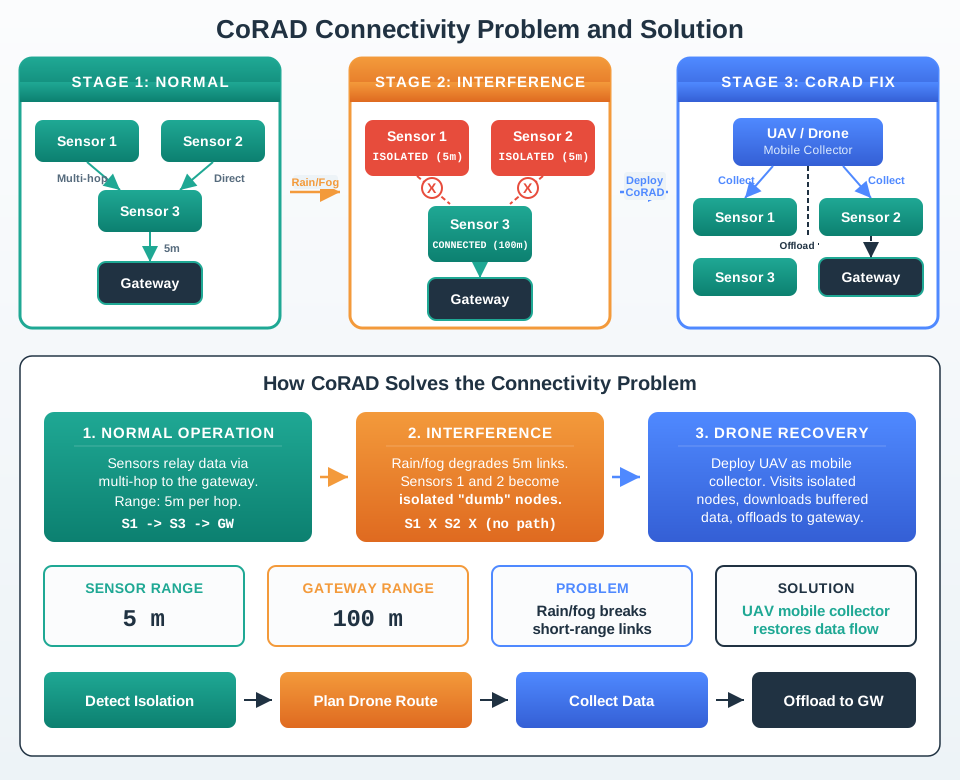
- Explain CoRAD Architecture: Describe how drones restore connectivity to isolated sensor nodes
- Apply TSP algorithms: Use Traveling Salesman Problem solutions for efficient flight path planning
- Plan recovery missions: Design complete drone data collection missions with multiple disconnected nodes
- Handle constraints: Account for battery limits, weather conditions, and real-time route adaptation
Major section
Phoebe's Field Notes: The Battery Line Item Is Hiding a Watt Number, Not Just Seconds
The mathematical gist.: The chapter’s 37 s flight plus 50 s hover uses 87/1800=4.83% of a time-only battery budget.
- If hover current is 1.3× cruise current, the same mission costs 37+1.3(50)=102 equivalent cruise seconds, or 5.67%—17.24% more than the time-only estimate.

Major section
Sensor Squad Rescue Drone
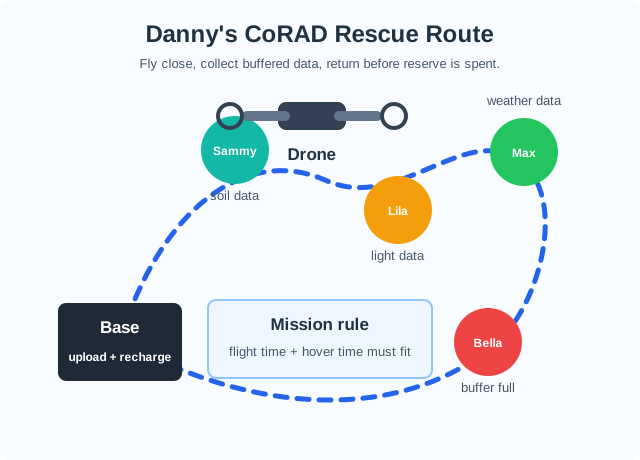
All the little sensor friends could still FEEL the rain and measure how wet the soil was, but they couldn't TALK to the base station anymore!
- Sammy the Soil Sensor was worried: "I've been saving important data for THREE WHOLE DAYS, but I can't send it anywhere!
- You have 20 minutes of battery.
Major section
Sensor Squad Rescue Drone (continued)
Danny had to be clever about where to fly---drones can't fly forever!
- I can only talk to things really, REALLY close---like 5 steps away instead of 100!".
- Their batteries run out, just like when your tablet runs out of charge.
- Fly back home before the battery runs out!
Major section
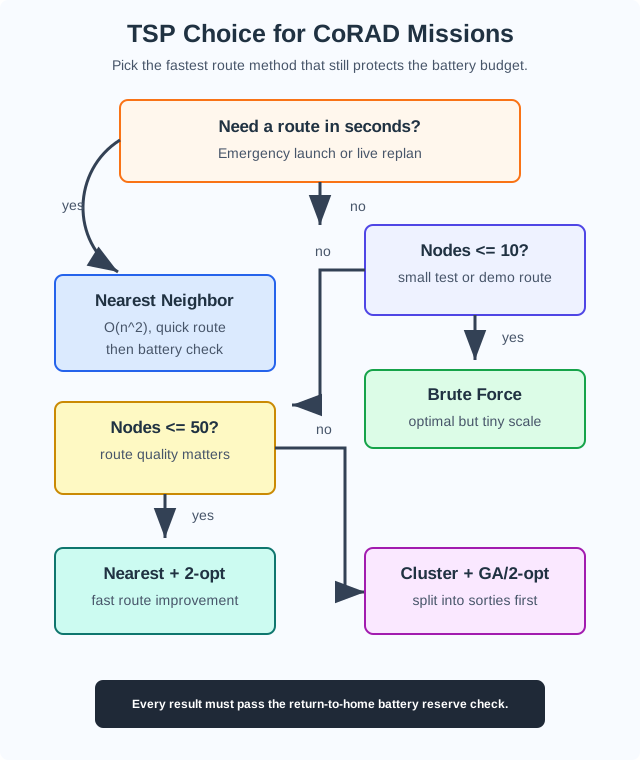
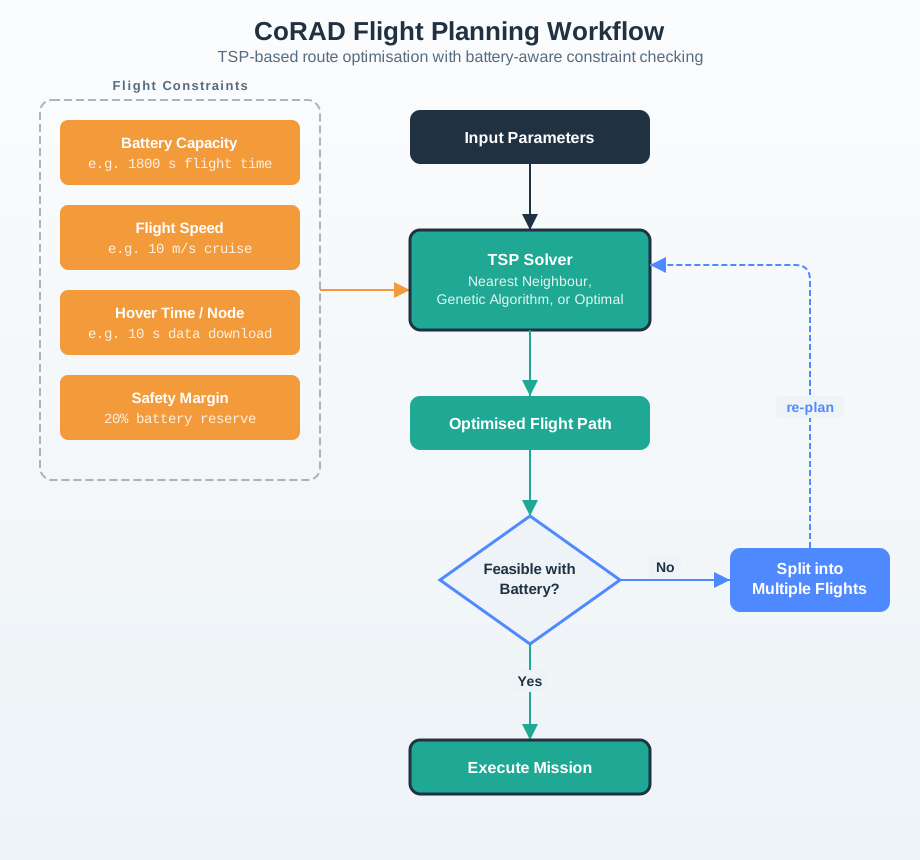
TSP Flight Path Optimization
Constraint: Drone battery capacity limits flight duration.
- For CoRAD applications, nearest neighbor heuristic provides a good balance of speed and solution quality for real-time drone deployment.
Major section
Alternative View: CoRAD Mission Timeline
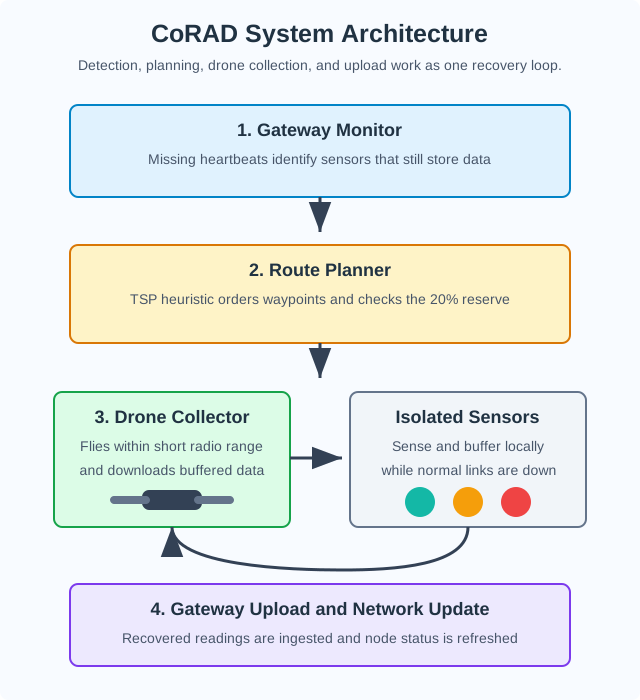
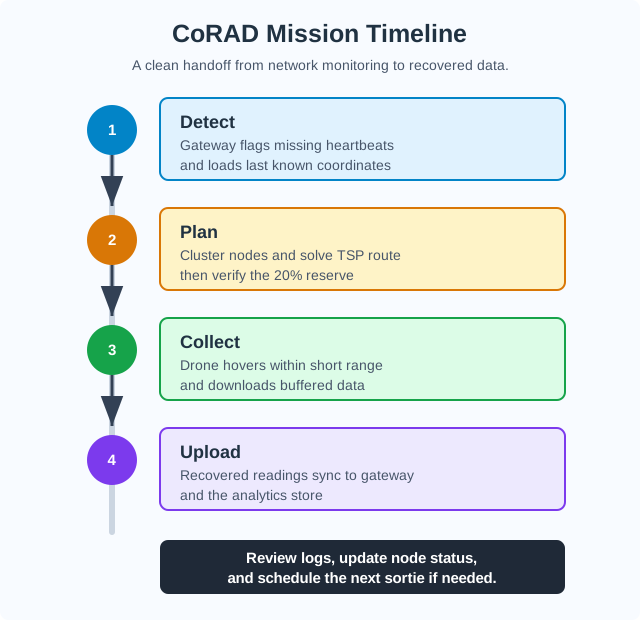
This variant shows a complete CoRAD mission lifecycle from detection to data recovery, illustrating the operational workflow.
- Operational Metrics: A small CoRAD mission for 8 disconnected nodes can take about 40 minutes end-to-end when weather and airspace are clear.
Major section
Scenario: Post-Storm Sensor Recovery
The farm used k-means clustering to partition 340 nodes into 9 geographic clusters, then ran 2-opt TSP optimization within each cluster.
- This planning scenario shows how CoRAD would be used after an ice storm damages gateway connectivity across a large agricultural deployment.
- In this scenario, all planned buffered readings are recovered before local buffers overwrite older samples.
- Key Takeaway: The 20% battery safety margin is a planning reserve, not spare capacity to spend.
Deck summary
Key takeaways
The mathematical gist.: The chapter’s 37 s flight plus 50 s hover uses 87/1800=4.83% of a time-only battery budget.
- All the little sensor friends could still FEEL the rain and measure how wet the soil was, but they couldn't TALK to the base station anymore!
- Danny had to be clever about where to fly---drones can't fly forever!
- Constraint: Drone battery capacity limits flight duration.
- This variant shows a complete CoRAD mission lifecycle from detection to data recovery, illustrating the operational workflow.
Retrieval practice
Recall check 1 of 5

Blueprint Bina says: answer from memory, then check your reasoning.
Q1What is the primary purpose of using TSP algorithms in CoRAD drone data collection?
Show answer
Answer: A TSP heuristics minimize total CoRAD flight distance and time while still visiting every disconnected node.
Retrieval practice
Recall check 2 of 5

Blueprint Bina says: answer from memory, then check your reasoning.
Q2In the agricultural field example above, the nearest neighbor heuristic found a path totaling 370.1 meters using only 4.8% of battery. If the field had 50 nodes instead of 5, what is the most important next consideration?
Show answer
Answer: B Scaling from 5 to 50 nodes dramatically increases mission time.
Retrieval practice
Recall check 3 of 5

Blueprint Bina says: answer from memory, then check your reasoning.
Q3A drone has a 30-minute (1800s) battery. Using the standard 20% safety margin rule, what is the maximum allowable mission time?
Show answer
Answer: C C is correct.
Q4Why does the "nearest neighbor" heuristic work well for real-time CoRAD drone deployment?
Show answer
Answer: A A is correct.
Retrieval practice
Recall check 4 of 5

Blueprint Bina says: answer from memory, then check your reasoning.
Q5Place each CoRAD flight-planning role where it lives so you can recover buffered sensor data with an efficient, auditable trip.
Show answer
Answer: A Separate isolated sensor demand, route planning and aerial collection, and gateway upload so you can trace data from an unreachable cluster back to the network.
Retrieval practice
Recall check 5 of 5

Blueprint Bina says: answer from memory, then check your reasoning.
Q6A CoRAD sortie passed the morning 20% reserve check, but wind increased and the first two nodes took twice as long to download as expected. What is the production-grade response?
Show answer
Answer: B A launchable CoRAD mission ties route planning to live field constraints.
Print reference
Answers
Answer key.
- A · TSP heuristics minimize total CoRAD flight distance and time while still visiting every disconnected node.
- B · Scaling from 5 to 50 nodes dramatically increases mission time.
- C · C is correct.
- A · A is correct.
- A · Separate isolated sensor demand, route planning and aerial collection, and gateway upload so you can trace data from an unreachable cluster back to the network.
- B · A launchable CoRAD mission ties route planning to live field constraints.