Energy & Power · Study deck

Context-Aware Energy Management

Picture a soil sensor that wakes every minute even though the field changes slowly.

Battery Bruno is your guide for this deck.

contextawaremanagement
Battery Bruno, the module guide, in a scene from this chapter.
iotclass.org

After studying this chapter

Learning objectives

You will be able to:

  • Explain how context signals change duty cycle, sensing, radio, and computation policies.
  • Distinguish cache hits, rule inference, direct sensing, and policy actuation.
  • Decide when an ACE-style cache-infer-sense strategy is appropriate for an IoT deployment.
  • Set guardrails for context confidence, cache freshness, latency, safety, and battery reserve.
iotclass.org

Major section

Start With a Device That Notices Nothing Changed

A second signal might let it wait, but that extra watcher also consumes energy and can miss an urgent change.

  • Duty cycle means the share of time a device spends active instead of asleep.
  • Latency means the delay between a real event and the system response.
  • Both must be measured under the same conditions.
iotclass.org

Major section

Start With a Device That Notices Nothing Changed (continued)

Force a sudden change, a stale watcher value, and a restart; compare energy, response delay, missed events, and recovery.

  • This runway does not prove that one rule suits every season or device.
  • The deeper sections explain context sources, decision costs, cache limits, fallbacks, and full energy accounting.
  • A device that senses on a fixed clock spends energy even when the room, machine, or soil has not changed.
iotclass.org

Major section

Phoebe's Field Notes: Why The Watcher Can Never Draw Zero Current

The mathematical gist.: At 290 K, thermal noise density is about -174 dBm/Hz.

  • A 200 kHz wake channel therefore contains about $8.01\times10^{-16}$ W, or -121.0 dBm, before the front end adds its own noise.

Numbers to remember

-174 dBmthermal noise density is about -174 dBm/Hz.
200 kHzA 200 kHz wake channel therefore contains about $8.01\times10^{-16}$ W
-121.0 dBmor -121.0 dBm, before the front end adds its own noise.
iotclass.org

Major section

In 60 Seconds

Context-aware energy management saves power by changing a device policy when the situation changes.

  • The device does not simply wake every fixed interval.
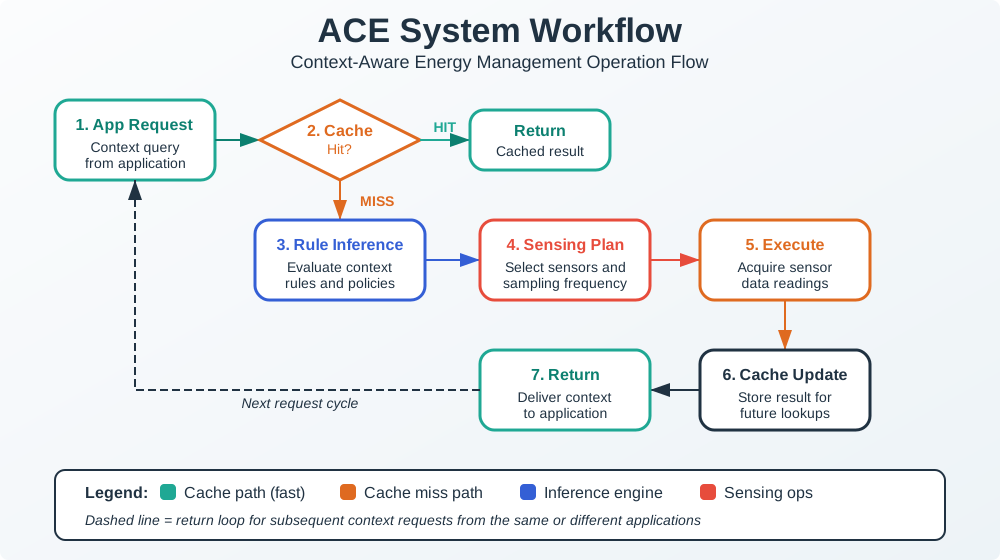
  • It checks whether a recent context value can be reused, whether a high-confidence rule can infer the answer, and only then pays the cost of direct sensing.
  • The policy is useful only when the saved energy is larger than the sensing, computation, communication, and validation cost.
iotclass.org

Major section

Cache, Infer, Sense

Sense: Activate the real sensor when cache and inference gates fail.

  • Cache: Serve a recent context value from memory when the value is still fresh enough.
  • Cache saves the sensor start-up cost and can also avoid a radio or location fix.
  • Direct sensing is not a failure; it is the reliability fallback that keeps the system honest.
iotclass.org

Major section

Policy Gates

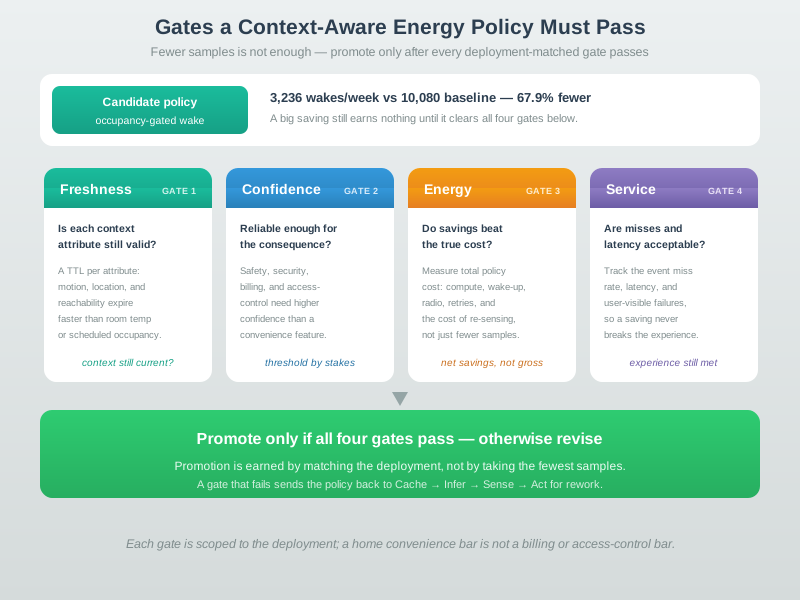
Promote it only when it passes the gates that match the deployment.

  • Its: Hard priority checkpoint adds a distinct review condition, before: EVIDENCE, NOT TRUTH states how the claim is checked.
  • Gate 1 Freshness asks whether each context attribute is still valid, with a TTL per attribute since motion, location, and reachability expire faster than room temperature or scheduled occupancy.
A context-aware energy policy is promoted only after it clears four deployment-matched gates — freshness, confidence, energy, and service — not because it takes the fewest samples.
iotclass.org

Major section

Evidence Record

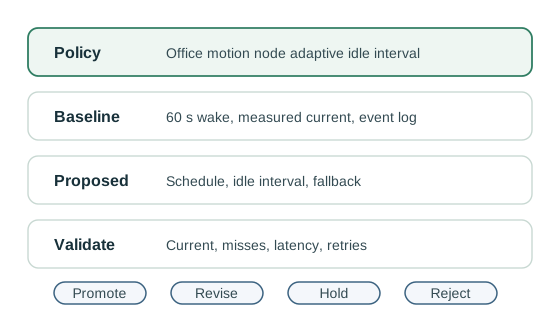
Every promoted context-aware policy needs an evidence record.

  • The new policy must beat a real baseline, not a vague fixed schedule.
  • Reviewers need to know when the rule is allowed to act.
  • Energy savings without service evidence can hide regressions.
  • Promote, revise, hold, or reject with the exact gate that drove the decision.

Key terms

What the visual establishes
What the visual establishes is that no-panel context-aware energy evidence record showing baseline, proposed policy, gates, measured current, service result, and final decision.
Context-aware energy evidence record showing baseline, proposed policy, gates, measured current, service result, and final decision.
iotclass.org

Deck summary

Key takeaways

A second signal might let it wait, but that extra watcher also consumes energy and can miss an urgent change.

  • Force a sudden change, a stale watcher value, and a restart; compare energy, response delay, missed events, and recovery.
  • The mathematical gist.: At 290 K, thermal noise density is about -174 dBm/Hz.
  • Context-aware energy management saves power by changing a device policy when the situation changes.
  • Sense: Activate the real sensor when cache and inference gates fail.
iotclass.org

Retrieval practice

Recall check 1 of 6

Battery Bruno says: answer from memory, then check your reasoning.

Q1A building node has a cached occupancy value that is 18 minutes old. The policy allows cached occupancy for noncritical HVAC setbacks only when the value is less than 10 minutes old. What should the controller do?

AReuse the occupancy value to avoid a fresh sensing cycle
BInfer or sense again because the cached value fails the freshness gate
CSwitch this node to direct sensing for future occupancy requests
DIncrease the TTL silently so the cache can be reused
Show answer

Answer: B Freshness is a gate.

iotclass.org

Retrieval practice

Recall check 2 of 6

Battery Bruno says: answer from memory, then check your reasoning.

Q2A team reports that a context-aware motion node reduced scheduled wakes by 68%. Which additional evidence is most important before promoting the policy?

AThe color palette used in the dashboard
BMeasured current plus service-quality evidence from realistic trials
CA longer list of possible context attributes
DA claim that context-aware systems usually save energy
Show answer

Answer: B Scheduled wake reduction is only a proxy.

iotclass.org

Retrieval practice

Recall check 3 of 6

Battery Bruno says: answer from memory, then check your reasoning.

Q3Place each context-energy control where it lives so you can save sensing energy without treating stale or weak inference as truth.

AContext request
BBattery replacement
CCloud billing
DPacket checksum
Show answer

Answer: A The three regions separate request and freshness intake, bounded inference and direct sensing, and validation evidence so you can defend when the policy saves energy and when it must measure again.

iotclass.org

Retrieval practice

Recall check 4 of 6

Battery Bruno says: answer from memory, then check your reasoning.

Q4Two identical nodes both report every 30 seconds when a room is occupied and every 10 minutes when it is empty. Node A's room is occupied 5% of the day; Node B's room is occupied 80% of the day. Which node saves the most from context-aware duty cycling versus always reporting every 30 seconds?

ANode A, because it spends most of the day in the low-rate context.
BNode B, because reducing its heavier reporting workload offers more opportunities to save energy.
CBoth save exactly the same, because they use the same two policies.
DNeither saves anything, because the fast policy is still present in both.
Show answer

Answer: A Context-aware savings scale with time spent in the low-activity context.

iotclass.org

Retrieval practice

Recall check 5 of 6

Battery Bruno says: answer from memory, then check your reasoning.

Q5A node draws 345 uA in its occupied context (37.5% of the day) and 28.7 uA in its vacant context (62.5% of the day). What is the correct daily average current to use for the battery-life estimate?

AAbout 147 uA, from 0.375 x 345 + 0.625 x 28.7.
BAbout 187 uA, from the plain average (345 + 28.7) / 2.
CAbout 345 uA, using the occupied-state draw as the conservative daily budget.
DAbout 28.7 uA, because the node is in the vacant context most of the time.
Show answer

Answer: A The daily budget is the time-weighted blend of the per-context average currents: 129.4 + 17.9 = 147 uA. Battery life then divides usable capacity by this blended current.

iotclass.org

Retrieval practice

Recall check 6 of 6

Battery Bruno says: answer from memory, then check your reasoning.

Q6A context-aware node computes 28.7 uA for its vacant context and expects long life because the room is usually empty. In the field the always-on PIR occupancy sensor and its conditioning draw about 50 uA continuously. What is the most important correction to the vacant-context budget?

AAdd the 50 uA watcher current to the vacant context.
BIgnore the PIR current, because context sensors are outside the energy budget.
CSubtract the PIR current, because detecting vacancy saves energy.
DApply the 50 uA only to the occupied context, since that is when motion occurs.
Show answer

Answer: A

iotclass.org

Print reference

Answers 1 of 2

Answer key.

  1. B · Freshness is a gate.
  2. B · Scheduled wake reduction is only a proxy.
  3. A · The three regions separate request and freshness intake, bounded inference and direct sensing, and validation evidence so you can defend when the policy saves energy and when it must measure again.
  4. A · Context-aware savings scale with time spent in the low-activity context.
iotclass.org

Print reference

Answers 2 of 2

Answer key.

  1. A · The daily budget is the time-weighted blend of the per-context average currents: 129.4 + 17.9 = 147 uA. Battery life then divides usable capacity by this blended current.
  2. A
iotclass.org