Connected Product and Service Design · Study deck
Device Lifecycle Management: LwM2M Workbench
An asset record is the saved history for one device.
UX Uma is your guide for this deck.

After studying this chapter
Learning objectives
You will be able to:
- map a connected device across provisioning, deployment, operation, update, maintenance, transfer, and decommissioning stages
- identify lifecycle checks needed before accepting device readiness claims
- review OTA update controls, rollback paths, staged rollout gates, and low-power deferral rules
- connect environmental, durability, and service evidence to the intended deployment context
Major section
Start With the Decision
An asset record is the saved history for one device.
- Its build is the version of software and parts in use.
- Keys are the secrets that control access; health limits mark when the device needs attention.
- It should name the device, owner, site, build, setup, keys, health limits, and care plan.
Major section
Start Simple
Firmware means software stored on a device.
- An over-the-air (OTA) update means sending new firmware through a network.
- A worker sets it up, another team watches its data, and a new site owner may take it over years later.
- A device lifecycle is the path from first record to safe retirement.
- Operation keeps watch on health.
Major section
Start Simple (continued)
Provisioning gives the device an identity and starting setup.
- Retirement removes access and deals with the data and hardware.
- It should also show each update, fault, part swap, reset, and owner change.
- A support worker should not have to guess which unit or version is in front of them.
- An update needs a safe path back.
Major section
Start Simple (continued)
Transfer is more than changing a name in an app.
- Retirement should end trust cleanly.
- The environment sets the care plan.
- Heat, water, dust, shock, radio noise, and power quality can shorten life.
- Real fleets may need more states, key rules, update waves, and legal records.
Major section
Start Simple (continued)
A bench pass does not prove a wall or field pass.
- During use, set clear health rules.
- A swap should not join the new unit to the wrong site or leave the old one live.
- The user should know what the light or screen means.
- The reset should not leak an old key or owner.
Major section
Start Simple (continued)
When the link returns, the device should join only the right account and site.
- These short questions keep a fleet safe through change.
- A site worker may check power and mounting.
- A network team may check the link.
- A maker may need to fix code.
Major section
Start Simple (continued)
Route each message to the person who can take the next safe step.
- A spare may sit for years and hold an old build or dead cell.
- Tell them what will still work, what will not, and what they can do next.
- A retired unit should not look live.
- A moved unit should not stay in the old site.
Major section
In 60 Seconds
Device lifecycle management reviews what happens after a connected device leaves the design bench.
- A device must be provisioned, installed, operated, updated, serviced, transferred, recovered, and eventually retired without losing security, safety, usability, or maintainability.
- The lifecycle review does not ask whether a device can work once.
- It asks whether the device can keep working through expected change: new owners, weak networks, low batteries, firmware fixes, failed updates, replacement parts, environmental wear, reset events, and end-of-life handling.
Major section
Device Lifecycle After Launch
A connected device is still being designed after the first shipment.
- It needs a way to receive identity, join the system, report health, accept updates, survive failed changes, move between owners, lose authority, and leave service without leaving active credentials behind.
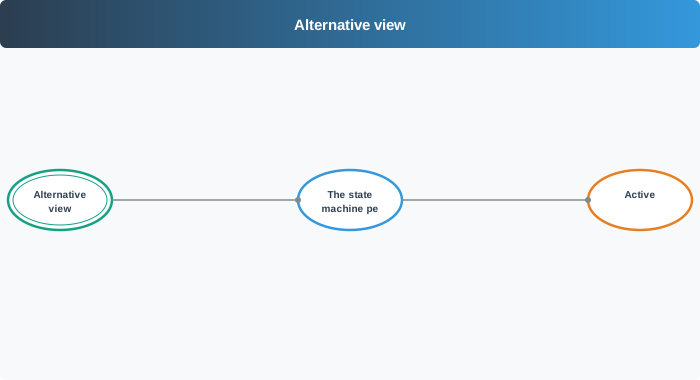
- Provisioned carries a firmware baseline, credential boundary, and owner association.
Major section
Device Lifecycle After Launch (continued)
For a battery sensor, lifecycle design includes factory identity, QR-code or NFC association, gateway join, heartbeat interval, stale-data rules, battery-aware firmware update deferral, rollback, field replacement, owner transfer, certificate revocation, and recycling.
- Active adds heartbeat freshness, power or fault reasons, and an update slot.
- An update pending or owner transfer route needs its own return evidence before the registry calls the unit active again.
- A reviewable lifecycle record should therefore travel with the unit.
Major section
Device Lifecycle After Launch (continued)
These transitions explain common support failures: a unit that cannot be claimed, stale telemetry, or an old owner link may be a state mismatch rather than a user mistake.
- Without that record, the team can only prove a successful demo, not a durable connected product.
- It also keeps support teams from guessing after the installer has left.
- During operation: track health, freshness, power state, fault reason, update slot, and what users or operators can see locally.
Major section
Review Every State Transition
The UI should expose lifecycle status at the level each role needs.
- A device may use LwM2M bootstrap and registration, Matter commissioning, LoRaWAN OTAA join, BLE-assisted Wi-Fi setup, a cellular eSIM profile, or factory certificate enrollment.
- Named protocols do not remove lifecycle responsibility.
- Installers need claim state, site context, and first health report.
Major section
Review Every State Transition (continued)
In each case, the reviewer should ask what identity is created, where credentials are stored, how failure is recovered, and who has authority after the step completes.
- Operate and update: Check heartbeat freshness, local buffering, low-battery behavior, staged rollout groups, signed firmware, A/B partitions or rollback slots, boot-success confirmation, and stop conditions.
- Maintain, transfer, and retire: Check calibration, cleaning, battery replacement, support logs, unlinking, re-provisioning, data wipe, certificate revocation, returned-unit handling, and disposal route.
- For provisioning, capture failed scans, duplicate serials, expired enrollment tokens, and devices that were claimed by the wrong tenant.
Major section
Review Every State Transition (continued)
MQTT retained state, CoAP resources, LwM2M Objects, OMA firmware-update resources, Matter fabrics, Thread credentials, LoRaWAN DevEUI/JoinEUI/AppKey material, and cellular SIM or eSIM profiles all need explicit ownership and retirement behavior.
- For operation, test stale data, clock drift, local buffering, gateway replacement, and low-rate reporting that is silent by design.
- Operators need freshness, update cohort, fault reason, and maintenance due state.
- Owners need transfer and deletion controls that remove authority without destroying records they must retain for warranty, safety, or compliance.
Major section
Lifecycle State Survives Faults
The lifecycle model should separate desired firmware, downloaded image, active image, confirmed image, rollback image, configuration version, credential version, and decommissioned state.
- Lifecycle reliability depends on state that survives bad timing.
- Storage choices shape what recovery is possible.
- Each item needs a reset rule, wipe rule, retention rule, and support visibility rule.
Major section
Lifecycle State Survives Faults (continued)
A device can lose power during flash write, wake with an old clock, miss a staged rollout window, fill its log buffer, lose gateway contact, or reboot between update download and boot confirmation.
- Internal flash, external QSPI flash, FRAM, EEPROM, secure elements such as ATECC608A, TPM-class modules, and SIM/eSIM secure storage can hold different combinations of keys, counters, calibration, update images, boot flags, and ownership data.
- For constrained devices, the lifecycle record must also know whether the unit has enough energy, storage, network time, and maintenance access to attempt the change.
- Server-side lifecycle state is just as important as device flash state.
Major section
Lifecycle State Survives Faults (continued)
The registry should distinguish manufactured, provisioned, commissioned, active, quarantined, update-pending, transfer-pending, retired, returned, and destroyed units.
- Credential revocation, topic or resource authorization, warranty state, data-retention policy, and support visibility should follow those states so a wiped or retired device cannot keep publishing, receiving commands, or appearing healthy in dashboards.
- Identity state: know which credential proves device identity, which proves owner or tenant authority, and which can be rotated remotely.
- A/B images, bootloader rollback flags, cryptographic signatures, monotonic version counters, staged deployment cohorts, and fleet stop conditions help prevent a bad release from becoming a fleet outage.
Deck summary
Key takeaways
An asset record is the saved history for one device.
- Firmware means software stored on a device.
- Provisioning gives the device an identity and starting setup.
- Transfer is more than changing a name in an app.
- A bench pass does not prove a wall or field pass.
Retrieval practice
Recall check 1 of 2

UX Uma says: answer from memory, then check your reasoning.
Q1An outdoor sensor passes its first indoor setup test. What evidence is needed before calling the device serviceable in the field?
Show answer
Answer: A Test weather exposure, mounting, and service access in the intended site, with a maintenance path.
Retrieval practice
Recall check 2 of 2
UX Uma says: answer from memory, then check your reasoning.
Q2A team is approving lifecycle readiness for an outdoor battery sensor before staged firmware updates and a future site-owner transfer. Which lifecycle record makes the decision reviewable?
Show answer
Answer: A A reviewable lifecycle decision ties identity, deployment assumptions, health signals, update gates, maintenance paths, authority removal, performed checks, owners, limits, and change conditions together before the device is trusted in the field.
Print reference
Answers
Answer key.
- A · Test weather exposure, mounting, and service access in the intended site, with a maintenance path.
- A · A reviewable lifecycle decision ties identity, deployment assumptions, health signals, update gates, maintenance paths, authority removal, performed checks, owners, limits, and change conditions together before the device is trusted in the field.