Integration & Gateways · Study deck
Practice: Gateway Protocol Translation
Picture a freezer reading that crosses a bridge but loses its unit and original time.
Gateway Gus is your guide for this deck.
After studying this chapter
Learning objectives
You will be able to:
- Build a source-to-target mapping record for a gateway translation path.
- Normalize source samples while preserving unit, timestamp, quality, and identity.
- Choose target routes and delivery expectations for telemetry, state, and command paths.
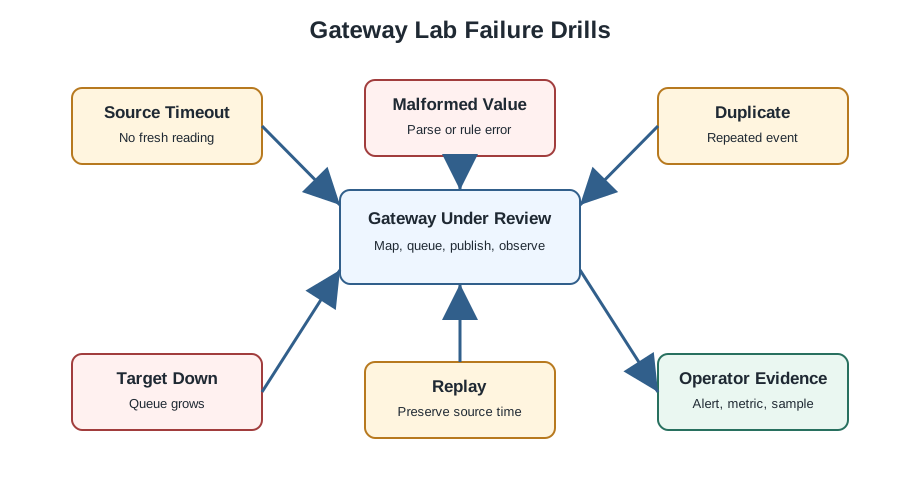
- Define queue behavior for ordinary messages, critical messages, stale messages, and malformed messages.
Major section
In 60 Seconds · Start With the Story
The target receives a number that it cannot safely interpret.
- A gateway means the boundary system that connects local devices to another network or service.
- Telemetry means records a system sends about readings, state, and health.
- This runway does not prove that every bridge or target is correct.
Major section
Lab Scenario · Lab Workbench
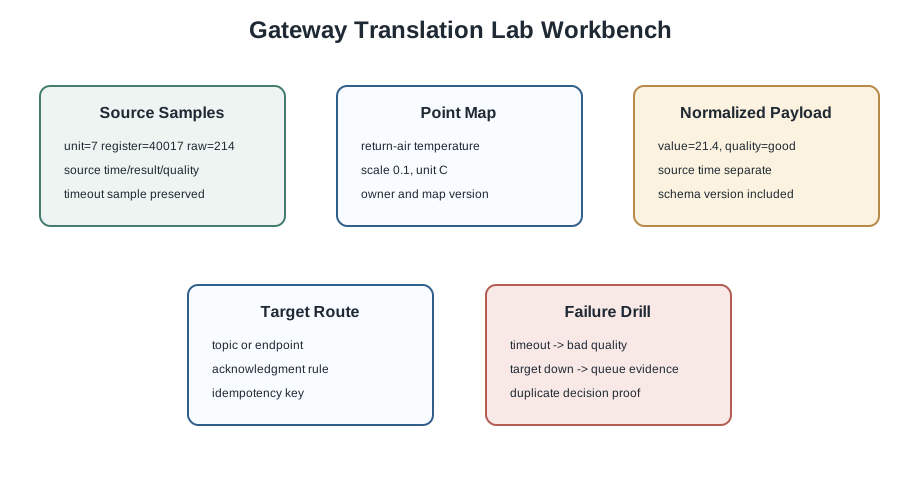
You can complete it with a spreadsheet, notes, a local script, or a gateway configuration review.
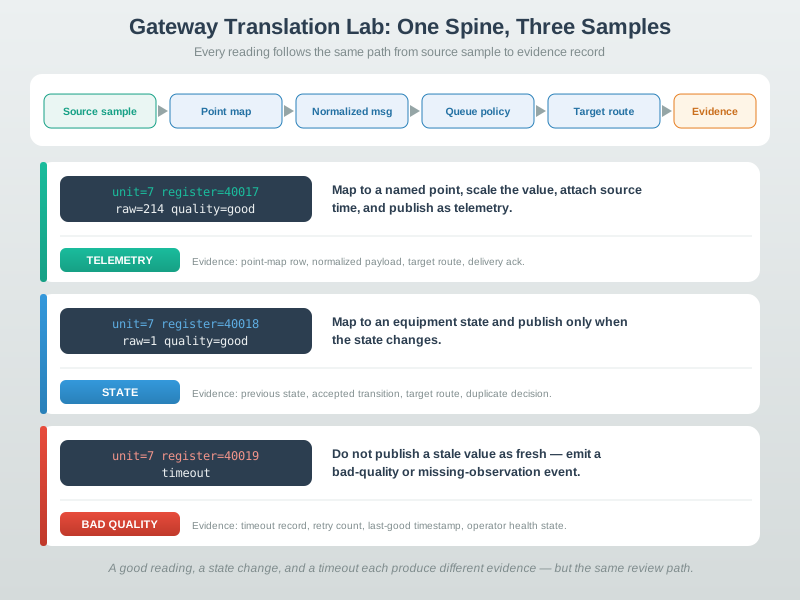
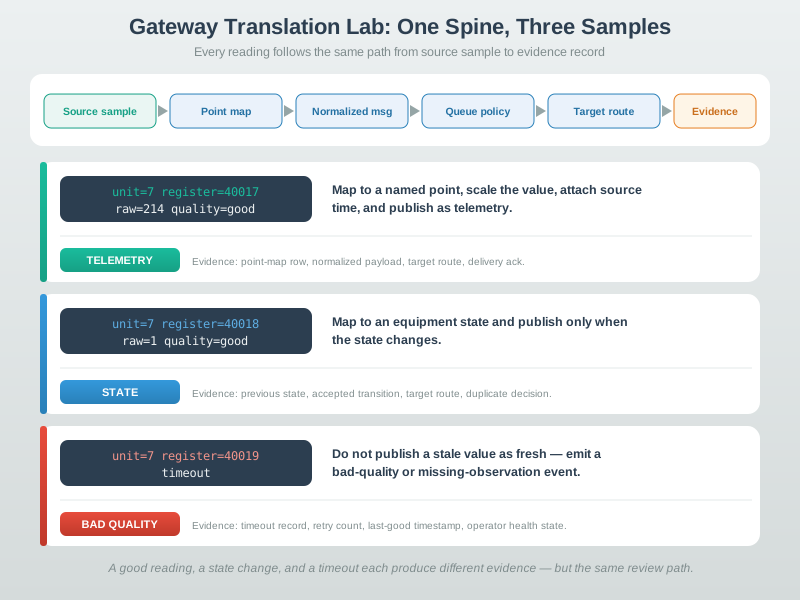
- You are reviewing a gateway that bridges local equipment readings into a target event route.
- Source sample Do Evidence.
- unit=7 register=40019 timeout Do not publish a stale value as fresh.
Try it: Lab Scenario · Lab Workbench in the chapter
Major section
Exercise 3: Choose the Target Route · Command Path Warning
Target routes are a contract.
- A route should be stable, authorized, and specific enough for consumers to subscribe without broad catch-all filters.
- Route family Do Evidence.
- Telemetry Use a stable hierarchy with site, system, asset, and point.
- Command Require identity, authorization, audit record, and timeout rule before writing to a source-side device.
Try it: Exercise 3: Choose the Target Route · Command Path Warning in the chapter
Major section
Lab Review Record · Source Evidence
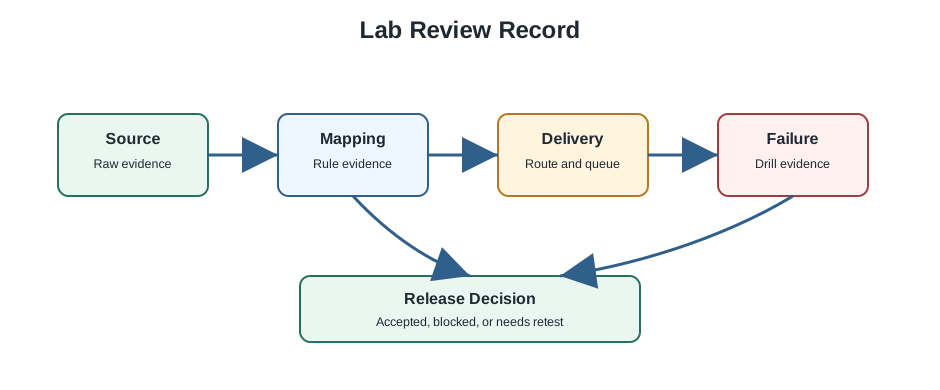
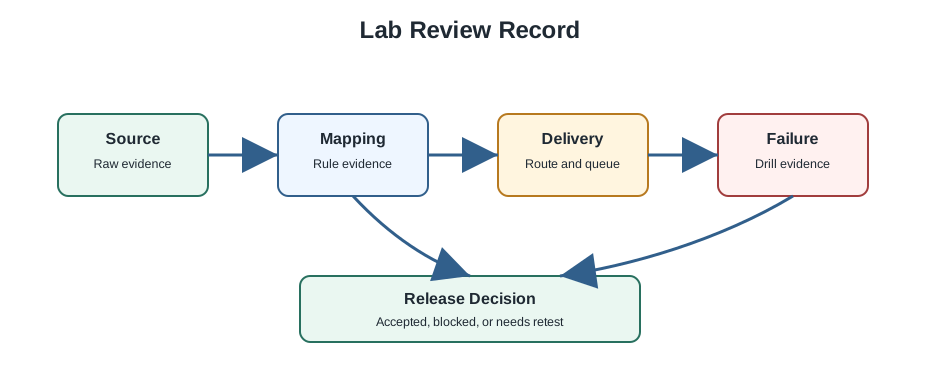
Your final deliverable is the review record.
- It should fit on one page and link every decision to evidence.
- The relationship between “Source” and “Raw evidence” is what makes Gateway protocol translation lab record showing source evidence, mapping evidence, delivery evidence, failure evidence, and release decision reviewable.
Try it: Lab Review Record · Source Evidence in the chapter
Major section
Overview: Translation Includes Delivery Semantics, Not Just Format
A protocol gateway is easy to underestimate as a format converter - reshape the bytes and change the addressing.
- The hard part is that protocols also differ in what they promise about delivery.
- One side may hold a message until an acknowledgment arrives; the other may discard it after one send attempt.
Major section
Overview: Translation Includes Delivery Semantics, Not Just Format (continued)
Intuition only: a gateway can only pass along the reliability it is actually given.
- Bridging the bytes while ignoring those delivery semantics quietly changes the reliability of the whole path, usually for the worse.
- A gateway therefore needs an explicit translation contract that maps not just field names but units, encodings, and delivery semantics.
- Encoding and units Field types, scales, endianness, and timestamp formats, so a value keeps its meaning.
Major section
Overview: Translation Includes Delivery Semantics, Not Just Format (continued)
For example, a Modbus RTU meter on RS-485 might expose register 40017 = 214 with a stale or failed read flag.
- A Node-RED, Telegraf, or custom Python gateway might turn that into MQTT topic site-a/mechanical/boiler-1/return-air-temperature or an HTTP event for a cloud API.
- The lab record must show whether 214 becomes 21.4 C, which source timestamp is kept, which map version made the decision, and whether the target sees good, stale, or bad_quality.
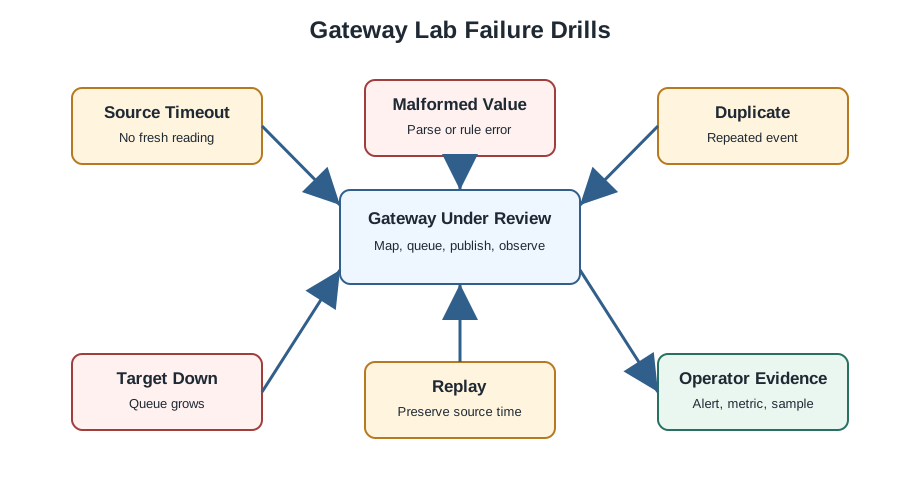
- Failure evidence Queue depth, retries, and drops recorded so a translation failure is visible, not silent.
Major section
Practitioner: Chain The Acknowledgment To Preserve Reliability
To preserve at-least-once behavior across a bridge, the gateway must not acknowledge the source until the target has committed.
- Worked Example: Bridge MQTT QoS 1 To An HTTP Endpoint The source publishes with MQTT QoS 1 (at-least-once): the broker keeps redelivering until the gateway sends its acknowledgment.
- If the POST fails, do not acknowledge; the broker will redeliver and the gateway retries.
- The important part is not the tool brand.
Major section
Practitioner: Chain The Acknowledgment To Preserve Reliability (continued)
The trap: if the gateway acknowledges the MQTT message immediately and then the POST fails, the message is gone - the path has been silently downgraded from at-least-once to at-most-once.
- The duplicate risk: a POST that succeeded but whose response was lost will be retried, so the cloud may see the same record twice.
- With acknowledgment chaining plus idempotency, the bridge preserves at-least-once behavior end to end and avoids duplicates, instead of quietly weakening the delivery contract.
- For HTTP, capture endpoint, status code, timeout, retry limit, idempotency key header, and the response body that proves acceptance.
Major section
Under The Hood: Reliability Is End To End, Not Per Hop
MQTT QoS 2 provides exactly-once delivery, but only between an MQTT client and its broker; it says nothing about a bridge from the broker to a different protocol.
- The deepest principle of bridging is that delivery behavior is a property of the whole path, not of any single leg.
- Under the hood, the gateway usually needs a small durable outbox.
- A durable target does not fix an unreliable source.
Major section
Under The Hood: Reliability Is End To End, Not Per Hop (continued)
Without that record, a process restart between source acknowledgment and target commit can lose the only copy of the message.
- And a gateway can destroy reliability it was given, by acknowledging one side before the other side has committed - a reliability air gap right in the middle of a nominally reliable path.
- Achieving exactly-once behavior across a gateway requires idempotency at the final sink - a deduplicating key that makes reprocessing a repeated message harmless - not merely selecting the strongest QoS on one leg.
- The bridge also needs a clear boundary between data-quality failure and delivery failure.
Major section
Under The Hood: Reliability Is End To End, Not Per Hop (continued)
The outbox records source id, source timestamp, mapping version, normalized payload hash, target route, target attempt count, last error, and final disposition.
- With it, the gateway can resume after restart, resend unfinished target attempts, and show which messages were accepted, rejected, expired, or dead-lettered.
- A Modbus timeout or BACnet fault value is not the same as a failed MQTT publish or HTTP 503 response.
- The first should become a target-visible quality state tied to the source observation.
- The second should stay in queue or retry state tied to transport delivery.
Deck summary
Key takeaways
The target receives a number that it cannot safely interpret.
- You can complete it with a spreadsheet, notes, a local script, or a gateway configuration review.
- Target routes are a contract.
- Your final deliverable is the review record.
- A protocol gateway is easy to underestimate as a format converter - reshape the bytes and change the addressing.
Retrieval practice
Recall check 1 of 6

Gateway Gus says: answer from memory, then check your reasoning.
Q1In the gateway translation lab, a source read times out for a mapped point. What is the best gateway behavior?
Show answer
Answer: A A timed-out source read should publish a missing or bad-quality state with retry and last-good evidence, not a fabricated value.
Retrieval practice
Recall check 2 of 6

Gateway Gus says: answer from memory, then check your reasoning.
Q2Place each gateway-lab artifact where it lives so you can prove the bridge preserves source meaning through translation and delivery.
Show answer
Answer: A Trace one source sample through its semantic map and queue policy to the target route so you can diagnose loss, staleness, or mistranslation.
Retrieval practice
Recall check 3 of 6

Gateway Gus says: answer from memory, then check your reasoning.
Q3During the lab, a source read times out for a mapped point. What is the best gateway behavior?
Show answer
Answer: B The review record should show timeout behavior, retry count, last-good timestamp, and the target-visible quality state.
Retrieval practice
Recall check 4 of 6

Gateway Gus says: answer from memory, then check your reasoning.
Q4Beyond converting byte formats, what must a protocol gateway also translate to avoid quietly changing a system's behavior?
Show answer
Answer: A Protocols differ in delivery behavior and value encoding.
Retrieval practice
Recall check 5 of 6

Gateway Gus says: answer from memory, then check your reasoning.
Q5A gateway bridges MQTT QoS 1 to an HTTP endpoint. To preserve at-least-once behavior, when should it acknowledge the incoming MQTT message?
Show answer
Answer: A Acknowledgment chaining preserves reliability: by withholding the MQTT ack until the downstream commit, a failure triggers redelivery instead of silent loss.
Retrieval practice
Recall check 6 of 6

Gateway Gus says: answer from memory, then check your reasoning.
Q6An engineer sets MQTT QoS 2 on the source leg and assumes the cloud will therefore receive each record exactly once through the gateway. Why is that assumption wrong?
Show answer
Answer: A Delivery behavior is end to end, and QoS 2 covers only the MQTT hop.
Print reference
Answers 1 of 2
Answer key.
- A · A timed-out source read should publish a missing or bad-quality state with retry and last-good evidence, not a fabricated value.
- A · Trace one source sample through its semantic map and queue policy to the target route so you can diagnose loss, staleness, or mistranslation.
- B · The review record should show timeout behavior, retry count, last-good timestamp, and the target-visible quality state.
- A · Protocols differ in delivery behavior and value encoding.
Print reference
Answers 2 of 2
Answer key.
- A · Acknowledgment chaining preserves reliability: by withholding the MQTT ack until the downstream commit, a failure triggers redelivery instead of silent loss.
- A · Delivery behavior is end to end, and QoS 2 covers only the MQTT hop.