Integration & Gateways · Study deck
Protocol Bridging Examples
A building thermostat, a factory controller, and a field radio can all feed the same operations service, but their messages do not carry meaning in the same way.
Gateway Gus is your guide for this deck.

After studying this chapter
Learning objectives
You will be able to:
- Explain: Keeping the source measurement time separate from the gateway-arrival time lets a downstream consumer tell the difference, which is exactly what is needed to trust an alarm or a control decision built on the stream.
- Explain: Semantic Mapping Versus Format Conversion Format conversion turns a register or object into a JSON field; semantic mapping records what that field means — the named point, the engineering unit, the scaling, the quality.
- Explain: Field gateway to cloud ingestion.: A field gateway collects intermittent low-power traffic, filters routine readings, and forwards a smaller set when the network is available.
Major section
Overview: A Bridge Translates Disagreement, Not Just Bytes
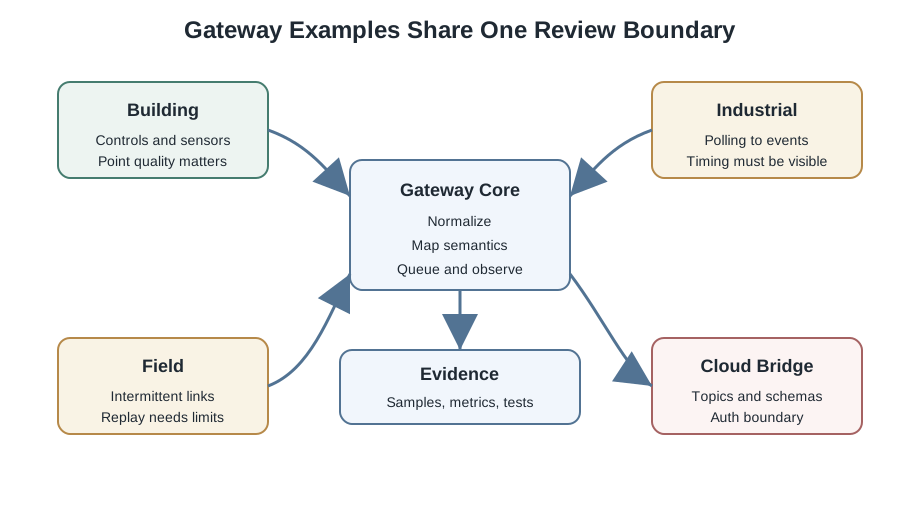
A protocol bridge connects systems that disagree — about timing, addressing, payload format, and reliability.
- The gateway's job is to reconcile those disagreements, and the useful insight is that the pattern matters far more than the brand of gateway or cloud.
- The trap is to think of a bridge as a byte converter.
Major section
Overview: A Bridge Translates Disagreement, Not Just Bytes (continued)
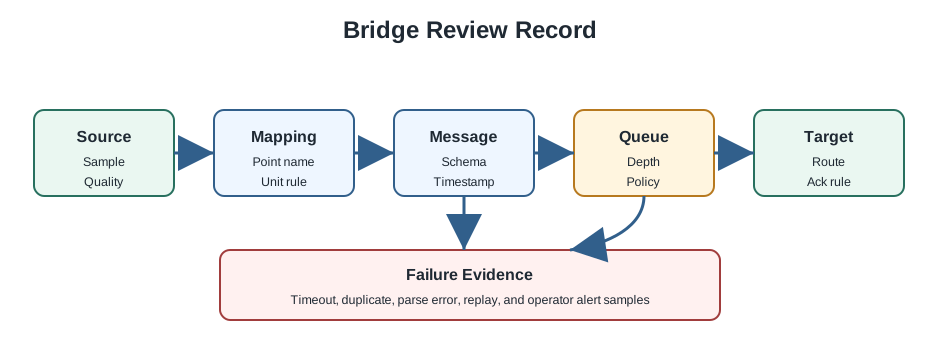
Once you can name the source protocol, target protocol, normalization rule, queue behavior, security boundary, and failure mode, the specific products become interchangeable details.
- Converting a Modbus register into a JSON field is the easy, mechanical part.
- The useful record carries the source timestamp, gateway-arrival timestamp, quality flag, unit, and mapping version.
- Once that review boundary is visible, the product names and protocol names stop distracting from the engineering decision.
Major section
Overview: A Bridge Translates Disagreement, Not Just Bytes (continued)
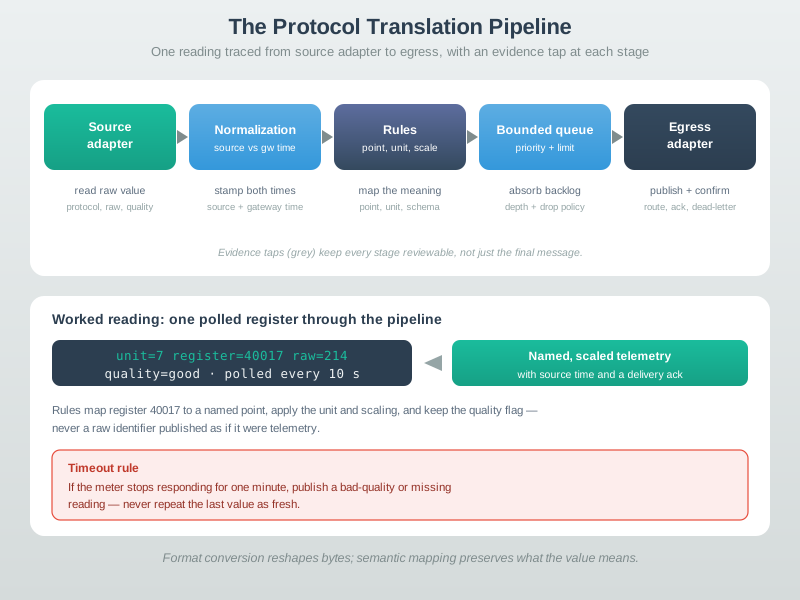
If the meter times out, the bridge should publish or record a missing or bad-quality state instead of replaying the last good value with a fresh gateway time.
- That small discipline lets a cloud rule decide whether to alarm, hold, or retry without guessing what happened at the source.
- A building gateway, a field gateway, an industrial gateway, and a cloud bridge all need a source sample, a point map, a normalized record, a queue decision, and failure evidence.
- If you can see the same review boundary behind every example, you have the core idea.
Major section
Overview: A Bridge Translates Disagreement, Not Just Bytes (continued)
The One-Minute View: Same Boundary, Many Settings Same review boundary Source contract, gateway work, target contract, failure behavior, evidence — the frame is identical across every example.
- A bridge is a trust boundary Changing protocol does not make data trustworthy; authentication, authorization, and audit still apply on both sides.
- A field gateway collects low-power sensor traffic, buffers it through an outage, and forwards a smaller cloud feed when the link returns.
- "The dashboard updated" proves a message arrived; "the value still means what the meter measured" is the claim a bridge review actually has to support.
Major section
Practitioner: Four Patterns and the Translation Pipeline
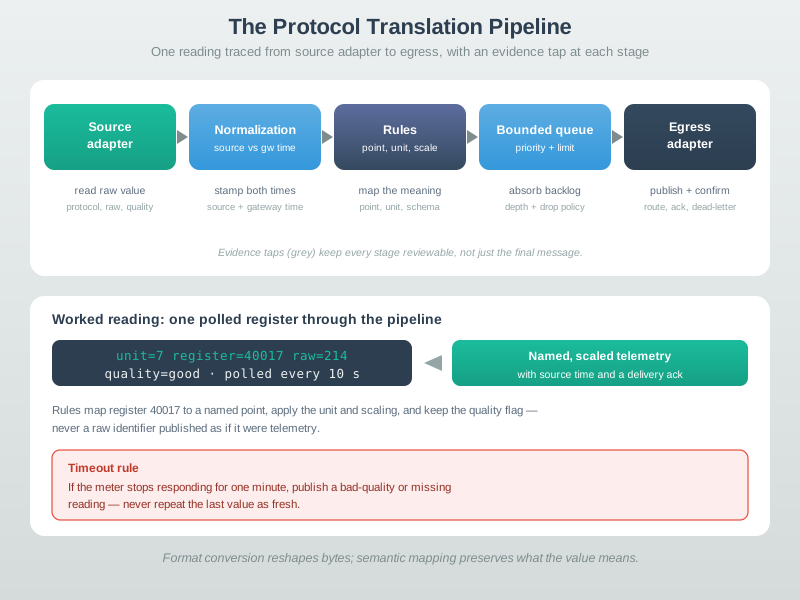
Building controls to telemetry.: A building gateway reads HVAC points, meters, and occupancy from BACnet objects, Modbus registers, or local wireless sensors, and publishes a consistent telemetry stream.
- Industrial polling to an event stream.: Industrial equipment is usually polled request-response, while analytics expects events.
- Named points and states to normalized telemetry.
Major section
Practitioner: Four Patterns and the Translation Pipeline (continued)
The decisive design choice is semantic mapping: a raw register or object identifier does not say whether a value is a temperature, a setpoint, a fan command, or an alarm.
- The gateway needs a point map that records meaning, preserves engineering units and point quality, and never exposes a raw identifier like 40017 as if it were telemetry.
- Field gateway to cloud ingestion.: A field gateway collects intermittent low-power traffic, filters routine readings, and forwards a smaller set when the network is available.
- Cloud bridge.: A cloud bridge forwards local broker topics or queued messages into a cloud ingestion path.
Major section
Under the Hood: Failure Paths, Timing, and Trust
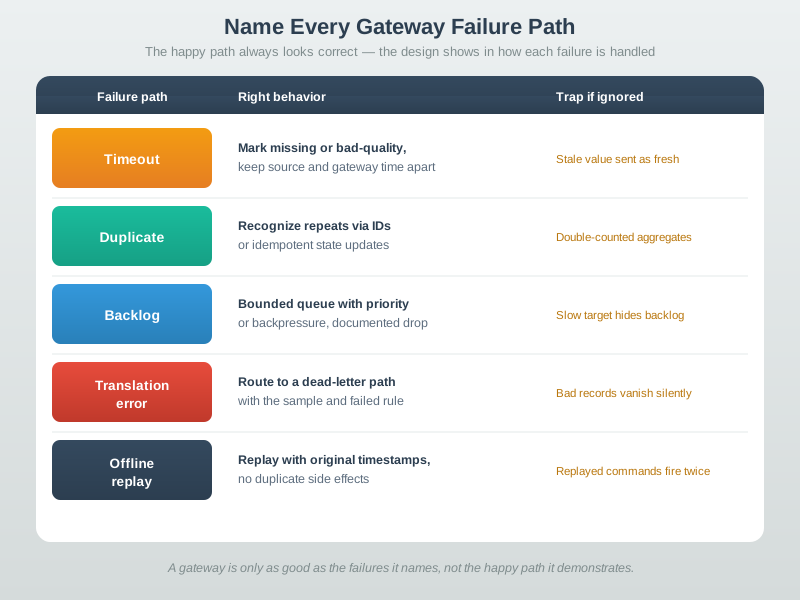
A gateway example is only as good as the failures it names.
- The happy path — read a value, convert it, publish it — is where every bridge looks correct.
- The Five Failure Paths A clean design names each path rather than inheriting whatever a library or broker does by default.
Major section
Under the Hood: Failure Paths, Timing, and Trust (continued)
On a timeout, mark the reading missing or bad-quality — never silently reuse an old value as if it were new.
- On a duplicate (a repeated event after a retry), use message identifiers, source timestamps, or idempotent state updates so the repeat is recognized.
- On offline replay, preserve the original source timestamps and protect downstream actions from duplicate side effects.
- Bad records vanish without a trace.
Major section
Under the Hood: Failure Paths, Timing, and Trust (continued)
Timing: "No Change" Is Not "Not Observed" The subtle bug in many bridges is conflating two very different states.
- A value that did not change is not the same as a value that was not observed, yet a naive bridge publishes the last value either way.
- Keeping the source measurement time separate from the gateway-arrival time lets a downstream consumer tell the difference, which is exactly what is needed to trust an alarm or a control decision built on the stream.
- At this depth, a protocol bridge is a discipline of preserved meaning and named failures.
Major section
Under the Hood: Failure Paths, Timing, and Trust (continued)
The Bridge Is a Trust Boundary Translating data into a new protocol does not make it trustworthy.
- Semantic Mapping Versus Format Conversion Format conversion turns a register or object into a JSON field; semantic mapping records what that field means — the named point, the engineering unit, the scaling, the quality.
- Two bridges can produce identical-looking JSON while one preserves meaning and the other ships a number with no unit and no quality flag.
- A trustworthy review traces that one reading and asks what happens when it times out, duplicates, or has to wait offline.
Major section
Compare Four Protocol translation Paths
The drawing is not asking which topology looks tidy; it asks where protocol translation happens and which component can expose a failed handoff.
- A valid protocol target payload at the last box is insufficient if the decoder chose the wrong byte order at the second box.
- Evidence should retain one sample at each important boundary.
Major section
Compare Four Protocol translation Paths (continued)
The fields in Figure: Protocol bridge review record tracing a cold-room Modbus are the comparison tool.
- Observation time differs from gateway processing time.
- Unit and quality preserve interpretation, while mapping version identifies the protocol translation rule.
- It publishes the tank identity, 72.5 kPa, source observation time, quality, and mapping version.
Major section
Compare Four Protocol translation Paths (continued)
A Modbus register contains 725 with scale 0.1 kPa, so the protocol bridge derives (725\times0.1\ \mathrm{kPa}=72.5\ \mathrm{kPa}).
- If the cloud schema expects pascals, the next explicit conversion is (72.5\ \mathrm{kPa}\times1{,}000=72{,}500\ \mathrm{Pa}).
- Keeping both rules makes the result re-derivable.
- Its frame counter helps detect a replay, while the tank's polled Modbus source needs a separate sample identifier.
Major section
Compare Four Protocol translation Paths (continued)
The normalized records may share a protocol target shape, but their evidence cannot claim identical source certainty.
- Submit an invalid protocol target bridging record and confirm that it is rejected visibly.
- The four results show whether the examples preserve meaning in both telemetry and control directions.
- Their common protocol target fields show where normalization helps, while their source samples show why one decoder cannot stand in for another.
Major section
Summary
A bridge can move the bytes, yet still attach the wrong unit, time, identity, or meaning.
- The system owner must prove that the target record means what the source measured.
- Translation does not create trust, and a successful connection does not prove meaning.
- This opening does not choose a bridge product or cover every field bus.
Major section
Summary (continued)
Under the Hood examines polling, events, maps, buffers, delivery states, write safety, security, and replay.
- Building bridges turn BACnet objects, Modbus registers, or wireless sensors into normalized telemetry, and the decisive choice is a semantic point map, not the byte conversion.
- Industrial bridges reconcile polling with event streams without hiding polling delay; publish bad-quality on timeout and keep source time separate from gateway time.
- Cloud bridges need topic mapping, authentication, schema validation, delivery acknowledgements, and a dead-letter path.
Deck summary
Key takeaways
A protocol bridge connects systems that disagree — about timing, addressing, payload format, and reliability.
- Once you can name the source protocol, target protocol, normalization rule, queue behavior, security boundary, and failure mode, the specific products become interchangeable details.
- If the meter times out, the bridge should publish or record a missing or bad-quality state instead of replaying the last good value with a fresh gateway time.
- The One-Minute View: Same Boundary, Many Settings Same review boundary Source contract, gateway work, target contract, failure behavior, evidence — the frame is identical across every example.
- A gateway example is only as good as the failures it names.
Retrieval practice
Recall check 1 of 3

Gateway Gus says: answer from memory, then check your reasoning.
Q1Why is a protocol bridge more than converting bytes from one protocol to another?
Show answer
Answer: A Reformatting bytes is the mechanical part.
Retrieval practice
Recall check 2 of 3

Gateway Gus says: answer from memory, then check your reasoning.
Q2A gateway polls a legacy meter every 10 seconds and publishes results to an event stream. The meter stops responding for one minute. What should the gateway do?
Show answer
Answer: A The bridge should make the observation failure visible and never let a stale value masquerade as fresh telemetry.
Retrieval practice
Recall check 3 of 3

Gateway Gus says: answer from memory, then check your reasoning.
Q3Which evidence best proves that a Modbus-to-MQTT bridge preserves meaning rather than only moving data?
Show answer
Answer: A That set connects the source value, the semantic conversion, the normalized message, and the target route, proving meaning travelled the whole path.
Print reference
Answers
Answer key.
- A · Reformatting bytes is the mechanical part.
- A · The bridge should make the observation failure visible and never let a stale value masquerade as fresh telemetry.
- A · That set connects the source value, the semantic conversion, the normalized message, and the target route, proving meaning travelled the whole path.