Integration & Gateways · Study deck

Message Queue Fundamentals

A pump sensor can produce a new pressure message while the cloud link is still sending the previous one.

Gateway Gus is your guide for this deck.

commbridgequeue
Gateway Gus, the module guide, in a scene from this chapter.
iotclass.org

After studying this chapter

Learning objectives

You will be able to:

  • explain how a queue decouples producer and consumer timing without decoupling responsibility for the message
  • define acknowledgment semantics and why "acknowledged" does not mean "exactly-once"
  • choose overflow and priority behavior for a bounded queue under load
  • diagnose queue health from more than depth alone (backpressure versus dropping)
iotclass.org

Major section

The Waiting Line Between Producer and Consumer
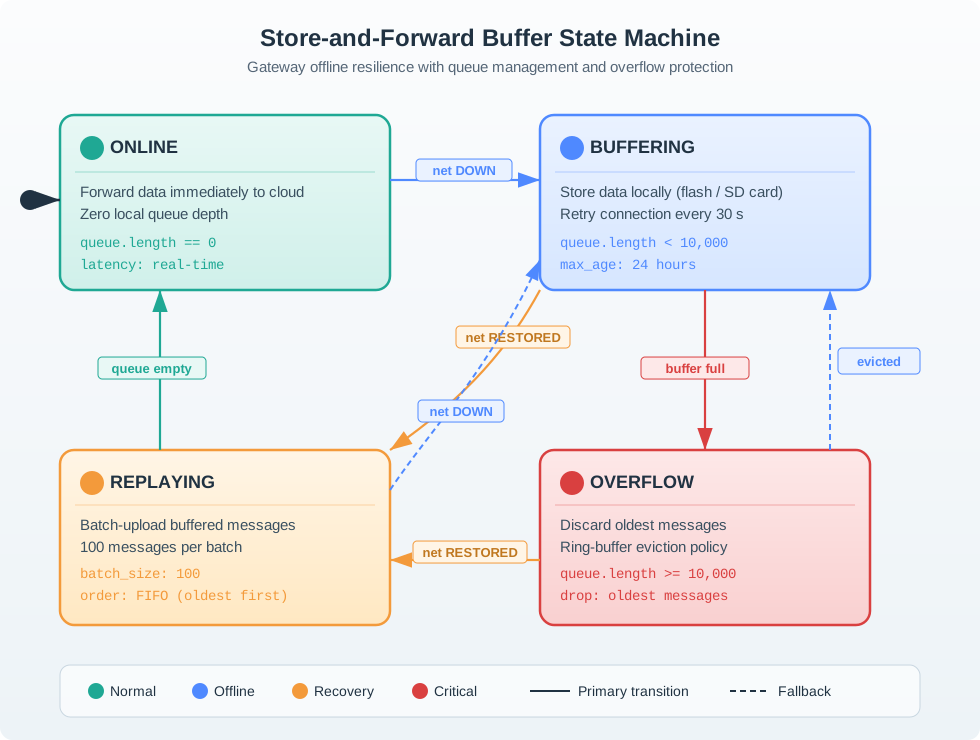
The waiting line hides the mismatch for a while, then reaches its limit during a fault.

  • If no one chose what to keep, the system may freeze or lose the most useful record.
  • One test cannot choose every storage or delivery design.

Why it matters

Two labels deserve attention—“ONLINE” and “Forward data immediately to cloud”—because they bound A queue contract should state the normal path, buffering condition, replay path, and overflow decision before the system is under pressure.

A queue contract should state the normal path, buffering condition, replay path, and overflow decision before the system is under pressure.
iotclass.org

Major section

Follow the Buffer From Arrival to Removal

The consumer takes work at its own rate, and acknowledgement marks the point at which the queue may safely remove that item.

  • The backlog grows by (20-15=5) messages per second.
  • Increasing capacity delays the failure but does not fix the sustained rate mismatch.
  • Acknowledgement defines delivery meaning.
  • Ordering is also scoped.

Key terms

Expiry
Expiry is different from priority: an old control request may be unsafe even when it reaches the front.

Why it matters

Capacity and overflow sit around this flow because a finite gateway cannot hold an unlimited difference between production and consumption.

A queue contract should state the normal path, buffering condition, replay path, and overflow decision before the system is under pressure.
iotclass.org

Major section

Follow the Buffer From Arrival to Removal (continued)

The design must reduce production, increase consumption, shed data by an explicit rule, or accept a bounded operating period.

  • If the consumer removes a record before the server accepts it, a crash can lose that record.
  • If removal happens only after acceptance, a crash between server storage and acknowledgement can cause redelivery.
  • One FIFO queue can preserve arrival order, but parallel consumers may finish out of order.
  • Message retention should match meaning.
iotclass.org

Major section

Follow the Buffer From Arrival to Removal (continued)

Stable message identifiers let the server recognize the second case. “At least once” delivery therefore needs duplicate-safe handling; it does not mean the physical event happened twice.

  • If pressure records from pump P4 must remain ordered while records from other pumps can proceed, partition by device identity.
  • That choice prevents one slow pump stream from freezing unrelated work while retaining a meaningful sequence within P4.
  • A queue policy should name capacity, ordering scope, acknowledgement point, retry delay, retry ceiling, dead-letter handling, retention, and overflow.
iotclass.org

Major section

Follow the Buffer From Arrival to Removal (continued)

Priority can help an alarm pass routine telemetry, but it changes order and can starve the lower class.

  • Expiry is different from priority: an old control request may be unsafe even when it reaches the front.
  • A short queue containing one hour-old record can be more serious than a longer queue of recent samples.
  • A routine sample may expire after a newer one supersedes it, while an audit event may require durable storage.
iotclass.org

Major section

Summary

A message queue decouples when work is produced from when it is consumed, absorbing bursts, but only when its behavior is visible and bounded.

  • Every real queue has a limit, so the full-queue behavior is a design choice; leaving it undefined lets the system invent a bad one under load.
  • The contract has four parts: producer, queue, consumer, and failure, and a sound design makes the envelope, buffer, acknowledgment point, overflow policy, and health evidence explicit.
  • The envelope carries identity, routing, and handling fields; without a stable id, timestamp, and source, the queue cannot judge replay safety or message validity.
iotclass.org

Deck summary

Key takeaways

The waiting line hides the mismatch for a while, then reaches its limit during a fault.

  • The consumer takes work at its own rate, and acknowledgement marks the point at which the queue may safely remove that item.
  • The design must reduce production, increase consumption, shed data by an explicit rule, or accept a bounded operating period.
  • Stable message identifiers let the server recognize the second case. “At least once” delivery therefore needs duplicate-safe handling; it does not mean the physical event happened twice.
  • Priority can help an alarm pass routine telemetry, but it changes order and can starve the lower class.
iotclass.org

Retrieval practice

Recall check 1 of 3

Gateway Gus says: answer from memory, then check your reasoning.

Q1A queue's buffer fills and the design never defined what to do when it is full. What is the likely result?

AThe queue automatically grows without limit so no data is ever lost
BPressure chooses an unreviewed behavior.
CNothing changes, because a full queue simply waits politely forever
DThe producer is guaranteed to slow down on its own
Show answer

Answer: B Every real queue is bounded, so a full-queue policy must be designed; leaving it undefined means pressure chooses behavior by inventing blocking, crashing, or silent dropping unpredictably under load.

iotclass.org

Retrieval practice

Recall check 2 of 3

Gateway Gus says: answer from memory, then check your reasoning.

Q2A queue acknowledges each message as soon as it is delivered to the consumer. The consumer then writes to a database. What is the main risk?

AThe queue will always process messages out of order
BThe message id becomes unnecessary
CThe crash can lose acknowledged work.
DThe queue can never apply backpressure again
Show answer

Answer: C Ack-on-delivery can lose work when the consumer crashes after delivery but before the protected database side effect; for protected side effects, acknowledge only after successful processing.

iotclass.org

Retrieval practice

Recall check 3 of 3

Gateway Gus says: answer from memory, then check your reasoning.

Q3In a circular-buffer queue, the head and tail pointers are equal. What does that condition mean, and how is it resolved correctly?

AIt always means the buffer is empty, so new work can be accepted freely
BIt always means the buffer is full, so all new work must be rejected
CIt means the queue is corrupted and must be discarded
DIt is ambiguous: equal pointers can mean the buffer is empty or full
Show answer

Answer: D The pointers alone cannot tell empty from full; without a count or full flag the queue may overwrite unread data or refuse work it has room for.

iotclass.org

Print reference

Answers 1 of 2

Answer key.

  1. B · Every real queue is bounded, so a full-queue policy must be designed; leaving it undefined means pressure chooses behavior by inventing blocking, crashing, or silent dropping unpredictably under load.
  2. C · Ack-on-delivery can lose work when the consumer crashes after delivery but before the protected database side effect; for protected side effects, acknowledge only after successful processing.
iotclass.org

Print reference

Answers 2 of 2

Answer key.

  1. D · The pointers alone cannot tell empty from full; without a count or full flag the queue may overwrite unread data or refuse work it has room for.
iotclass.org