CoAP · Study deck
CoAP Security: Implementation and Operations
CoAP is a compact request-and-response protocol for constrained devices.
Broker Bex is your guide for this deck.
After studying this chapter
Learning objectives
You will be able to:
- Explain: A stack must keep those layers distinct: the method states intent, the message type chooses an exchange policy, and the Token and Observe state preserve application continuity.
- Explain: A CoAP payload that works on local Wi-Fi can fail on a constrained network when its transfer exceeds the available packet budget.
- Explain: The acceptance test must use the actual constrained path because Wi-Fi success does not establish that path’s behavior.
- Explain: A performance comparison must therefore account for the combined pattern instead of treating a short header as the entire implementation.
Major section
Start With the Decision
CoAP is a compact request-and-response protocol for constrained devices.
- A token matches a response to its request.
- A CON retransmission repeats a message when its acknowledgment is missing; an application may separately retry an unanswered request.
- A resource is the named item the client asks about, and an error response explains why a request failed.
Major section
CoAP Implementation Patterns
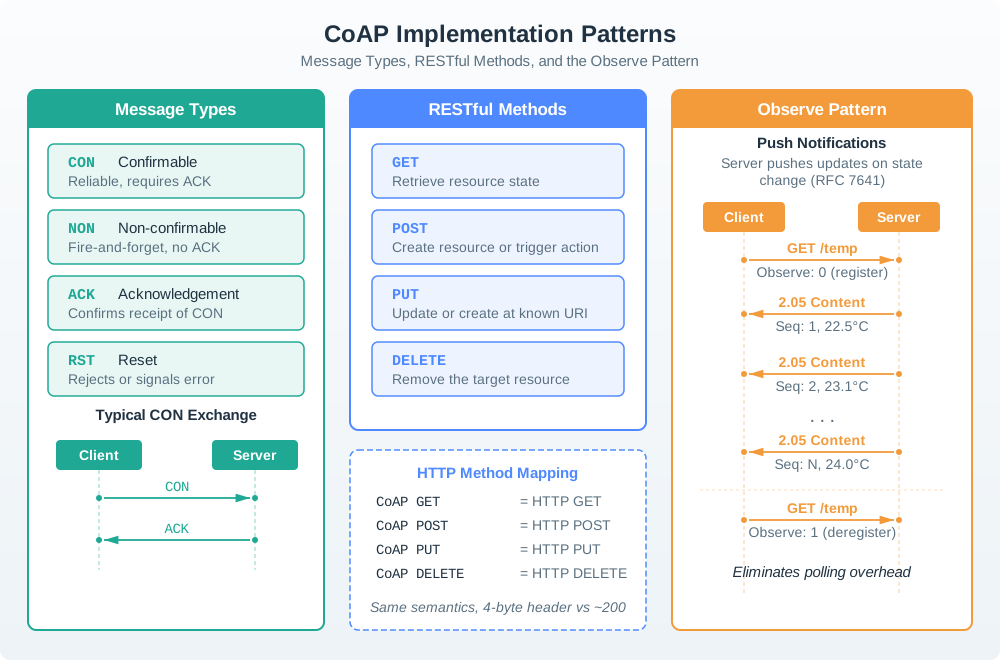
A CoAP implementation keeps resource intent, message delivery, and observation continuity as distinct parts of the same exchange.
- CON and NON select exchange behavior, while Token and Observe state preserve the application relationship.
- A performance comparison must therefore account for the combined pattern instead of treating a short header as the entire implementation.
Major section
CoAP Implementation Patterns (continued)
An implementation combines three contracts that are easy to learn separately but must cooperate in code.
- A stack must keep those layers distinct: the method states intent, the message type chooses an exchange policy, and the Token and Observe state preserve application continuity.
- Actual requests add fields and transport costs; latency depends on the network and connection state.
- CoAP over UDP: 4-byte fixed header + 20-byte payload = 24 bytes; 4/24 = 16.7% application-header share.
Major section
Common Problems and Solutions
A CoAP failure needs a diagnosis at the boundary where the observed behavior stops matching the request.
- A timeout can involve packet loss, acknowledgement behavior, or an unavailable endpoint rather than a wrong resource path.
- A failed DTLS handshake instead calls for key or certificate checks before resource handling can succeed.
- Monitor block number sequence (must be consecutive).
Major section
Common Problems and Solutions (continued)
Response codes then distinguish a missing resource from a method that the resource does not support.
- Verify server is reachable on UDP port 5683 (or 5684 for DTLS).
- For multicast: verify IPv6 multicast is enabled on network interface.
- Use CoAP client tool to test server response (e.g., coap-client, libcoap).
- Monitor network latency (affects retransmission timing).
Major section
Common Problems and Solutions (continued)
Check message type (CON requires ACK, NON does not).
- Verify token in response matches token in request.
- Check server sends notifications with observe option and increasing sequence numbers.
- Test smaller block sizes if large transfers fail.
- Measure UDP packet loss and whether it causes unacceptable CoAP retries or delay for this workload.
Major section
Common Pitfall: CoAP Message Size Exceeds MTU
The acceptance test must use the actual constrained path because Wi-Fi success does not establish that path’s behavior.
- A CoAP payload that works on local Wi-Fi can fail on a constrained network when its transfer exceeds the available packet budget.
- Fragment loss can prevent the receiver from reconstructing the complete message even though other fragments arrived.
- Prevention: Design payloads to fit in 64-128 bytes for 6LoWPAN networks.
Major section
Common Pitfall: Misusing CON vs NON Message Types
A battery sensor needs different exchange policies for routine measurements and important control messages.
- Repeated confirmable exchanges add acknowledgements and retry work that may be unnecessary when the next reading replaces a missed one.
- Non-confirmable delivery does not supply the failure-detection behavior required by the command path in this example.
- The mistake: Using Confirmable (CON) messages for all communications because "reliability is important," leading to excessive battery drain and network congestion, or using Non-Confirmable (NON) for critical commands where delivery must be guaranteed.
Deck summary
Key takeaways
CoAP is a compact request-and-response protocol for constrained devices.
- A CoAP implementation keeps resource intent, message delivery, and observation continuity as distinct parts of the same exchange.
- An implementation combines three contracts that are easy to learn separately but must cooperate in code.
- A CoAP failure needs a diagnosis at the boundary where the observed behavior stops matching the request.
- Response codes then distinguish a missing resource from a method that the resource does not support.
Retrieval practice
Recall check 1 of 3

Broker Bex says: answer from memory, then check your reasoning.
Q1A client uses PUT in a CON exchange. How should the developer interpret those two choices?
Show answer
Answer: D The chapter keeps resource operations separate from message exchange policy.
Retrieval practice
Recall check 2 of 3
Broker Bex says: answer from memory, then check your reasoning.
Q2A developer needs a command-line tool to exercise a CoAP endpoint. Which listed resource fits?
Show answer
Answer: B The libcoap coap-client executable sends a CoAP request from a shell so the developer can inspect the endpoint response.
Retrieval practice
Recall check 3 of 3
Broker Bex says: answer from memory, then check your reasoning.
Q3A CoAP request fails. Which debugging record best locates the fault?
Show answer
Answer: C These fields locate the exchange or security boundary that failed.
Print reference
Answers
Answer key.
- D · The chapter keeps resource operations separate from message exchange policy.
- B · The libcoap coap-client executable sends a CoAP request from a shell so the developer can inspect the endpoint response.
- C · These fields locate the exchange or security boundary that failed.