CoAP · Study deck
CoAP Message Exchanges
The Constrained Application Protocol (CoAP) is a protocol for small devices and limited links.
Broker Bex is your guide for this deck.

After studying this chapter
Learning objectives
You will be able to:
- Distinguish the four CoAP message types (CON, NON, ACK, RST) and their roles in the protocol
- Select the appropriate message type based on reliability requirements and battery constraints
- Explain piggyback vs separate response patterns and when each is used
- Calculate the energy trade-off between CON and NON messages for battery-powered devices
Major section
In 60 Seconds
The Constrained Application Protocol (CoAP) is a protocol for small devices and limited links.
- A protocol is an agreed set of exchange rules.
- A payload is the useful content carried inside a message.
- The next reading can replace a lost routine update.
- The alarm needs a clear receipt or a safe fallback.
Major section
Phoebe's Field Notes: The Sleep Current Hidden Behind CON and NON
The mathematical gist.: NON uses 0.0136 mAh/day of active charge and CON uses 0.218 mAh/day, but practical lifetime must add the always-on current: $Q_{day}=Q_{active}+24I_{sleep}/1000$.
- The separate 8 mA transmit pulse through 0.5 ohm sags only 4.0 mV, so the charge comparison is plausible for this fresh-cell case.
Major section
Four Ways to Send a Message
"I have four different ways to send my readings?" asked Temperature Terry, confused.
- "Think of it like four types of mail!" said the microcontroller. "Confirmable (CON) is like certified mail -- you send it and wait for a signed receipt.
- If you don't get one, you send it again.
- Perfect for important alerts like 'the freezer door is open!'".
Major section
CoAP Message Types
The first message-type decision is consequence: if loss changes system state, start with CON; if the next sample replaces this one, start with NON.
- CON starts a reliability exchange and waits for a matching ACK, while NON spends no acknowledgment traffic and accepts possible loss.
- Critical data must arrive.
Major section
CoAP Message Types (continued)
ACK is therefore a response type, not a competing delivery policy, and RST reports that a message reached a receiver that could not process its protocol state.
- In Figure: CoAP confirmable exchange showing a CON request with, begin with the CON GET and its Message ID 0x1234; the timer starts as that datagram leaves.
- A matching ACK stops retransmission, and the Token T7 associates returned content with the request.
- If the ACK is absent, the client retransmits the same CON with backoff rather than inventing a new operation.
Major section
Checkpoint: CON or NON
NON fits frequent sensor readings where loss is acceptable and battery conservation is critical.
- Scenario:: A pharmaceutical warehouse uses 200 CoAP sensors monitoring freezer temperatures.
- Each sensor sends a 20-byte reading every 30 seconds.
- Sensors use 802.15.4 radios (250 Kbps) with 8 mA TX, 5 mA RX current at 3.0V.
Major section
Interactive: CoAP Message Energy Calculator
ACKs cost power, but their meaning is narrow: they confirm CON receipt.
- Application success still depends on the response code they carry.
- RST is a message-layer rejection, not an application error shortcut.
- An unknown Message ID or an empty CON ping can therefore produce RST.
Try it: Interactive: CoAP Message Energy Calculator in the chapter
Major section
Message Exchange Patterns
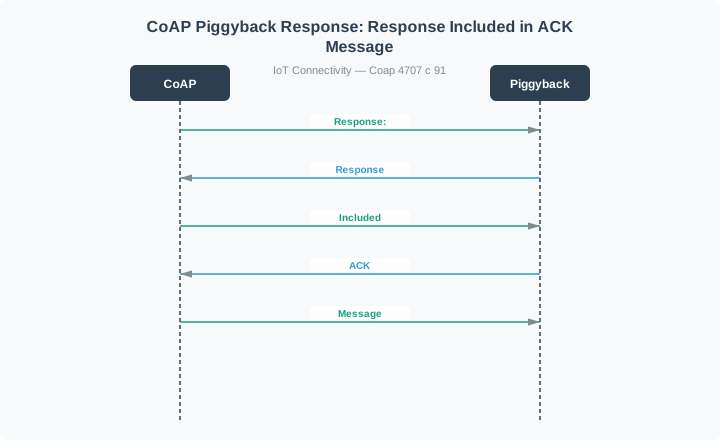
Fast work can ride inside ACK; slow work needs an empty ACK first.
- The ACK repeats Message ID 0x44A2, which stops retransmission of that CON, while Token T9 tells the client which request owns the 2.05 Content payload.
- If producing the representation takes longer than the acknowledgment window, the two jobs must separate.
Deck summary
Key takeaways
The Constrained Application Protocol (CoAP) is a protocol for small devices and limited links.
- The mathematical gist.: NON uses 0.0136 mAh/day of active charge and CON uses 0.218 mAh/day, but practical lifetime must add the always-on current: $Q_{day}=Q_{active}+24I_{sleep}/1000$.
- "I have four different ways to send my readings?" asked Temperature Terry, confused.
- The first message-type decision is consequence: if loss changes system state, start with CON; if the next sample replaces this one, start with NON.
- NON fits frequent sensor readings where loss is acceptable and battery conservation is critical.
Retrieval practice
Recall check 1 of 5

Broker Bex says: answer from memory, then check your reasoning.
Q1A home security company deploys window sensors that send 'OPEN' or 'CLOSED' events. Each sensor runs on a CR2032 coin cell battery. The product manager wants both 3-year battery life AND guaranteed delivery of every door/window event. Which message type configuration best balances these requirements?
Show answer
Answer: C Correct!
Retrieval practice
Recall check 2 of 5

Broker Bex says: answer from memory, then check your reasoning.
Q2An industrial IoT gateway sends a CoAP CON request to a sensor asking for a complex diagnostic report. The sensor needs 8 seconds to collect data from multiple subsystems. What is the correct response pattern to avoid timeout issues?
Show answer
Answer: B Correct!
Retrieval practice
Recall check 3 of 5

Broker Bex says: answer from memory, then check your reasoning.
Q3A battery-powered temperature sensor sends readings every minute to a server. Which message type should it use?
Show answer
Answer: B Non-Confirmable (NON) messages are better for this use case.
Retrieval practice
Recall check 4 of 5

Broker Bex says: answer from memory, then check your reasoning.
Q4A CoAP client sends a CON message with Message ID 0x1234, but receives an ACK with Message ID 0x5678. What should the client do?
Show answer
Answer: C No, this is invalid - it indicates an error or a separate response pattern.
Q5When should a CoAP client send a Reset (RST) message?
Show answer
Answer: D see answers page
Retrieval practice
Recall check 5 of 5

Broker Bex says: answer from memory, then check your reasoning.
Q6Complete the CoAP client that sends a confirmable request and handles the response type:
Show answer
Answer: A CON (Confirmable) messages are set via mtype=CON.
Print reference
Answers 1 of 2
Answer key.
- C · Correct!
- B · Correct!
- B · Non-Confirmable (NON) messages are better for this use case.
- C · No, this is invalid - it indicates an error or a separate response pattern.
- D · RST messages reject invalid or unexpected messages: 1) Unknown Message ID - received ACK for a CON you never sent, 2) Duplicate message - received the same confirmed message twice (duplicate detection failed), 3) Server unavailable - can't process the request, 4) Protocol error - malformed message.
Print reference
Answers 2 of 2
Answer key.
- A · CON (Confirmable) messages are set via mtype=CON.