CoAP · Study deck

CoAP Stack and Trace Contracts

A valve controller takes time to read its position, so it acknowledges a request before returning the value.

Broker Bex is your guide for this deck.

implementationstacktrace
Broker Bex, the module guide, in a scene from this chapter.
iotclass.org

After studying this chapter

Learning objectives

You will be able to:

  • Select an appropriate CoAP stack for a host, gateway, or constrained embedded node.
  • Map each URI and method to a resource handler, response code, payload, and trace artifact.
  • Verify client behavior by checking response codes, payloads, Tokens, Message IDs, options, and retransmissions.
  • Diagnose classic implementation failures: Message ID correlation, overuse of Confirmable messages, stale proxy caches, and repeated DTLS handshakes.
iotclass.org

Major section

Start With the Trace That Must Prove It

The packet record reveals that replies are being matched to the wrong request after a restart.

  • A convincing screen can hide a message contract that is already unsafe.
  • A protocol is a shared set of rules for exchanging messages.
  • Constrained Application Protocol (CoAP) is a compact web-style protocol for small devices.

Key terms

Transport Layer Security
Transport Layer Security is a way to protect message traffic.

Why it matters

A lab can appear to work because the browser prints a value, while the packet trace shows token confusion, wasteful Confirmable messages, stale cache data, or repeated DTLS handshakes.

iotclass.org

Major section

Start With the Trace That Must Prove It (continued)

A payload is the useful data in a message.

  • Transport Layer Security is a way to protect message traffic.
  • Datagram Transport Layer Security (DTLS) adapts that protection to a datagram link.
  • A gateway is the device that joins unlike networks.
  • The implementation is not accepted until the trace explains the behavior.
iotclass.org

Major section

Overview: You Rarely Write CoAP Bytes by Hand — You Use a Stack
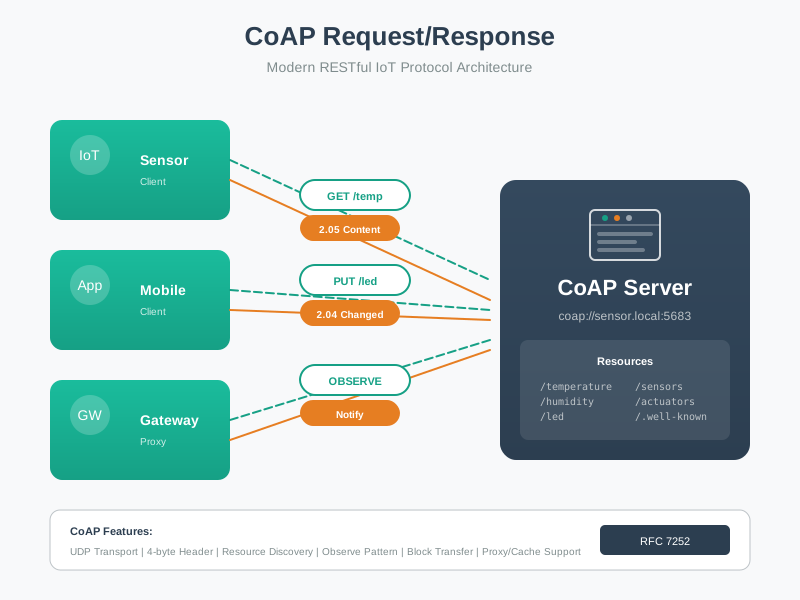
On general-purpose hosts and gateways the common stacks are aiocoap (Python, asyncio — the library these labs use), libcoap (C, which also ships the handy coap-client CLI), and Eclipse Californium (Java).

  • The labs below use that chain as their debugging order.
CoAP implementation lab diagram showing sensor, mobile app, and gateway clients sending GET, PUT, and Observe requests to a CoAP server with resource handlers.
iotclass.org

Major section

Overview: You Rarely Write CoAP Bytes by Hand — You Use a Stack (continued)

They implement the same RFC 7252 on the wire, so an aiocoap client can talk to an ESP32 server — interoperability is the whole point of the standard.

  • That framing keeps the code examples from becoming copy-paste snippets: every run should leave a response code, a payload sample, and a packet trace you can compare with the handler you wrote.
  • Host and gateway stacks aiocoap (Python), libcoap (C + CLI), Californium (Java) run on Linux hosts, gateways, and cloud bridges.
  • Embedded stacks RIOT gcoap/nanocoap, Contiki-NG Erbium, Zephyr CoAP, and ESP/Arduino libraries fit constrained nodes.
iotclass.org

Major section

Practitioner: A Server Is Handlers by URI+Method; A Client Reads Code and Payload

A small toolkit proves the exchange is doing what you think.

  • If an ESP32 version and a Python version expose the same resource contract, use the same client checklist for both; only the build and deployment step changes.
  • coaps traffic is encrypted ApplicationData.
  • Proving DTLS actually protects the payload.
iotclass.org

Major section

Under the Hood: The Token Bug and Three Classic Pitfalls

The single most common implementation bug in hand-rolled correlation is matching responses by Message ID instead of Token.

  • The rule is simple: correlate application responses by Token; the Message ID is only for message-layer ACK and duplicate handling.
  • Good libraries already do this, which is a strong reason to use one.
  • You will see one Token repeated across notifications while the Message ID changes each time.
iotclass.org

Major section

Under the Hood: The Token Bug and Three Classic Pitfalls (continued)

Correlate by Token Notifications and separate responses share the Token, not the Message ID; key your dispatch on the Token.

  • If your handler only fires on the first notification, you are matching on the Message ID.
  • Three deployment pitfalls recur, and each is visible in a capture.
  • NON for telemetry Reserve CON for messages whose loss is unsafe; frequent readings as NON save radio-on energy.
iotclass.org

Major section

Follow a Separate Response through a Restart

The server sends an empty acknowledgement for Message ID 100.

  • That packet stops the request's message-level retry cycle; it contains no valve-position result.
  • Later, a separate Confirmable response arrives with Message ID 700 and the same Token A1.
  • The trace shows a 40 ms acknowledgement delay and a 240 ms response delay.

Numbers to remember

40 msThe trace shows a 40 ms acknowledgement delay
iotclass.org

Major section

Follow a Separate Response through a Restart (continued)

Reporting only the smaller number would hide the time the application waited for data.

  • Neither figure measures the valve's physical travel unless the handler contract explicitly waits for that outcome.
  • Its old request state may have vanished.
  • An empty acknowledgement already proved receipt of the request, but the application still has no result.
iotclass.org

Major section

Release Checklist

Client checks branch on response.code before trusting response.payload, and tests include at least one success path and one documented error path.

  • Message policy distinguishes CON from NON and explains which application messages can tolerate loss.
  • Freshness policy records Max-Age and proxy-cache behavior for resources that may be cached or observed.
  • Security evidence shows whether the lab uses plain CoAP, DTLS, or OSCORE, and whether DTLS sessions are reused instead of renegotiated per request.
iotclass.org

Major section

Reference: CoAP Quick Reference Card

A protocol means shared rules for an exchange.

  • Constrained Application Protocol (CoAP) means a compact request method for small devices.
  • User Datagram Protocol (UDP) means sending separate messages without a lasting connection.
  • Hypertext Transfer Protocol (HTTP) means a request-and-response format used by web systems.
  • A payload means the useful data inside one message.

Key terms

Transport layer security
Transport layer security means protection for a network exchange.
iotclass.org

Deck summary

Key takeaways

The packet record reveals that replies are being matched to the wrong request after a restart.

  • A payload is the useful data in a message.
  • On general-purpose hosts and gateways the common stacks are aiocoap (Python, asyncio — the library these labs use), libcoap (C, which also ships the handy coap-client CLI), and Eclipse Californium (Java).
  • They implement the same RFC 7252 on the wire, so an aiocoap client can talk to an ESP32 server — interoperability is the whole point of the standard.
  • A small toolkit proves the exchange is doing what you think.
iotclass.org

Retrieval practice

Recall check 1 of 5

Broker Bex says: answer from memory, then check your reasoning.

Q1When you build a CoAP server with a library like aiocoap, what does the library handle so your code does not have to?

ANothing — you must encode the 4-byte header and options manually for each message.
BIt replaces UDP with TCP automatically for reliability.
CIt writes your application's business logic for each resource.
DThe messaging layer — Confirmable retransmission, deduplication, token generation.
Show answer

Answer: D The stack implements RFC 7252 formatting, option encoding, token handling, retransmission, and duplicate suppression; your code owns resource handlers.

iotclass.org

Retrieval practice

Recall check 2 of 5

Broker Bex says: answer from memory, then check your reasoning.

Q2In client code, which two fields of a CoAP response should you inspect to handle the result correctly?

AThe response code (to branch on success like 2.05 or errors like 4.04) and the payload
BOnly the payload, since the code is always 2.05 for a successful library call.
CThe Message ID and the UDP source port, which together carry the result.
DThe TTL and the checksum, which encode the outcome.
Show answer

Answer: A The code tells you what happened and the payload carries the data; robust clients check the code before trusting the representation.

iotclass.org

Retrieval practice

Recall check 3 of 5

Broker Bex says: answer from memory, then check your reasoning.

Q3Your CoAP client receives only the first Observe notification and misses the rest. What is the most likely implementation bug?

AIt correlates responses by Message ID
BThe server stopped sending notifications after the first one by design.
CDTLS re-keyed after the first message and dropped the rest.
DThe Max-Age expired, so notifications stopped.
Show answer

Answer: A Observe notifications share the registration Token but each has a fresh Message ID; correlating by Message ID drops all but the first.

iotclass.org

Retrieval practice

Recall check 4 of 5

Broker Bex says: answer from memory, then check your reasoning.

Q4Per this CoAP cheat sheet's Message Types list, which message type requires an acknowledgment (ACK) from the receiver?

ACON (Confirmable)
BNON (Non-confirmable)
CACK (Acknowledgment)
DRST (Reset)
Show answer

Answer: A The cheat sheet's Message Types block distinguishes CON ('Confirmable, needs ACK') from NON ('Non-confirmable'), with ACK and RST as the acknowledgment and error/reset signals respectively.

iotclass.org

Retrieval practice

Recall check 5 of 5

Broker Bex says: answer from memory, then check your reasoning.

Q5According to this cheat sheet's 'Key Feature' note, what does CoAP's Observe option provide?

APub/sub-like notifications when a resource changes
BA retry mechanism for lost UDP packets
CA way to negotiate DTLS instead of plain UDP on port 5683
DA method for bulk-deleting multiple resources at once
Show answer

Answer: A The cheat sheet's Key Feature callout states the Observe option gives 'pub/sub-like notifications on resource changes,' distinct from the four basic methods (GET/POST/PUT/DELETE) listed above it.

iotclass.org

Print reference

Answers 1 of 2

Answer key.

  1. D · The stack implements RFC 7252 formatting, option encoding, token handling, retransmission, and duplicate suppression; your code owns resource handlers.
  2. A · The code tells you what happened and the payload carries the data; robust clients check the code before trusting the representation.
  3. A · Observe notifications share the registration Token but each has a fresh Message ID; correlating by Message ID drops all but the first.
iotclass.org

Print reference

Answers 2 of 2

Answer key.

  1. A · The cheat sheet's Message Types block distinguishes CON ('Confirmable, needs ACK') from NON ('Non-confirmable'), with ACK and RST as the acknowledgment and error/reset signals respectively.
  2. A · The cheat sheet's Key Feature callout states the Observe option gives 'pub/sub-like notifications on resource changes,' distinct from the four basic methods (GET/POST/PUT/DELETE) listed above it.
iotclass.org