Cloud Computing Foundations · Study deck
Service Management, SLAs, and Economics
The last three chapters asked what cloud is, which service model to use, and how to deploy and virtualize it.
Cloud Clara is your guide for this deck.
After studying this chapter
Learning objectives
You will be able to:
- State the named cloud service-management objectives and the SLA's own quality/utility/warranty framing
- Trace the accounting-to-billing pipeline from metered resource usage to a calculated invoice
- Compare traditional and cloud economics using the named differences and the economics-of-scaling framework
- Name the demands a cloud database-management system must meet and place named DBaaS products against them
Major section
Start With What "Service Management" Actually Buys You
Cloud service management aims to keep on-demand virtual services useful and efficient.
- It gives the customer's goals equal weight and aims to add no cost or risk for them.
- The Service Level Agreement (SLA) is where several of those objectives -- clear description of services, service guarantees -- become a written commitment.
Major section
Service Management Objectives and the Service Level Agreement
Reading an unfamiliar SLA is a matter of finding where each of those four areas is measured, not learning a new vocabulary for each vendor.
- What varies by provider, and what does not.
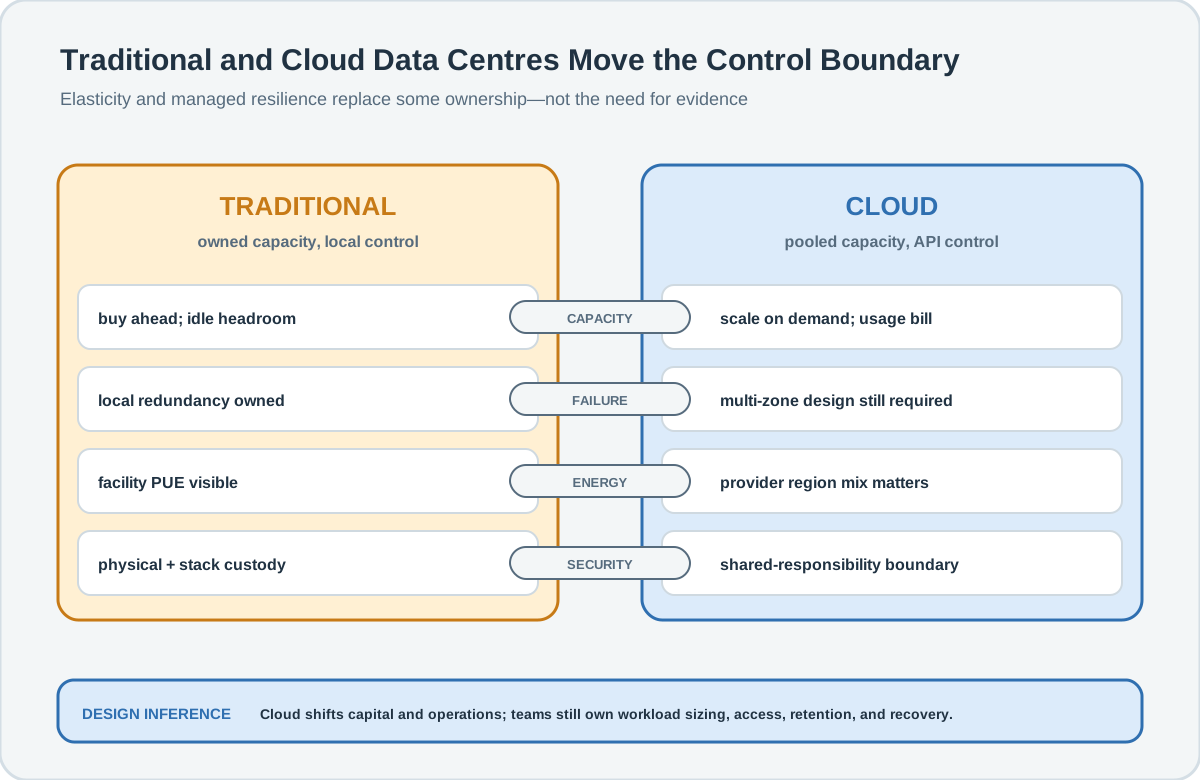
- The: SECURITY row is the crucial boundary: cloud custody is shared, so workload access, retention, and recovery remain the customer's evidence obligations.
Major section
Paying For It: Accounting, Billing, and Cloud vs. Traditional Economics
Aims to obtain resource-usage information, typically in the form of records.
- This depends on infrastructure and service monitoring, since usage information is obtained from metric measurements.
- The service provider calculates billing information using three inputs together: the accounting records, the resource prices, and the provider's own billing rules.
Major section
Paying For It: Accounting, Billing, and Cloud vs. Traditional Economics (continued)
That accounting-then-billing pipeline sits inside a bigger economic contrast: traditional, owned infrastructure versus cloud infrastructure.
- Every economic argument above assumes the underlying workload can actually run well on shared, provider-managed infrastructure.
- Once an application type is defined, a cloud database-management system has to meet five named demands (D.
Deck summary
Key takeaways
Cloud service management aims to keep on-demand virtual services useful and efficient.
- Reading an unfamiliar SLA is a matter of finding where each of those four areas is measured, not learning a new vocabulary for each vendor.
- Aims to obtain resource-usage information, typically in the form of records.
- That accounting-then-billing pipeline sits inside a bigger economic contrast: traditional, owned infrastructure versus cloud infrastructure.
Retrieval practice
Recall check 1 of 3

Cloud Clara says: answer from memory, then check your reasoning.
Q1SLAs from two different cloud providers define completely different numeric thresholds for uptime and response time. According to this chapter's own framing, what stays constant across providers even as the specific metrics differ?
Show answer
Answer: A An SLA's exact metrics are provider-specific, but the source material names four areas that stay constant across every SLA: volume and quality of work, speed, and efficiency.
Retrieval practice
Recall check 2 of 3

Cloud Clara says: answer from memory, then check your reasoning.
Q2A provider calculates a customer's monthly invoice by combining metered resource-usage records with per-unit resource prices and its own billing rules. Which two functions does this describe, and in what order do they occur?
Show answer
Answer: A Accounting turns monitored metrics into resource-usage records; billing then combines those records with resource prices and billing rules to calculate the invoice -- accounting always precedes billing.
Retrieval practice
Recall check 3 of 3

Cloud Clara says: answer from memory, then check your reasoning.
Q3A cloud database stores sensitive records that stay encrypted, and the system still has to query and process them without decrypting everything first, while also interoperating with other tools already in the customer's stack. Which two named demands of a cloud DBMS does this describe?
Show answer
Answer: A A cloud DBMS's five named demands include operating comfortably on encrypted data and interfacing with other products/solutions -- both directly matching this scenario.
Print reference
Answers
Answer key.
- A · An SLA's exact metrics are provider-specific, but the source material names four areas that stay constant across every SLA: volume and quality of work, speed, and efficiency.
- A · Accounting turns monitored metrics into resource-usage records; billing then combines those records with resource prices and billing rules to calculate the invoice -- accounting always precedes billing.
- A · A cloud DBMS's five named demands include operating comfortably on encrypted data and interfacing with other products/solutions -- both directly matching this scenario.