Cloud, SDN & Production Architectures · Study deck

Cloud Security: Identity and Monitoring Controls

A cold-store gateway sends data through several cloud trust zones.

Cloud Clara is your guide for this deck.

cloudcomputingsecurity
Cloud Clara, the module guide, in a scene from this chapter.
iotclass.org

After studying this chapter

Learning objectives

You will be able to:

  • Map IoT cloud-security responsibilities across device, network, platform, application, data, and operations layers.
  • Design per-device identity and credential lifecycle controls for enrollment, rotation, revocation, and retirement.
  • Apply least-privilege access boundaries to telemetry, commands, state updates, files, and operator workflows.
  • Select data-protection and monitoring records that fit an IoT workload.
iotclass.org

Major section

Start With the Cloud Boundary

A gateway is a local system that passes device data to other services.

  • A broker is a service that receives named messages and sends them to allowed readers.
  • This freezer path does not prove the whole cloud is secure.
  • Those choices need owners and tested records.
  • Each boundary needs identity, permission, logging, and recovery evidence.
iotclass.org

Major section

Minimum Viable Understanding

Every device needs its own identity.: Shared fleet credentials turn one extracted secret into a fleet-wide incident.

  • Responsibility must be explicit.: Record which team owns device credentials, application access, data classes, network paths, logs, and incident actions.
  • Least privilege is operational.: Permissions should match message family, topic, site, command type, and lifecycle state.
  • Encryption is not enough by itself.: Key ownership, rotation, access checks, retention, and recovery records matter.
iotclass.org

Major section

Responsibility Model

A shared cloud design is secure only when responsibilities are written down.

  • Typically owns physical facilities, base infrastructure, service availability controls, managed runtime internals, and core service patching.
  • Control record: service boundary statement, support path, availability assumptions, and incident notification route.
  • Owns device identity, message permissions, application code, data classification, dashboards, command approval, and business workflow controls.
iotclass.org

Major section

Provider, Host, And Assessment Checks

A cloud-security review should separate provider assurance from workload proof.

  • Reputation, published audit standards, and SLA language can screen a provider, but they do not prove this IoT workload is safe.
  • For IaaS, host security remains visible: guest operating systems, runtime patching, firewall and network policy, application secrets, and customer-controlled keys need owners even when the provider operates the physical facility and hypervisor.
  • Risk assessment should include both qualitative and quantitative evidence.
iotclass.org

Major section

Device Identity Lifecycle
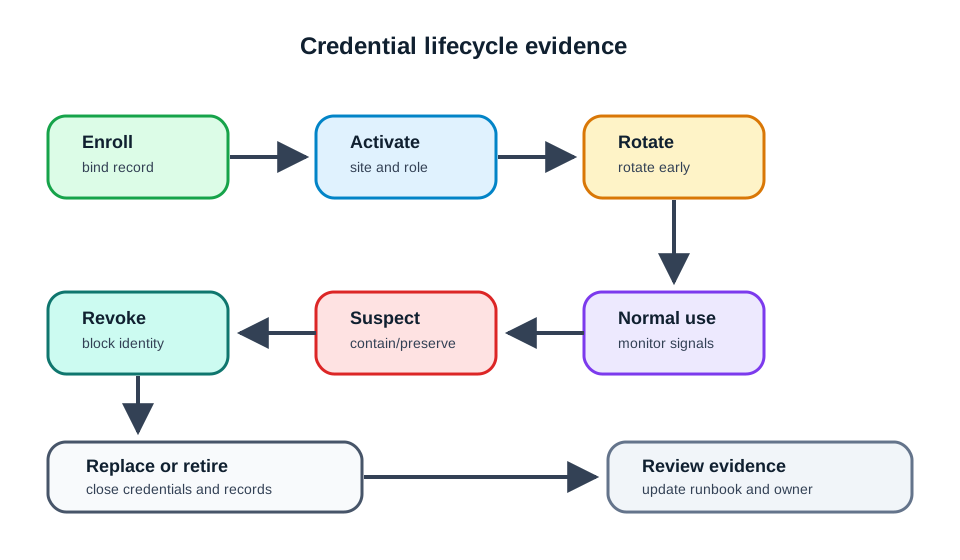
The most important IoT cloud-security decision is whether each device has an identity that can be controlled independently.

  • The resulting visual statement is: Device identity lifecycle moves from manufacturing enrollment through activation, rotation, normal use, suspected compromise, revocation, replacement, and retirement.
  • Shared fleet credentials should be treated as an emergency migration target.
Device identity lifecycle moves from manufacturing enrollment through activation, rotation, normal use, suspected compromise, revocation, replacement, and retirement.
iotclass.org

Major section

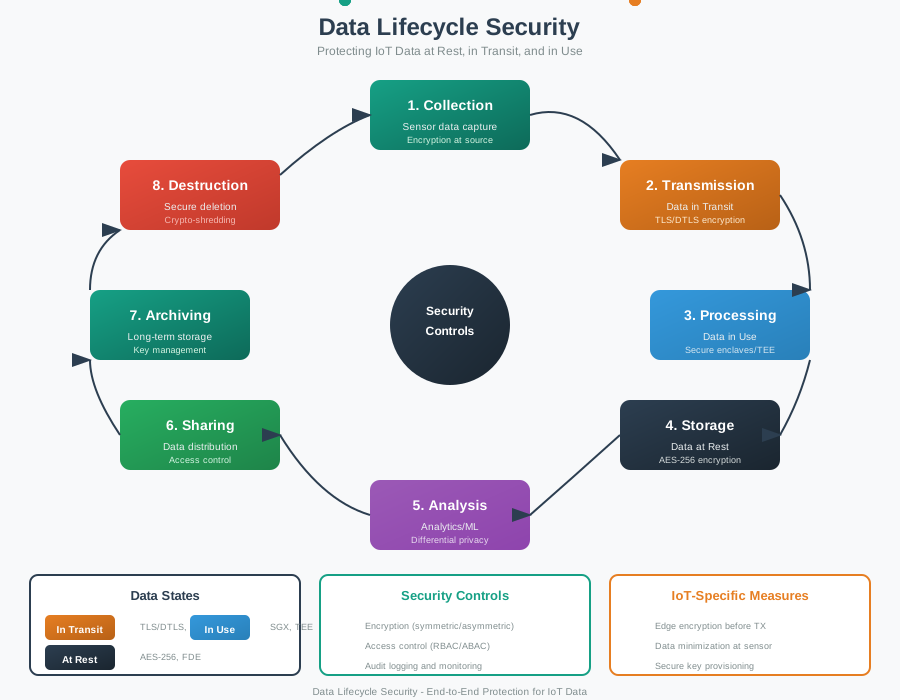
Data Protection

IoT data protection is a lifecycle decision.

  • Some readings are operational state, some are safety records, some are personal or site-sensitive, and some are low-value noise.
  • Encryption at rest and in transit should be the baseline.
  • The control record still needs to show key rotation, access checks, restore behavior, and deletion behavior.
End-to-end IoT data lifecycle security: encrypt at collection, protect data in transit with TLS or DTLS, isolate processing in secure enclaves, encrypt storage at rest, control analysis and sharing, manage keys through archiving, and crypto-shred at destruction.
iotclass.org

Major section

Monitoring And Incident Response
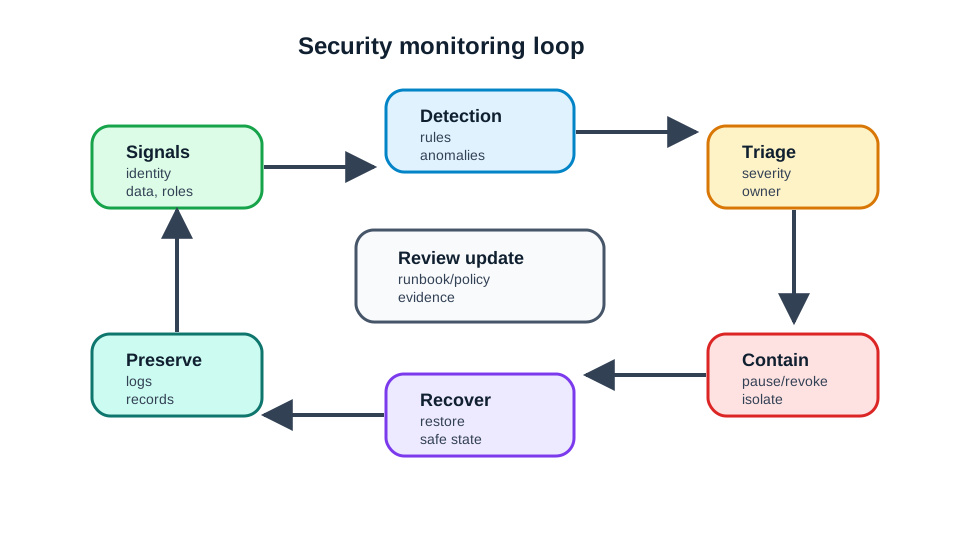
Security monitoring should distinguish normal IoT churn from suspicious behavior.

  • A large fleet always has offline devices, failed updates, bad payloads, and network interruptions.
  • The question is whether the pattern indicates risk.
  • Incident response should be rehearsed.
Cloud IoT security monitoring loops from signals through detection, triage, containment, recovery, record preservation, and control updates.
iotclass.org

Deck summary

Key takeaways

A gateway is a local system that passes device data to other services.

  • Every device needs its own identity.: Shared fleet credentials turn one extracted secret into a fleet-wide incident.
  • A shared cloud design is secure only when responsibilities are written down.
  • A cloud-security review should separate provider assurance from workload proof.
  • The most important IoT cloud-security decision is whether each device has an identity that can be controlled independently.
iotclass.org

Retrieval practice

Recall check

Cloud Clara says: answer from memory, then check your reasoning.

Q1An operator changes roles but retains access to sensitive IoT commands. Which boundary needs review?

ASensor sampling as the permission record
BCloud storage capacity as the command policy
COperator access and message authorization
DRadio coverage as the access decision
Show answer

Answer: C Role changes must be reflected in access and command permissions.

Q2A team moves its broker to a managed service. Which responsibility remains with the IoT application team?

AThe provider’s base infrastructure maintenance
BDevice trust and application authorization
CPhysical facilities of the managed platform
DManaged-runtime internal service patching
Show answer

Answer: B Managed runtime operations do not transfer the team’s identity, data, and permission duties.

iotclass.org

Print reference

Answers

Answer key.

  1. C · Role changes must be reflected in access and command permissions.
  2. B · Managed runtime operations do not transfer the team’s identity, data, and permission duties.
iotclass.org