Cloud, SDN & Production Architectures · Study deck
Cloud Security: Control Records and Failure Modes
A cold-store alert is useful only when a reviewer can trace the security control behind it.
Cloud Clara is your guide for this deck.

After studying this chapter
Learning objectives
You will be able to:
- Explain: If containment deletes the evidence, the team cannot tell whether the credential was copied, whether the wrong topic policy was used, or whether an operator account widened access during the incident.
- Explain: A device credential that cannot be revoked precisely, a command path that cannot be paused safely, or logs that disappear during recovery will turn a preventable incident into a reconstruction exercise.
- Explain: A dashboard viewer should not inherit command privileges, a maintenance account should not be able to alter identity records, and analytics exports should not bypass retention or data-class rules.
Major section
Scenario: Cold-Storage Security Check
A cold-storage operator connects gateways at many facilities.
- Operators can acknowledge alarms, schedule maintenance, and send limited configuration changes.
- Each gateway has a unique credential bound to a site and lifecycle record.
- Downstream sensors are mapped to a gateway inventory with last-seen and replacement status.
- No shared fleet secret is allowed in production firmware.
Major section
Scenario: Cold-Storage Security Check (continued)
Credential rotation is scheduled and tested on a small cohort before broad rollout.
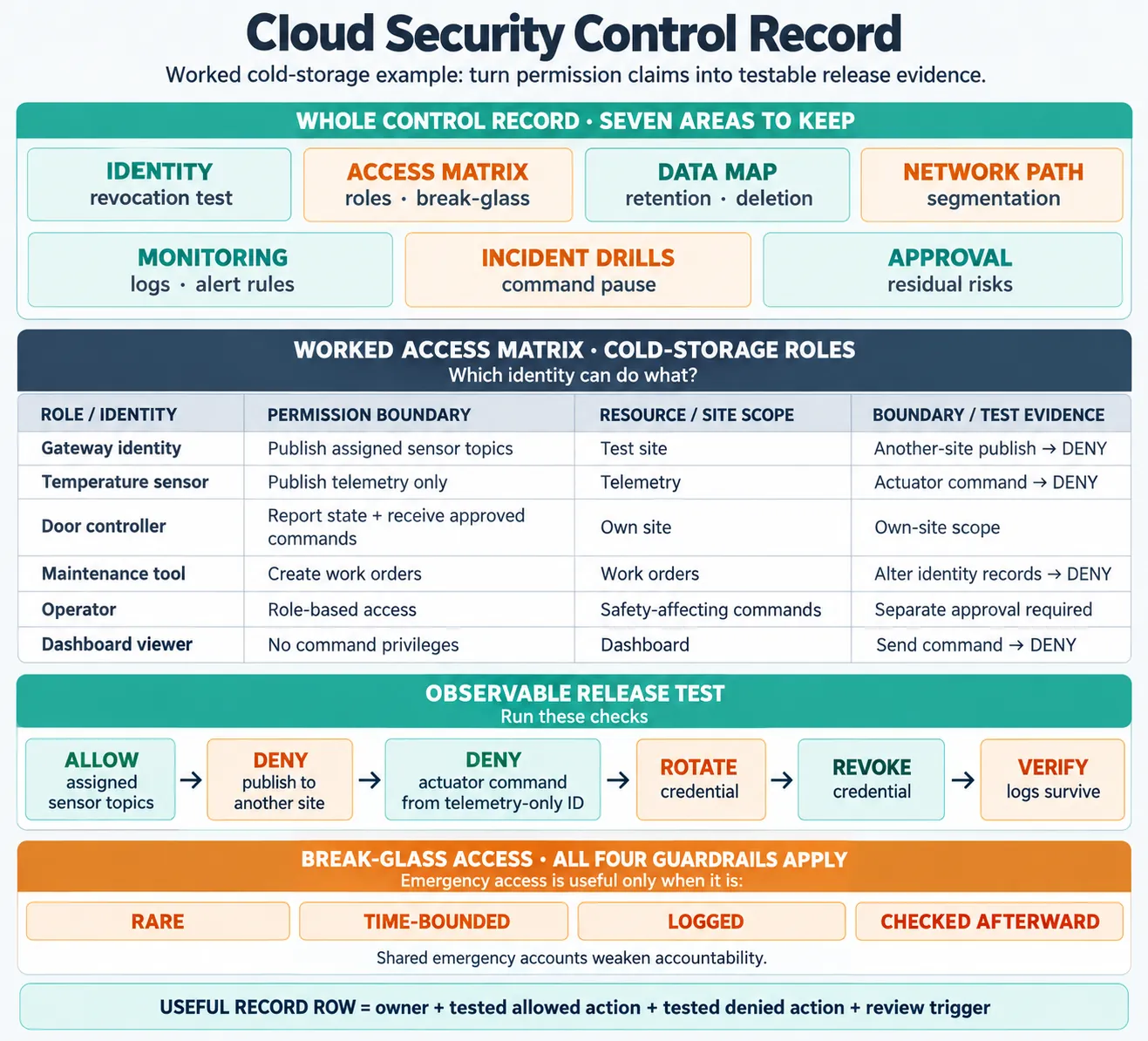
- Door controllers can report state and receive approved commands for their own site.
- Maintenance tools can create work orders but cannot alter device identity records.
- Operators use role-based access and separate approval for safety-affecting commands.
Major section
Scenario: Cold-Storage Security Check (continued)
Alarm records and command audit records have stronger retention than routine telemetry summaries.
- Raw high-frequency telemetry is retained only where it supports investigation or model validation.
- Local safety alarms continue even when the cloud command path is paused.
- Decision record: The security design is accepted only after per-gateway identity, topic authorization, command approval, data retention, log delivery, credential rotation, and gateway revocation have been tested and recorded.
Major section
Security Control Record
A security control record makes the design auditable and repeatable.
- It should be updated when device classes, message families, operator roles, data classes, or cloud paths change.
- Identity records cover enrollment, credential type, rotation, revocation, and retirement.
- The data map identifies sensitive classes, storage, key ownership, retention, and deletion.
- The network path records approved endpoints and segmentation.
Major section
Security as Blast-Radius Control
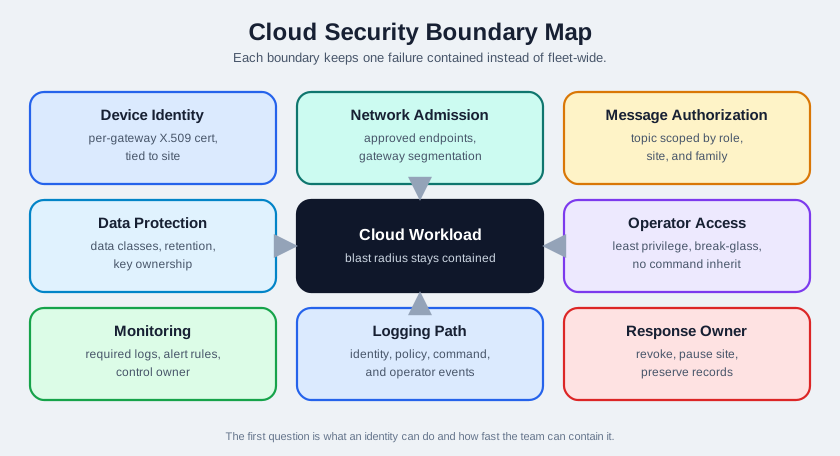
IoT cloud security is strongest when one failure stays small.
- A copied device, over-broad topic rule, exposed operator account, or broken gateway should not become a fleet-wide incident.
- The architecture must bound identity, permissions, data, network paths, monitoring, and response ownership.
- Monitoring and logging keep denied messages, policy changes, and operator actions visible.
Major section
Security as Blast-Radius Control (continued)
A gateway identity tied to a site should have a narrow topic and network path, so a copied credential cannot command the fleet.
- A response owner can then revoke the device, pause a site route, and preserve records.
- Mobile summary: Cloud security is release-ready when identity, permissions, data, network paths, operators, monitoring, and incident response are bounded, tested, and owned.
- For a cold-storage fleet, blast-radius control starts before the first gateway ships.
Major section
Security as Blast-Radius Control (continued)
The first security question is not "which cloud feature is enabled?" The first question is "what can this identity do, what records can it reach, and how quickly can the team contain it when it fails?".
- Each gateway can carry its own X.509 client certificate or equivalent device credential, tied to a site, model, firmware stream, and permitted MQTT topic family.
- A door sensor may publish state and battery health, while a compressor controller may receive only approved configuration for its own room.
- The same pattern applies to cloud operators and support tools.
Major section
Security as Blast-Radius Control (continued)
A dashboard viewer should not inherit command privileges, a maintenance account should not be able to alter identity records, and analytics exports should not bypass retention or data-class rules.
- Security therefore becomes a set of small, testable boundaries: device identity, message authorization, data access, network admission, operator role, logging path, and recovery owner.
- The control record is useful only when those boundaries are specific enough to test.
- The design is safer when these attempts fail clearly and leave useful audit events.
- Unique device or gateway credentials make revocation precise instead of fleet-wide.
Major section
Security Control Record
One device can be revoked or replaced without disturbing unrelated devices.
- It should say what is allowed, how the permission was tested, who owns the control, and what event forces a new review.
- In practice, build the record from observable tests.
- A device can perform only the message actions required for its role and site.
Major section
Security Control Record (continued)
For operators, prove that a viewer cannot send commands and that break-glass access is time-bounded and logged.
- A useful control record is boring in the best way: every row has an owner, a tested allowed action, a tested denied action, and a condition that requires review.
- Sensitive records are protected, queryable only by approved roles, and removable or archived by policy.
- New field, partner, retention period, analytics use, or support access path.
Major section
Prevention Needs Revocation
A copied gateway credential that can still publish to another site's topic is not contained, even if the TLS handshake is technically valid.
- Most controls are incomplete until the failure path is rehearsed.
- Credential revocation works only when identity checks sit on the actual message path.
- Command pause is a separate control.
Major section
Prevention Needs Revocation (continued)
A refrigeration controller can keep local alarms and compressor protection active while the cloud command route for that site is disabled.
- A device credential that cannot be revoked precisely, a command path that cannot be paused safely, or logs that disappear during recovery will turn a preventable incident into a reconstruction exercise.
- Topic authorization then has to be evaluated after identity, not assumed from a successful encrypted session.
- Security evidence is not just a list of enabled controls.
Major section
Prevention Needs Revocation (continued)
Many IoT incidents are not solved by turning the cloud off; local safety behavior may need to continue while cloud-originated commands are stopped.
- Identity logs, policy versions, command requests, operator approvals, denied-topic events, credential rotation events, and gateway replacement notes should be retained through the response.
- Durable logs and versioned policies make recovery narrow rather than improvisational.
- The system must reject one identity, preserve its records, and allow unaffected devices to continue operating.
Major section
Prevention Needs Revocation (continued)
If containment deletes the evidence, the team cannot tell whether the credential was copied, whether the wrong topic policy was used, or whether an operator account widened access during the incident.
- Unsafe return paths need a controlled pause, acknowledgement state, and local safety behavior while the cloud path is investigated.
- Identity, policy, command, operator, and telemetry logs must survive containment and recovery actions.
- Access changes need versioned policies, approval owners, and tested rollback so the team can recover without broad emergency access.
Deck summary
Key takeaways
A cold-storage operator connects gateways at many facilities.
- Credential rotation is scheduled and tested on a small cohort before broad rollout.
- Alarm records and command audit records have stronger retention than routine telemetry summaries.
- A security control record makes the design auditable and repeatable.
- IoT cloud security is strongest when one failure stays small.
Retrieval practice
Recall check 1 of 3

Cloud Clara says: answer from memory, then check your reasoning.
Q1A gateway credential is suspected to be copied from one returned unit. Which security posture limits blast radius best?
Show answer
Answer: C Blast radius is controlled by unique identity, least privilege, monitoring, revocation, rotation, and replacement records.
Retrieval practice
Recall check 2 of 3
Cloud Clara says: answer from memory, then check your reasoning.
Q2A site gateway should publish telemetry for assigned sensors and receive approved configuration for that site only. Which release record best proves least privilege?
Show answer
Answer: D Least privilege for IoT cloud systems is release evidence: scoped identity, permitted actions, denied actions, ownership, and review triggers.
Retrieval practice
Recall check 3 of 3
Cloud Clara says: answer from memory, then check your reasoning.
Q3A suspected gateway compromise affects one cold-storage site. Operators must keep local alarms running but stop unsafe cloud commands while preserving evidence. Which incident sequence is strongest?
Show answer
Answer: B Incident response must combine precise containment, local safety behavior, evidence preservation, credential recovery, and control-record updates.
Print reference
Answers
Answer key.
- C · Blast radius is controlled by unique identity, least privilege, monitoring, revocation, rotation, and replacement records.
- D · Least privilege for IoT cloud systems is release evidence: scoped identity, permitted actions, denied actions, ownership, and review triggers.
- B · Incident response must combine precise containment, local safety behavior, evidence preservation, credential recovery, and control-record updates.