Cloud, SDN & Production Architectures · Study deck
Cloud Platforms: Provider Checks and Selection
A provider demo cannot prove how a whole fleet of devices behaves under load, when many devices use the service at once, or during an outage, when the service is unavailable.
Cloud Clara is your guide for this deck.

After studying this chapter
Learning objectives
You will be able to:
- Explain: The design must say who proves device identity, who accepts messages, where work is buffered, which events are retained for replay, which state is synchronized, and how commands return toward the field.
- Explain: A provider demo cannot prove how a whole fleet of devices behaves under load, when many devices use the service at once, or during an outage, when the service is unavailable.
- Explain: Room temperature telemetry, compressor-fault alarms, gateway health reports, firmware rollout status, and setpoint commands should not be forced through one generic "cloud messaging" answer.
Major section
Start With the Decision · Simulation and Provider Checks
They should not replace the platform record.
- A provider demo cannot prove how a whole fleet of devices behaves under load, when many devices use the service at once, or during an outage, when the service is unavailable.
- Pair it with checks on the path the product will use.
- Named platforms need the same discipline.
Try it: Start With the Decision · Simulation and Provider Checks in the chapter
Major section
Cold-Storage Platform Messaging · Platform Selection Record
A cold-storage operator has gateways at many facilities.
- Each gateway receives temperature readings, door events, compressor state, local alarm events, and device-health records.
- The system needs local alarms, central dashboards, maintenance workflows, and replayable records for investigations.
- Enforces gateway identity and allowed topic patterns.
- Records command intent, approval, delivery, acknowledgment, and rollback state.
Major section
Platforms Map Message Duties
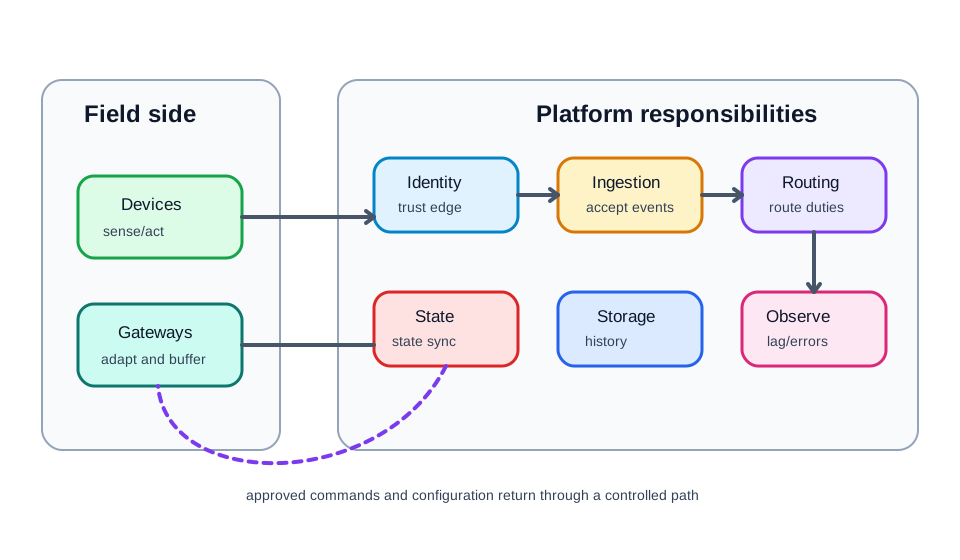
An IoT cloud platform is a set of responsibilities around messages, not a single endpoint.
- The design must say who proves device identity, who accepts messages, where work is buffered, which events are retained for replay, which state is synchronized, and how commands return toward the field.
- Logs and health checks show whether each handoff works.
- It makes the decision concrete by showing use the platform responsibility map to keep identity, ingestion, routing, storage, observability, state, and return-path duties visible before choosing a managed, self-managed, or hybrid shape, so the relationships can be checked before they are turned into a design claim.
Major section
Platforms Map Message Duties (continued)
Those first services decide who may join and which events may pass.
- Safe commands and settings must use a ruled path; they cannot skip identity and policy.
- A platform choice is complete only when the team names an owner and proof for each duty.
- A state view must expose stale devices when messages stop.
Major section
Platforms Map Message Duties (continued)
Each family has a different identity check, delivery consequence, retention need, and owner.
- It also needs a safe response when either a managed part or a self-run part is down.
- Identity must establish which source may publish, and ingestion must accept valid messages while rejecting bad ones.
- That trace should also name what is not proven.
Major section
Platforms Map Message Duties (continued)
Routing sends urgent alarms to a queue and later action, while storage and the event stream retain accepted telemetry for replay and analysis.
- Managed, self-managed, and hybrid designs can put those duties in different services, but the duties do not disappear.
- A broker handles live publish-subscribe communication, a queue controls processor work, and a stream keeps accepted events available for replay, analytics, and audit.
- A broker acknowledgement does not prove dashboard freshness.
Major section
Platforms Map Message Duties (continued)
Room temperature telemetry, compressor-fault alarms, gateway health reports, firmware rollout status, and setpoint commands should not be forced through one generic "cloud messaging" answer.
- If those answers point to different components, the platform design should say so explicitly.
- Owns work dispatch, retry timing, back-pressure, dead-letter handling, and alerting when processors cannot keep up.
- Owns ordered event history, retention, consumer lag, schema evolution, and replay after analytics or model changes.
Major section
Platforms Map Message Duties (continued)
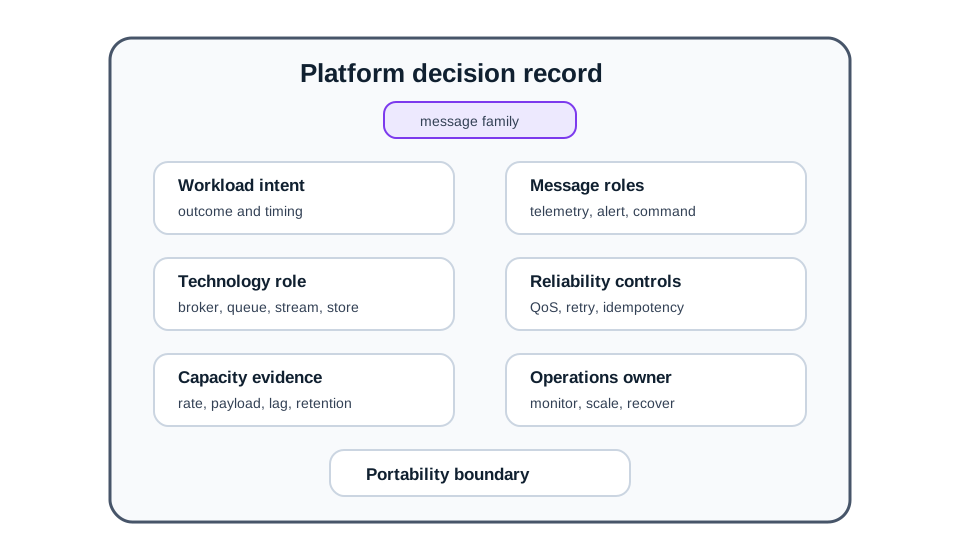
A strong platform choice can trace each message family from publish source to accepted record, processing owner, retained history, and return path.
- A queue retry does not prove long-term history.
- A stream replay window does not prove that a command reached a gateway.
- The overview record should keep those boundaries visible before the team chooses managed, self-managed, or hybrid platform pieces.
Major section
Platform Selection Record
The record should not merely say "use managed IoT" or "self-host MQTT." It should tie workload behavior to the component role, validation evidence, operations owner, and retest trigger.
- Broker accepts authenticated publishes and routes accepted events.
- Topic authorization, payload limits, QoS behavior, and reconnect burst test.
- Queue controls retry, escalation, and processor concurrency.
Major section
Platform Selection Record (continued)
Platform operations; retest after topic, credential, gateway, or burst-shape change.
- Application operations; retest after severity, retry, processor, or escalation-policy change.
- Stream retains accepted events for replay and consumer groups.
- Data platform; retest after model, schema, retention, or partition-key change.
- Broker or command service sends approved configuration and action messages.
Major section
Platform Selection Record (continued)
Topic naming, rule engines, device shadows, retained state, stream partition keys, and dead-letter formats can become service-specific.
- Device and platform owners; retest after command type, firmware, role, or safety rule change.
- Temperature summaries use a replay stream with schema version and consumer-lag alert.
- Those details make the platform choice testable.
Major section
Reliability Across Boundaries · Summary
MQTT QoS can confirm delivery between MQTT endpoints, but it does not prove downstream processing, storage, replay, dashboard state, or command execution.
- Each boundary needs its own failure rule, duplicate rule, and inspection path.
- At the stream boundary, the questions are partitioning, ordering scope, retention, schema evolution, lag, and replay authority.
- Command return paths need the same treatment.
Deck summary
Key takeaways
They should not replace the platform record.
- A cold-storage operator has gateways at many facilities.
- An IoT cloud platform is a set of responsibilities around messages, not a single endpoint.
- Those first services decide who may join and which events may pass.
- Each family has a different identity check, delivery consequence, retention need, and owner.
Retrieval practice
Recall check 1 of 3

Cloud Clara says: answer from memory, then check your reasoning.
Q1A cold-storage operator needs an IoT cloud path for room telemetry, compressor alarms, replay analytics, and safe setpoint commands. Which first step keeps the platform decision traceable?
Show answer
Answer: A IoT platform selection should connect message families to concrete responsibilities, owners, validation results, and retest triggers before the architecture depends on them.
Retrieval practice
Recall check 2 of 3
Cloud Clara says: answer from memory, then check your reasoning.
Q2A factory gateway publishes vibration telemetry every few seconds, and the maintenance team must replay the last month of accepted events after a model bug is fixed. Which platform record best supports the replay requirement?
Show answer
Answer: C Brokers, queues, and streams serve different platform roles.
Retrieval practice
Recall check 3 of 3
Cloud Clara says: answer from memory, then check your reasoning.
Q3A cold-storage alarm uses MQTT QoS 1 into a broker, a queue for processors, and a stream for audit history. After a downstream outage, duplicate alarm events appear. Which fix belongs in the platform release record?
Show answer
Answer: B Reliability must be designed across every platform boundary.
Print reference
Answers
Answer key.
- A · IoT platform selection should connect message families to concrete responsibilities, owners, validation results, and retest triggers before the architecture depends on them.
- C · Brokers, queues, and streams serve different platform roles.
- B · Reliability must be designed across every platform boundary.