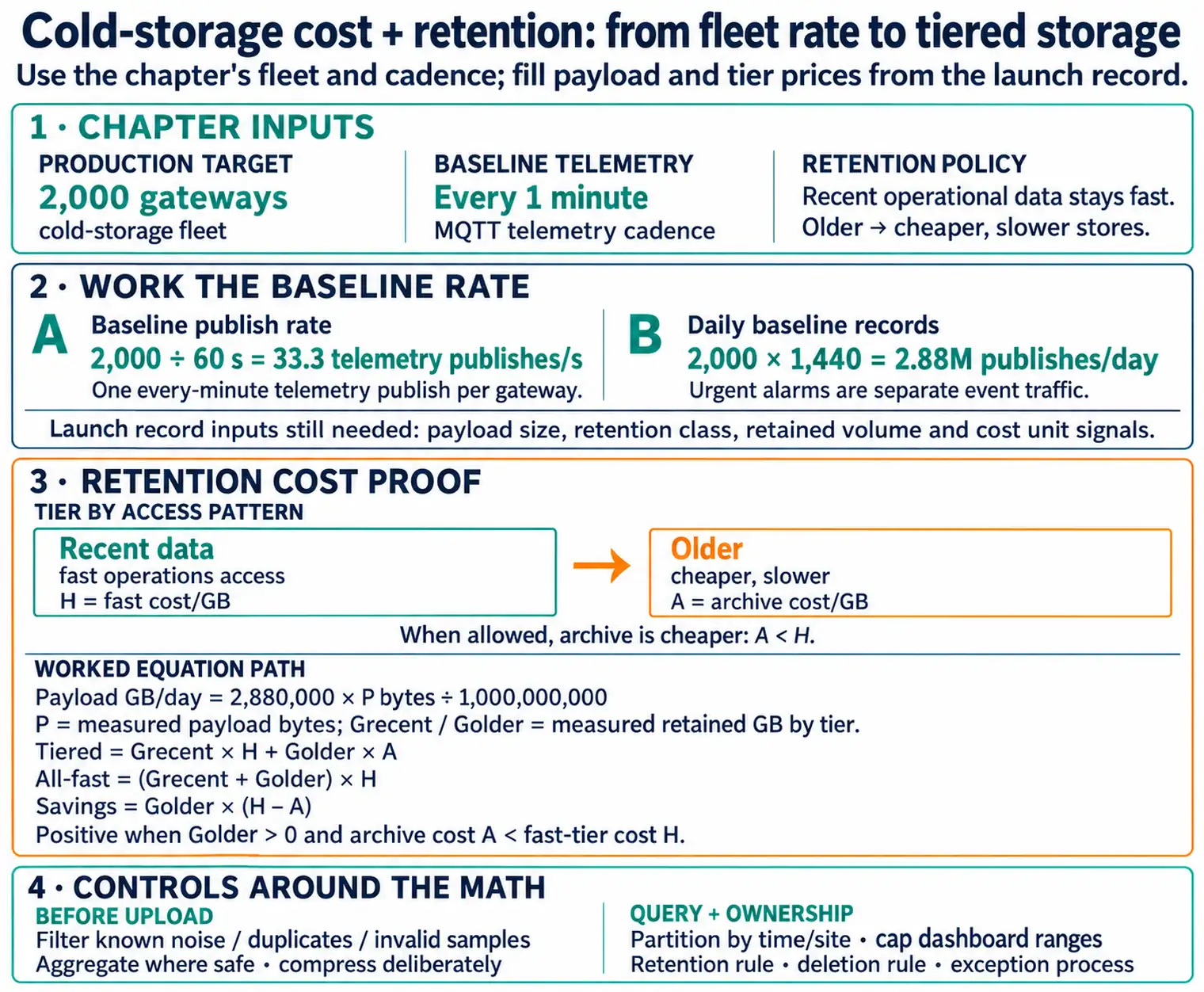
Cloud, SDN & Production Architectures · Study deck
Production Cloud Deployment for IoT
Picture ten test devices becoming ten thousand real devices.
Cloud Clara is your guide for this deck.

After studying this chapter
Learning objectives
You will be able to:
- Convert a pilot IoT cloud path into a production readiness plan.
- Identify launch risks from quotas, reconnect storms, storage growth, stale state, and downstream bottlenecks.
- Design observability and back-pressure controls for device ingestion and processing.
- Build rollout, rollback, recovery, and retirement records for a production fleet.
Major section
Start With the Launch Record
Messages pile up, storage slows, costs rise, and the person who built the first demo is asleep.
- Production means the service must keep a safe, useful state under real load and failure.
- Firmware is the device software stored on the device.
- The system needs a safe way to slow, hold, reject, or shed work before it collapses.
Major section
Start With the Launch Record (continued)
Operators need clear signs, alerts, and written recovery steps.
- A release needs health checks, a stop rule, a return path, and proof that old devices can be retired.
- Pilot success does not prove production readiness.
- A clean chart may hide retries, stale state, missing records, or a cost path that grows without bound.
Major section
In 60 Seconds · Minimum Viable Understanding
Production changes the failure mode.: Small pilots hide quotas, retry storms, stale state, storage growth, and operations gaps.
- Production IoT cloud deployment is an operations problem, not only a scale problem.
- A launch-ready system has quota records, load and reconnect tests, back-pressure, observability, cost and retention controls, staged rollout, rollback, device retirement, and recovery drills.
- Readiness must be record-backed.: Checklists are useful only when linked to tests, screenshots, dashboards, runbooks, and named owners.
Major section
Production Readiness Uses Records · Development To Production Gap
Long retention and replay needs.
- Production readiness is not the moment a dashboard looks correct.
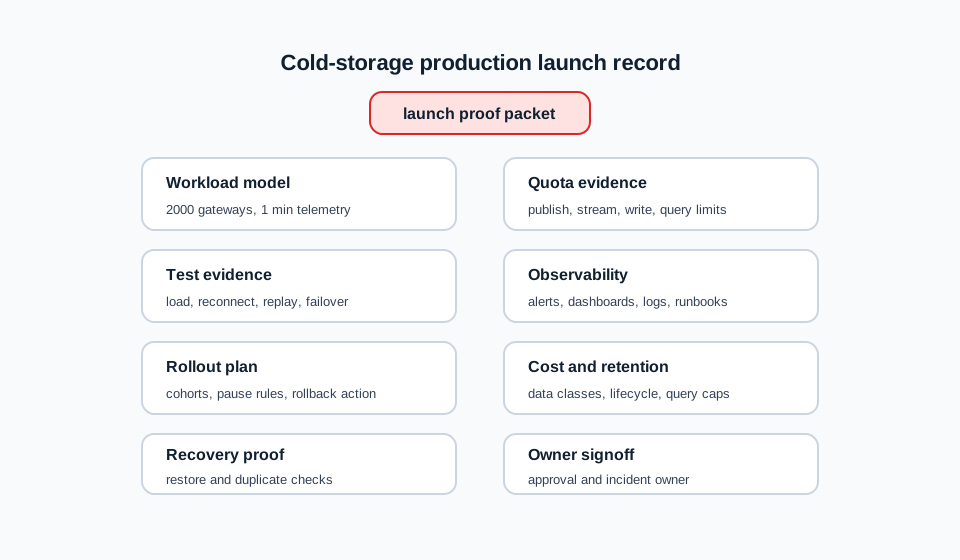
- The overview depth layer shows the production readiness map that links workload evidence, quota checks, back-pressure, observability, recovery drills, cost and rollout controls, and owner signoff around the launch gate.
- Quota check and increase plan.
Major section
Quotas, Bursts, And Back-Pressure · Observability And Incident Response
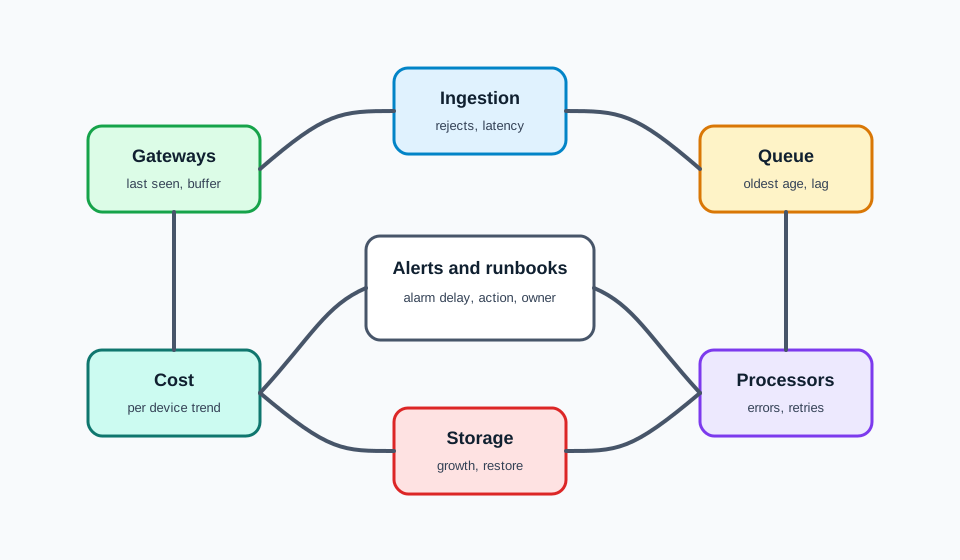
Every cloud path has limits.
- They may appear as request rates, connection rates, registry operation rates, queue throughput, database writes, index updates, or dashboard query limits.
- Production readiness means knowing which limit fails first and how the system responds.
- When a network returns, many devices may reconnect and replay buffered events together.
Major section
Rollout, Rollback, And Retirement · Scenario: Cold-Storage Launch
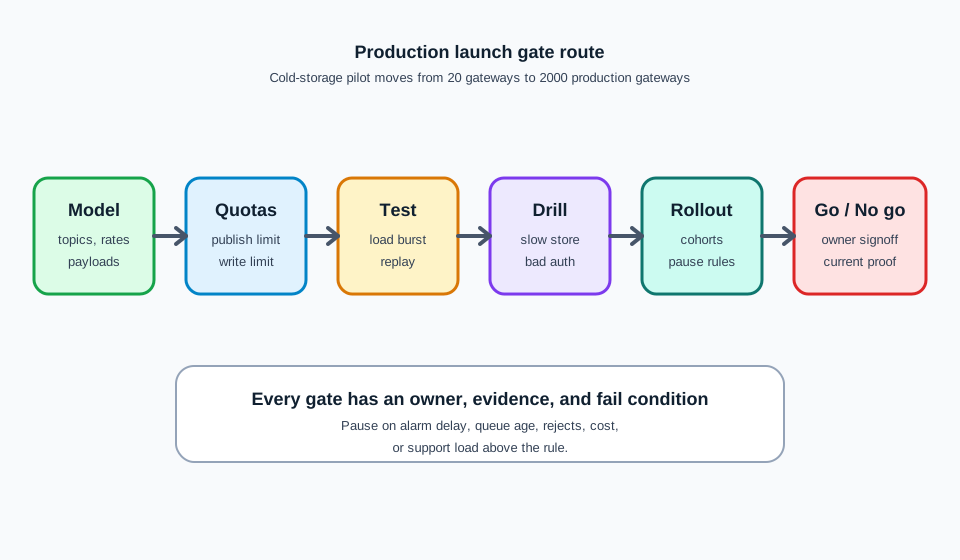
Production deployment is not a single release event.
- Devices, gateways, cloud services, schemas, dashboards, and operators all change over time.
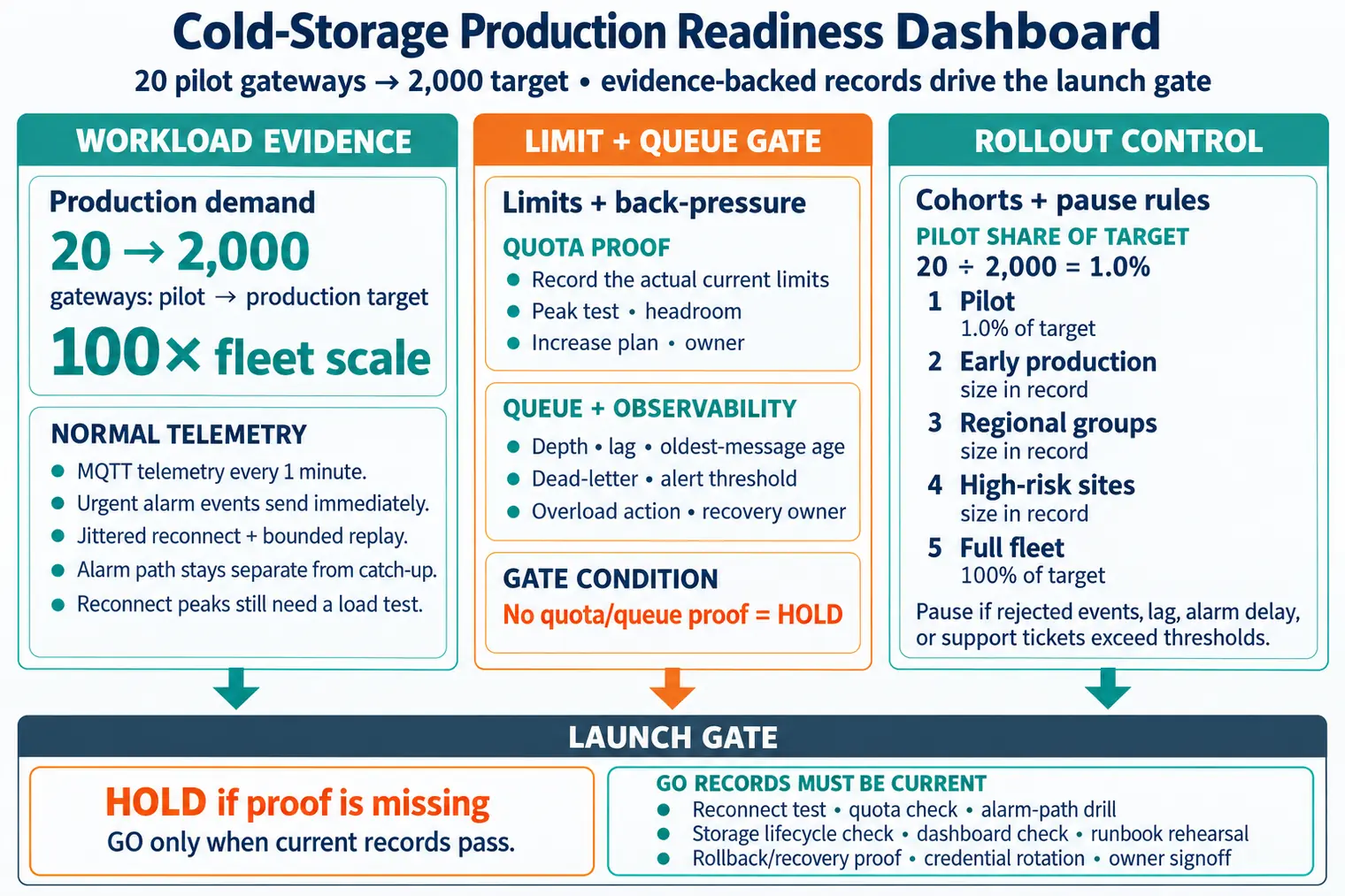
- A cold-storage operator is moving from a 20-gateway pilot to production across many facilities.
- The platform must support local alarms, central dashboards, maintenance workflows, and event replay.
Major section
Production Launch Record
The production launch record is the artifact that prevents launch decisions from relying on optimism.
- That observation connects this visual to the chapter's running narrative: use it to justify the next design decision and to record what evidence would confirm it in operation.
Major section
4. Leaving Device Retirement For Later · Production Failure Boundaries
Retired devices with active credentials can keep consuming capacity and creating risk.
- Include credential revocation, inventory status, data retention, and support handoff in the lifecycle.
- A production IoT cloud launch is ready when expected failures are bounded, visible, recoverable, and owned.
- The production record makes those conditions explicit.
Major section
Launch Gate Record
Each row should say what was tested, which result is acceptable, who owns the control, and what change forces another check.
- That list gives the team something concrete to test rather than a generic statement that the cloud is elastic.
- A quota gate can include load-test output, service-limit screenshots, and requested limit increases.
- A back-pressure gate can show queue depth, consumer lag, dead-letter inspection, and what happens when an analytics worker slows.
Major section
Launch Gate Record (continued)
If a new firmware image changes payload size, the workload model is updated.
- An observability gate can link dashboard panels to alert rules and runbook steps.
- If a new dashboard queries two years of raw telemetry, query guardrails and storage costs are reviewed.
- The system slows or separates noncritical work before urgent flows are harmed.
Major section
Launch Gate Record (continued)
New limit, processor, storage path, retry policy, or site connectivity pattern.
- A rollout gate can define pilot, early production, regional, and full-fleet cohorts with pause criteria based on rejected messages, alarm delay, oldest queued message, failed authentications, support tickets, and cost-per-device trend.
- If a facility leaves the service, credentials, topics, dashboards, and retained data follow the retirement path.
- An operator can identify affected workload, safe action, and recovery owner quickly.
Major section
Design Recovery Before Outages
The queue and storage layers need equally explicit behavior.
- Production failure modes are often caused by recovery itself: retries multiply, stale device state looks current, queues hide the oldest message, dashboards query too much history, and retired devices keep credentials alive.
- Retirement and rollback are part of recovery too.
- A recovery drill is not optional evidence.
Major section
Design Recovery Before Outages (continued)
The cloud path should know whether replayed records are idempotent, whether command acknowledgments are separated from telemetry catch-up, and whether an operator can distinguish observation time from delivery time.
- Without those details, a dashboard can show a value that looks current while the underlying event is hours old.
- A stream processor may write raw events to object storage, summaries to a time-series database, and alerts to a notification workflow.
- If the platform only watches average latency, it can miss a stuck partition, expensive dashboard query, or retry loop that keeps capacity saturated after the original incident is over.
Major section
Design Recovery Before Outages (continued)
Old credentials, schemas, topics, dashboards, and support procedures can keep producing events after devices leave service.
- A rollback plan should say which firmware or gateway version is restored, which schema version remains accepted, which data is replayed, and which records are preserved under the retention policy.
- Strong production design keeps recovery from widening permissions, hiding stale state, or turning temporary failure into permanent operational debt.
- Close credentials, topics, schemas, dashboards, support ownership, and retained data when devices leave service.
- It proves whether the launch plan can restore service without losing records, widening permissions, or depending on stale state.
Major section
Summary · Key Takeaway
Production cloud deployment for IoT requires records across scale, limits, operations, release safety, recovery, and cost control.
- A launch-ready design has tested quota headroom, back-pressure, observability, staged rollout, rollback, recovery drills, retention controls, and clear ownership.
- The goal is not to prove that nothing will fail.
- The goal is to prove that expected failures are bounded, visible, recoverable, and assigned.
Deck summary
Key takeaways
Messages pile up, storage slows, costs rise, and the person who built the first demo is asleep.
- Operators need clear signs, alerts, and written recovery steps.
- Production changes the failure mode.: Small pilots hide quotas, retry storms, stale state, storage growth, and operations gaps.
- Long retention and replay needs.
- Every cloud path has limits.
Retrieval practice
Recall check 1 of 3

Cloud Clara says: answer from memory, then check your reasoning.
Q1A production launch test shows that many gateways reconnect after a site outage and replay buffered telemetry together. Queue lag rises and alarm processing slows. Which launch record is strongest?
Show answer
Answer: A Production readiness proves expected abnormal conditions are bounded, visible, recoverable, and owned.
Retrieval practice
Recall check 2 of 3

Cloud Clara says: answer from memory, then check your reasoning.
Q2A building operator wants to launch a cloud service for 600 boiler-room leak sensors after a pilot dashboard showed one gateway uploading readings. Gateways can replay buffered telemetry after overnight outages, alarm processing must stay timely, and storage costs have a fixed cap. Which added record makes the launch decision defensible?
Show answer
Answer: A A defensible production launch record ties workload behavior to limits, tests, visibility, rollout, recovery, cost controls, and accountable owners.
Retrieval practice
Recall check 3 of 3

Cloud Clara says: answer from memory, then check your reasoning.
Q3After a storage slowdown, a production IoT system catches up but dashboards show stale device state and retry volume remains high. Which follow-up belongs in the production record?
Show answer
Answer: A Production recovery needs explicit controls for retry storms, stale state, queue lag, replay ownership, restore proof, and device retirement.
Print reference
Answers
Answer key.
- A · Production readiness proves expected abnormal conditions are bounded, visible, recoverable, and owned.
- A · A defensible production launch record ties workload behavior to limits, tests, visibility, rollout, recovery, cost controls, and accountable owners.
- A · Production recovery needs explicit controls for retry storms, stale state, queue lag, replay ownership, restore proof, and device retirement.