Testing & Validation · Study deck

OTA Update Architecture for IoT

A roadside controller downloads a new image, then loses power before its first successful boot.

Test Tessa is your guide for this deck.

ota-updatesfirmware-validationrelease-gates
Test Tessa, the module guide, in a scene from this chapter.
iotclass.org

After studying this chapter

Learning objectives

You will be able to:

  • treat an OTA update as a controlled release, not a file copy
  • build release-side and device-side update evidence
  • use atomic slots and the three install states to support real recovery
  • Explain: On restart, it must not run a half-written image or report the new version before that image is accepted.
iotclass.org

Major section

Start With the Device You Cannot Touch

On restart, it must not run a half-written image or report the new version before that image is accepted.

  • An over-the-air update is a software change delivered through a network instead of a local cable.
  • OTA is its short name.
  • Firmware is the stored device code and its version.
iotclass.org

Major section

Practitioner: Release-Side and Device-Side Evidence
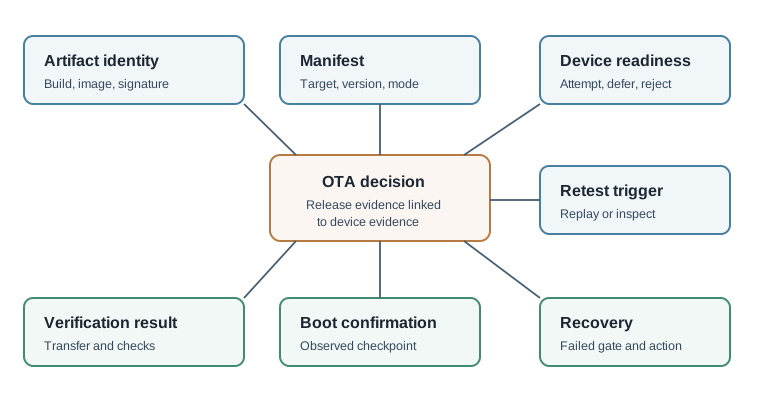
Recovery evidence records the previous working image and failed gate, while the retest trigger says what change can reopen the attempt.

  • This record carries the controlled-release story onto the device instead of ending it when bytes arrive.
An OTA review record preserves artifact identity, manifest constraints, readiness, verification, boot confirmation, recovery evidence, and the retest trigger.
iotclass.org

Major section

Under the Hood: Three States, Atomic Slots, and Real Recovery

End at the retest trigger, which prevents the same unsafe candidate from cycling indefinitely.

  • This closes the dual-slot story with evidence that rollback is executable, not merely promised.

Why it matters

Boot confirmation matters because it is the point where installation evidence becomes running-system evidence.

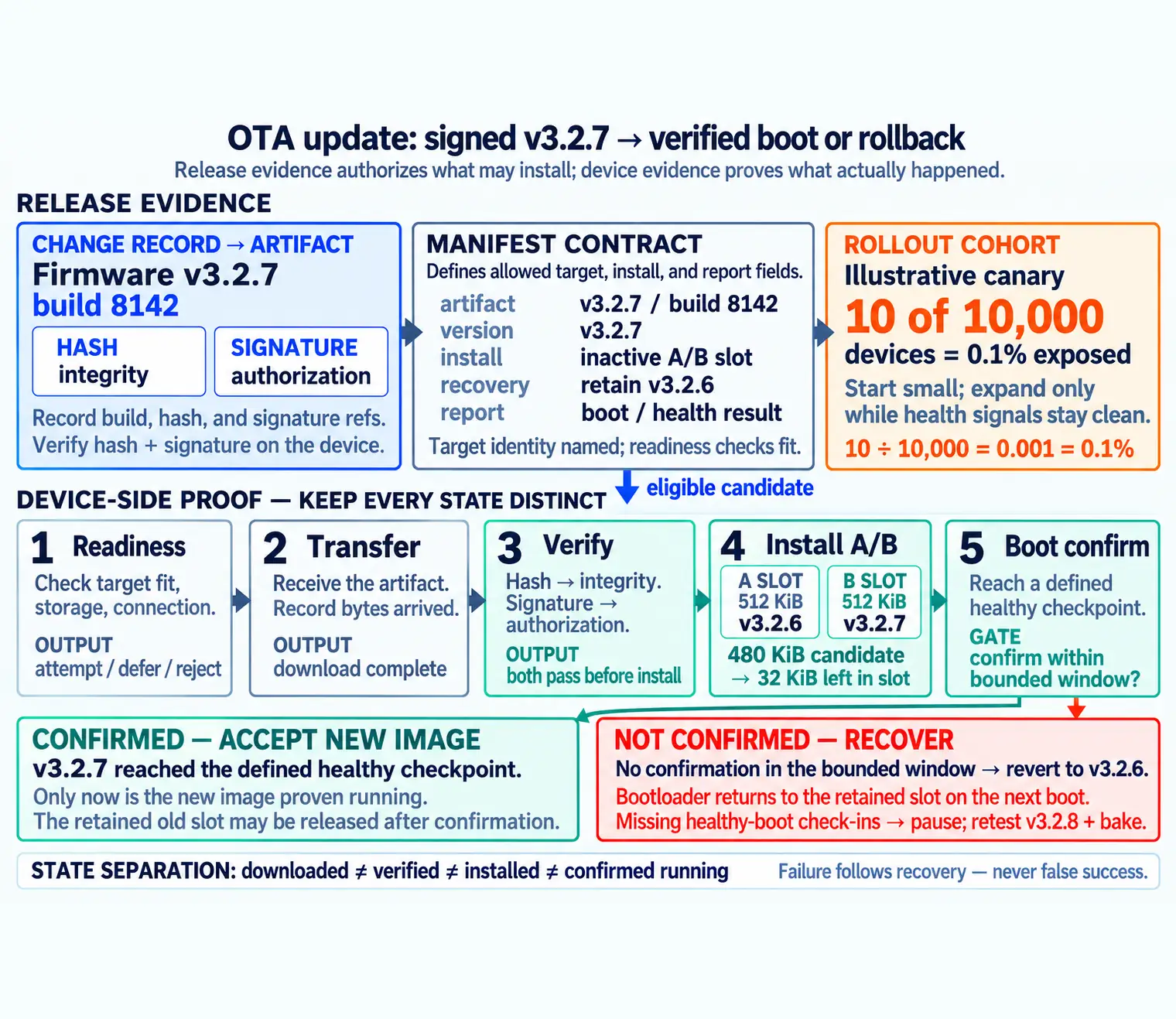
The OTA gate path separates release-side identity and authorization from device readiness, verification, boot confirmation, and recovery.
iotclass.org

Major section

Rollback and Staged Rollouts

Firmware means the software stored on a device that controls its behavior and can be updated in the field.

  • This sequence connects the banquet analogy to the engineering purpose of staged rollout: a measurable blast radius and a tested way back.
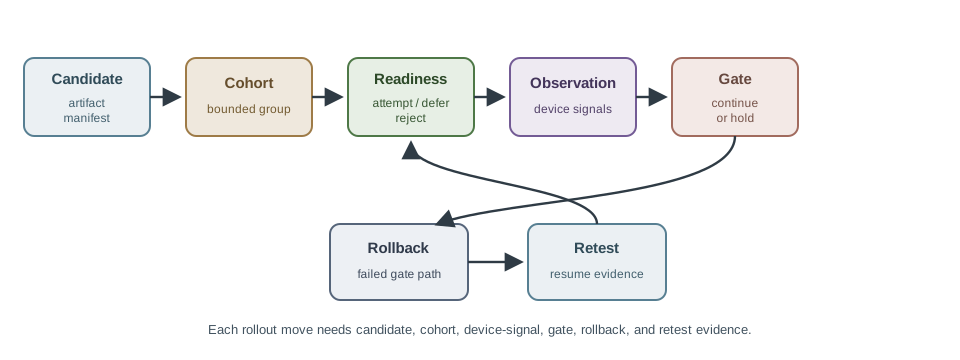
  • The sequence connects a predefined health condition to an executable rollback rather than an improvised reaction.

Why it matters

Readiness prevents unsuitable devices from attempting the change; observation compares predefined health signals with the gate; and the decision either expands, pauses, or rolls back.

The staged-rollout gate path sends a candidate to a bounded cohort, checks readiness and observed health, then continues, pauses, rolls back, or waits for retest evidence.
iotclass.org

Major section

Rollback and Staged Rollouts (continued)
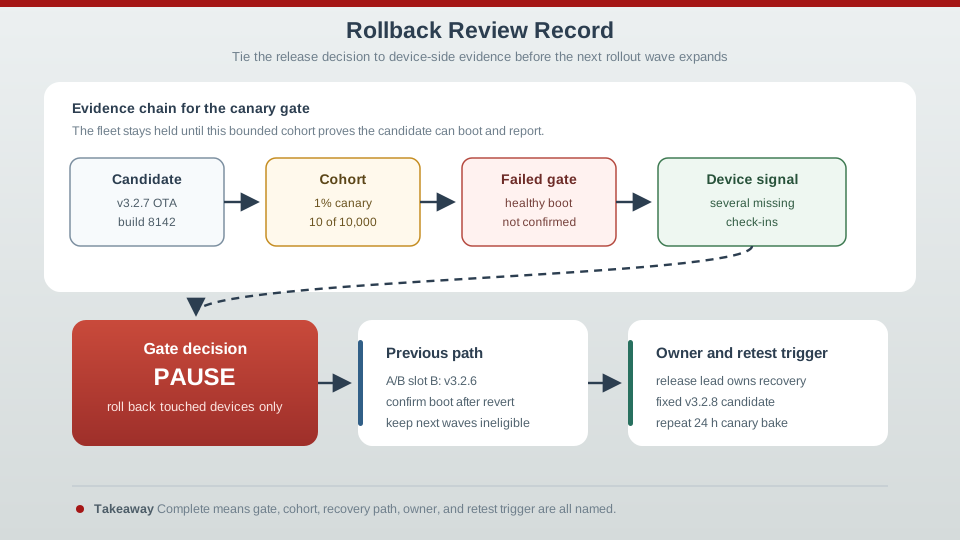
A canary or staged ring sends the candidate to a small device cohort and expands only through evidence gates, while blue-green switching serves gateways or backends that can maintain two swappable environments.

  • Those conditions turn each expansion into a repeatable decision and make missing check-ins a warning rather than allowing a silent, possibly bricked device to count as healthy.
  • Rollback is itself an update: it needs a retained, tested image, often in an A/B layout, and it must restore and confirm a healthy boot only for the cohort tied to the failed gate.
  • That path is not always available.
iotclass.org

Major section

Prove the Trial Slot before Expanding the Cohort

A 480 KiB candidate leaves 32 KiB within its slot for any slot-resident overhead.

  • The update must check the actual signed image layout rather than comparing only the uncompressed application binary with nominal flash capacity.
  • The architecture should recover according to its documented state machine without selecting partially written code.

Key terms

Download complete
Download complete means the bytes arrived; verification checks their integrity and authorization; confirmation establishes that the new running image met the defined health conditions.

Why it matters

This module treats remote updates as controlled state changes because the device may be beyond physical reach.

The OTA gate path separates release-side identity and authorization from device readiness, verification, boot confirmation, and recovery.
iotclass.org

Major section

Prove the Trial Slot before Expanding the Cohort (continued)

Download complete means the bytes arrived; verification checks their integrity and authorization; confirmation establishes that the new running image met the defined health conditions.

  • The boot architecture needs power-loss evidence to establish its flash-write and metadata guarantees.
  • The exposed fraction is 10 divided by 10,000 = 0.001, or 0.1%.
  • If two fail the healthy-boot check, that is 20% of the trial cohort.
iotclass.org

Major section

Summary

On the release side, the change record, immutable artifact identity, hash, signature, and manifest establish what may be installed; the manifest also fixes the target, version intent, slot or install mode, recovery expectation, and reporting fields.

  • On the device side, readiness, transfer, verification, boot confirmation, and recovery remain separate states.
  • In particular, downloaded is not installed, and installed is not confirmed: success requires a defined healthy-boot checkpoint rather than the mere arrival of bytes.
  • A dual-slot layout leaves the running image untouched during the write and retains the previous image for recovery.
iotclass.org

Deck summary

Key takeaways

On restart, it must not run a half-written image or report the new version before that image is accepted.

  • Recovery evidence records the previous working image and failed gate, while the retest trigger says what change can reopen the attempt.
  • End at the retest trigger, which prevents the same unsafe candidate from cycling indefinitely.
  • Firmware means the software stored on a device that controls its behavior and can be updated in the field.
  • A canary or staged ring sends the candidate to a small device cohort and expands only through evidence gates, while blue-green switching serves gateways or backends that can maintain two swappable environments.
iotclass.org

Retrieval practice

Recall check 1 of 6

Test Tessa says: answer from memory, then check your reasoning.

Q1Why is an over-the-air (OTA) update best treated as a controlled release rather than a simple file transfer?

ABecause firmware is large, so compression is the main safety control
BBecause it must authorize, verify, confirm boot, and retain recovery
CBecause phased downloads spread bandwidth use across the device fleet
DBecause bytes arriving on flash mean the update is complete and trusted
Show answer

Answer: B The transfer is the easy part.

iotclass.org

Retrieval practice

Recall check 2 of 6

Test Tessa says: answer from memory, then check your reasoning.

Q2A device downloaded an OTA artifact, but the manifest's target does not match the device's hardware and version profile. What should the review record show first?

AThe device installed the artifact because the transfer had completed
BThe same artifact was retried until the device accepted the manifest
CA reject or defer at the manifest/readiness gate, with a target-mismatch reason
DThe device reported only a generic failure status for the release dashboard
Show answer

Answer: C A target mismatch belongs in the manifest or readiness evidence, with a reason that distinguishes it from a transfer or device fault.

iotclass.org

Retrieval practice

Recall check 3 of 6

Test Tessa says: answer from memory, then check your reasoning.

Q3After an OTA install, a device reports 'installed' but then keeps restarting before the application ever runs. Which design lets the fleet recover automatically, and what evidence proves recovery worked?

AA boot-confirmation handshake with a dual-slot
BMarking the update successful as soon as the bytes are written, because a completed transfer proves the image is good
COverwriting the previous image during install to save storage, then re-downloading if the device fails
DIncreasing the download retry count so the device eventually boots
Show answer

Answer: A Confirmation distinguishes 'installed' from 'running healthy,' and the retained slot makes the failure survivable.

iotclass.org

Retrieval practice

Recall check 4 of 6

Test Tessa says: answer from memory, then check your reasoning.

Q4Why are staged rollouts and a defined rollback path especially important for IoT firmware compared with a typical web service deploy?

ADevices are hard to reach physically
BFirmware updates never fail, so staging and rollback are only paperwork
CWeb deploys are riskier than firmware, so IoT needs less caution
DStaging exists only to make releases slower for compliance reasons
Show answer

Answer: A The cost of a fleet-wide bad update is high and hard to undo by hand, so bounding exposure and planning recovery in advance are essential.

iotclass.org

Retrieval practice

Recall check 5 of 6

Test Tessa says: answer from memory, then check your reasoning.

Q5A canary cohort reports successful transfer and signature verification of the new firmware, but several devices never report a confirmed healthy boot. What is the strongest rollout decision?

APause the rollout and review the affected devices for recovery or rollback
BContinue to the next wave, since the artifact was downloaded and its signature verified
CImmediately roll back every device in every cohort across the whole fleet
DDelete the boot-confirmation gate so the rollout can be marked complete
Show answer

Answer: A A downloaded, verified image that never confirms a healthy boot is exactly the condition a boot-confirmation gate exists to catch; expanding would risk bricking more devices.

iotclass.org

Retrieval practice

Recall check 6 of 6

Test Tessa says: answer from memory, then check your reasoning.

Q6A firmware update rewrites each device's stored configuration into a new on-flash format. Field reports come in, and the team triggers a rollback to the previous version, but the reverted devices now fail to start. What most likely happened, and what should have been planned?

AThe network download failed; the team should retry the same downgrade after congestion clears
BThe migration was forward-incompatible; recovery needed a compatible data path or roll-forward fix
CAnti-rollback blocked the old image; the team should bypass version checks in production
DThe rollback succeeded; boot confirmation can be skipped once the version number changes
Show answer

Answer: B State migrations can make rollback effectively impossible; the safe options are backward-compatible migrations or recovering by rolling forward, decided before the release ships.

iotclass.org

Print reference

Answers 1 of 2

Answer key.

  1. B · The transfer is the easy part.
  2. C · A target mismatch belongs in the manifest or readiness evidence, with a reason that distinguishes it from a transfer or device fault.
  3. A · Confirmation distinguishes 'installed' from 'running healthy,' and the retained slot makes the failure survivable.
  4. A · The cost of a fleet-wide bad update is high and hard to undo by hand, so bounding exposure and planning recovery in advance are essential.
iotclass.org

Print reference

Answers 2 of 2

Answer key.

  1. A · A downloaded, verified image that never confirms a healthy boot is exactly the condition a boot-confirmation gate exists to catch; expanding would risk bricking more devices.
  2. B · State migrations can make rollback effectively impossible; the safe options are backward-compatible migrations or recovering by rolling forward, decided before the release ships.
iotclass.org