Testing & Validation · Study deck
CI/CD Fundamentals for IoT
Imagine changing one line that controls a pump.
Test Tessa is your guide for this deck.

After studying this chapter
Learning objectives
You will be able to:
- move a change through pipeline stages to a releasable candidate, repeatably
- apply automated gates at each pipeline stage
- explain what makes an IoT CI/CD pipeline different from a pure-software one
- Explain: A fast test can catch a simple mistake, but the real device must still behave safely.
Major section
Start With the Change That Must Ship
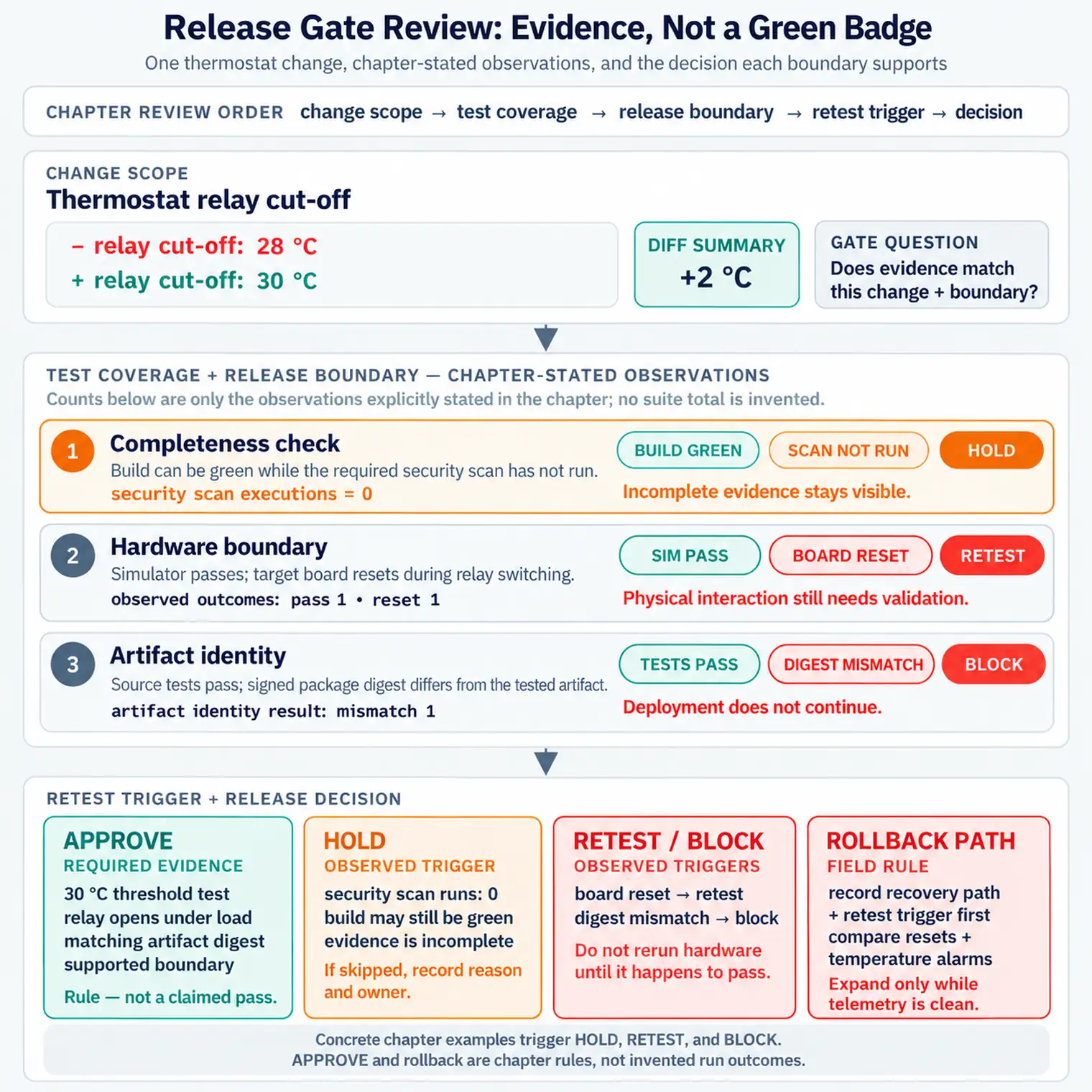
A fast test can catch a simple mistake, but the real device must still behave safely.
- Continuous integration and continuous delivery (CI/CD) is a repeatable path that builds, checks, and records each change.
- Firmware means the software stored inside the device.
- A green early stage cannot replace a later physical check.
Major section
Overview: From a Change to a Releasable Candidate, Repeatably
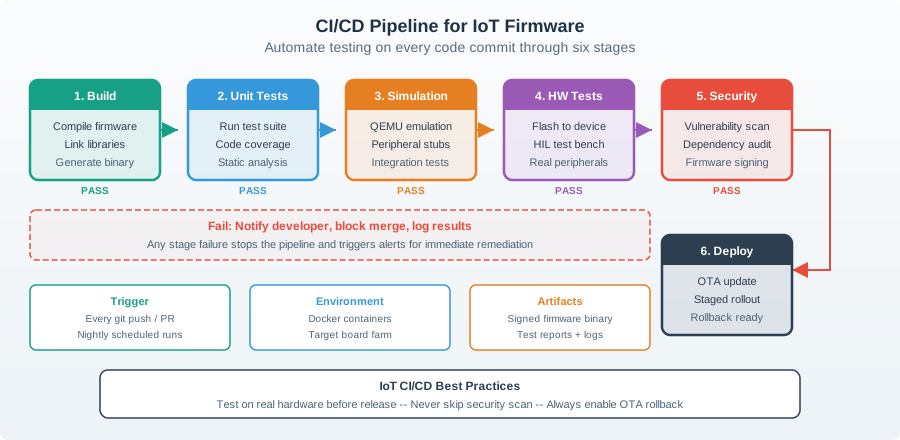
The source change establishes what must be traced; build, static analysis, and unit tests reject inexpensive defects first; simulation exercises modeled peripherals; and hardware-in-the-loop checks the real target and timing.
- The final release decision therefore inherits a chain of increasingly physical evidence, connecting rapid integration feedback to an IoT candidate that is genuinely ready for a controlled rollout.
Major section
Gate a Thermostat Firmware Change
For these CI/CD fundamentals, the thermostat pipeline can prove that the same source made the tested firmware artifact.
- A unit test can check the 30 °C threshold.
- Hardware-aware CI/CD fundamentals require a test that shows whether the real relay opens under load.
- The physical power and relay interaction needs hardware validation.
Major section
Summary
The value is repeatable evidence and fast feedback, not automatic release.
- A typical pipeline runs commit → build (per target) → static + unit → integration + hardware-aware → package + sign → release gate → staged delivery, each stage leaving evidence.
- Automated quality gates stop a candidate that fails a required check; a gate is honest only when a skipped check is recorded with a reason and owner.
- A build matrix compiles for every claimed target; the tested, approved, and shipped artifact must be the same bytes, promoted and verified by digest rather than rebuilt.
Deck summary
Key takeaways
A fast test can catch a simple mistake, but the real device must still behave safely.
- The source change establishes what must be traced; build, static analysis, and unit tests reject inexpensive defects first; simulation exercises modeled peripherals; and hardware-in-the-loop checks the real target and timing.
- For these CI/CD fundamentals, the thermostat pipeline can prove that the same source made the tested firmware artifact.
- The value is repeatable evidence and fast feedback, not automatic release.
Retrieval practice
Recall check 1 of 3

Test Tessa says: answer from memory, then check your reasoning.
Q1What does a CI/CD pipeline primarily provide for an IoT project?
Show answer
Answer: C The point is a repeatable, traceable record and quick feedback on each change, with release controlled by a gate, not automation for its own sake.
Retrieval practice
Recall check 2 of 3

Test Tessa says: answer from memory, then check your reasoning.
Q2A firmware change alters how rejected sensor readings are encoded for downstream consumers, but the CI record only shows the image compiled and the parser's unit tests passed. What is the strongest gate decision?
Show answer
Answer: B The changed behavior is a consumer-facing contract.
Retrieval practice
Recall check 3 of 3

Test Tessa says: answer from memory, then check your reasoning.
Q3To save time, a team's pipeline rebuilds the firmware image at deploy time from the same commit instead of shipping the exact artifact that passed the tests. Why is this risky for IoT, and what is the fix?
Show answer
Answer: A Rebuilding breaks the link between tested and shipped.
Print reference
Answers
Answer key.
- C · The point is a repeatable, traceable record and quick feedback on each change, with release controlled by a gate, not automation for its own sake.
- B · The changed behavior is a consumer-facing contract.
- A · Rebuilding breaks the link between tested and shipped.