Cellular IoT · Study deck

Cellular IoT Overview and Evolution

Imagine a water meter must report from a locked pit for many years without a local hub.

Radio Remi is your guide for this deck.

Radio Remi, the module guide, in a scene from this chapter.
iotclass.org

After studying this chapter

Learning objectives

You will be able to:

  • Explain: The green 4G strip names the current workhorses, LTE-M and NB-IoT, which is why this module keeps returning to those two categories rather than to headline rates.
  • Explain: That convenience adds obligations: technology fit, operator support, SIM or eSIM lifecycle, antenna validation, power-mode evidence, data budgeting, certification and firmware planning, support diagnostics, and lifecycle review.
  • Explain: Those labelled dimensions show why an operator-backed service must be accepted through an evidence record and retested when a route, profile, payload, or deployment site changes.
  • Explain: A payload is the useful data carried by a message.
iotclass.org

Major section

A Clear First Route

The team must decide whether a mobile operator's service fits the whole device life.

  • A gateway is a device or service that links one network or system to another.
  • A payload is the useful data carried by a message.
  • This page starts with one job.
  • A phone nearby and a map can guide a trial.
iotclass.org

Major section

A Clear First Route (continued)

Last, choose choose a mobile service, narrow the claim, change the device, or use another link.

  • They do not prove the final meter will work.
  • This first route is a guide to the main choice.
  • The Practitioner sections add the full fit record, operator plan, device classes, trial, and life-cycle duties.
iotclass.org

Major section

A Clear First Route (continued)

Under the Hood adds radio access, identity, power modes, data paths, sleep, reach, and network change.

  • They do not reverse its main claim.
  • If two sources differ, keep that fact in the record.
  • A late result may be true about the past and still be unsafe now.
  • A person may inspect the site.
iotclass.org

Major section

A Clear First Route (continued)

A missing result is also useful news when the system shows it at once.

  • A local rule may hold a safe state.
  • A remote team may ask for more proof.
  • The right step depends on the claim that was tested.
  • It must not depend on a broad product label.
iotclass.org

Major section

Overview: Cellular IoT Is an Operator-Backed Service Decision
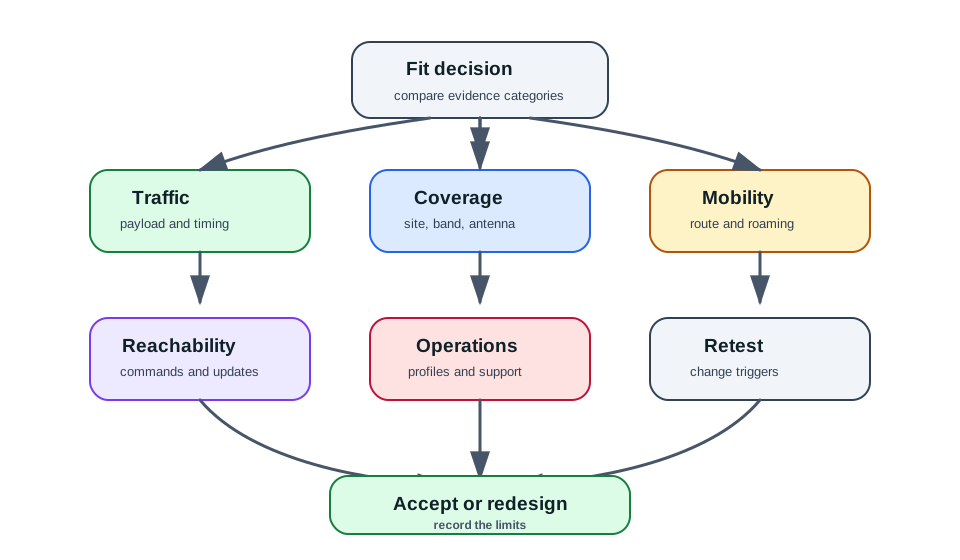
Those labelled dimensions show why an operator-backed service must be accepted through an evidence record and retested when a route, profile, payload, or deployment site changes.

  • Those labels explain cellular technology fit evidence map connecting traffic, coverage, mobility, reachability, operations, retest triggers, and accept-or-redesign limits.
Cellular technology fit evidence map connecting traffic, coverage, mobility, reachability, operations, retest triggers, and accept-or-redesign limits.
iotclass.org

Major section

Under the Hood: Identity, Radio Access, Power Modes, and Data Paths

Even HD video ~5 Mbps needs under a thousandth of that headline, and the bars themselves are shared-cell lab peaks, not per-device promises.

  • A category chosen from the top of the ladder is usually a battery budget quietly thrown away.

Numbers to remember

~5 MbpsEven HD video ~5 Mbps needs under a thousandth of that headline
Peak-rate headlines against the throughput real IoT workloads use — three orders of magnitude apart, by design.
iotclass.org

Major section

Start With the Story

Cellular IoT is the choice to borrow a managed wide-area network instead of building one.

  • 3G's spectrum is mostly refarmed already.
  • The green 4G strip names the current workhorses, LTE-M and NB-IoT, which is why this module keeps returning to those two categories rather than to headline rates.
Five cellular generations in review terms: what each one enabled, its headline rates, and its honest IoT status today.
iotclass.org

Major section

Summary

Cellular IoT uses operator mobile networks to connect distributed, mobile, or customer-site devices without a private gateway network.

  • That convenience adds obligations: technology fit, operator support, SIM or eSIM lifecycle, antenna validation, power-mode evidence, data budgeting, certification and firmware planning, support diagnostics, and lifecycle review.
  • NB-IoT, LTE-M, LTE Cat-1 class devices, 5G device categories, RedCap, and private cellular are not interchangeable defaults.
  • The right option is the one that matches the service contract and survives final-device pilot evidence.
iotclass.org

Deck summary

Key takeaways

The team must decide whether a mobile operator's service fits the whole device life.

  • Last, choose choose a mobile service, narrow the claim, change the device, or use another link.
  • Under the Hood adds radio access, identity, power modes, data paths, sleep, reach, and network change.
  • A missing result is also useful news when the system shows it at once.
  • Those labelled dimensions show why an operator-backed service must be accepted through an evidence record and retested when a route, profile, payload, or deployment site changes.
iotclass.org

Retrieval practice

Recall check 1 of 3

Radio Remi says: answer from memory, then check your reasoning.

Q1A municipal water-meter prototype connects from a lab bench, and a nearby phone shows good signal outside the building. What is the strongest cellular IoT review response?

ATreat lab result as narrow; require final-meter site, power, operator, and recovery evidence
BApprove the full deployment because cellular coverage has already been proven
CSkip SIM lifecycle planning because the network already accepted the prototype
DChoose a high-throughput LTE Cat 4 module for every meter because a larger data category will minimize battery use and service cost.
Show answer

Answer: A A lab connection and a phone signal do not prove the meter in its final enclosure, installation point, service profile, and power policy.

iotclass.org

Retrieval practice

Recall check 2 of 3

Radio Remi says: answer from memory, then check your reasoning.

Q2A team wants to buy fleet hardware after one successful desk test with a development board and starter SIM. What should the cellular IoT feasibility record require first?

ARequire a final-device pilot with sites, current traces, data use, and diagnostics
BImmediate procurement because the module has already shown it can attach to a network
CIncrease the data plan to cover retries, then rely on the operator's managed network for deployment readiness.
DA public coverage map, because maps are more representative than measured final-device pilots
Show answer

Answer: A A desk test is useful but too narrow.

iotclass.org

Retrieval practice

Recall check 3 of 3

Radio Remi says: answer from memory, then check your reasoning.

Q3A cellular IoT device attached to the network and opened a packet data session during a lab test. Which conclusion is too broad without more evidence?

AThe fleet is ready across target sites
BThe modem could register under the tested lab conditions
CFurther site or route pilots may be needed before procurement
DThe support record should still separate RF, SIM, APN, cloud, firmware, and power failures
Show answer

Answer: A A lab attach supports a narrow network observation.

iotclass.org

Print reference

Answers

Answer key.

  1. A · A lab connection and a phone signal do not prove the meter in its final enclosure, installation point, service profile, and power policy.
  2. A · A desk test is useful but too narrow.
  3. A · A lab attach supports a narrow network observation.
iotclass.org