Cellular IoT · Study deck

Choosing NB-IoT or LTE-M

A tracker on a chilled delivery van sends temperature alarms and receives a request for a diagnostic upload.

Radio Remi is your guide for this deck.

nbiotltemcomparison
Radio Remi, the module guide, in a scene from this chapter.
iotclass.org

After studying this chapter

Learning objectives

You will be able to:

  • Explain: The mathematical gist.: A 128-repeat baseline has 21.1 dB of ideal combining gain, consistent with the chapter's 20 dB extended-coverage comparison.
  • Explain: NB-IoT is often the first pilot for fixed, compact, delay-tolerant telemetry where operator support exists and coverage depth dominates the risk.
  • Explain: Narrowband Internet of Things (NB-IoT) and Long Term Evolution for Machines (LTE-M) are two cellular options for small connected devices.
  • Explain: LTE-M is often the first pilot for connected mobility, bounded response, richer diagnostics, update traffic, or verified voice-capable service.
iotclass.org

Major section

Overview: Choose From the Service Contract
A payload is the useful content carried in a message.

  • Telemetry is a time-linked record of a device or process.
  • Narrowband Internet of Things (NB-IoT) and Long Term Evolution for Machines (LTE-M) are two cellular options for small connected devices.
  • One stays in a basement and sends a few small readings each day.

Key terms

Firmware
Firmware is the software stored inside a device.

Numbers to remember

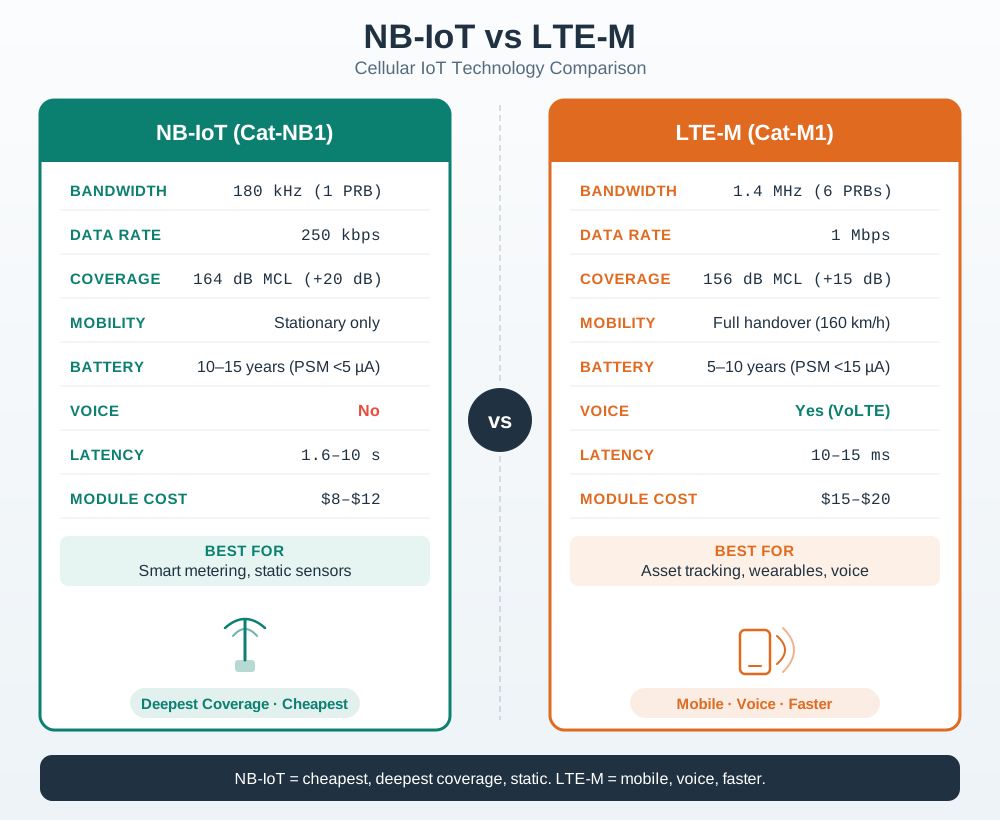
180 kHzwhile 180 kHz (1 PRB) shows why their fit differs.
NB-IoT vs LTE-M: Cellular IoT Technology Comparison, NB-IoT (Cat-NB1), BANDWIDTH, 180 kHz (1 PRB), DATA RATE, 250 kbps, COVERAGE, 164 dB MCL (+20 dB), MOBILITY
iotclass.org

Major section

Overview: Choose From the Service Contract (continued)

The deeper sections compare the radio methods, power behaviour, mobility, and retest triggers when the fleet or service changes.

  • The other moves between sites and needs prompt fault details and larger updates.
  • The same cellular choice may not fit both jobs.
  • No table can promise local operator features or future coverage.
iotclass.org

Major section

Phoebe's Field Notes: The +20 dB in This Chapter's Own Coverage Number

The mathematical gist.: A 128-repeat baseline has 21.1 dB of ideal combining gain, consistent with the chapter's 20 dB extended-coverage comparison.

  • That halves the repetition-dominated radio-energy share, not total device energy.
iotclass.org

Major section

Compare the Cold-Chain Command Window
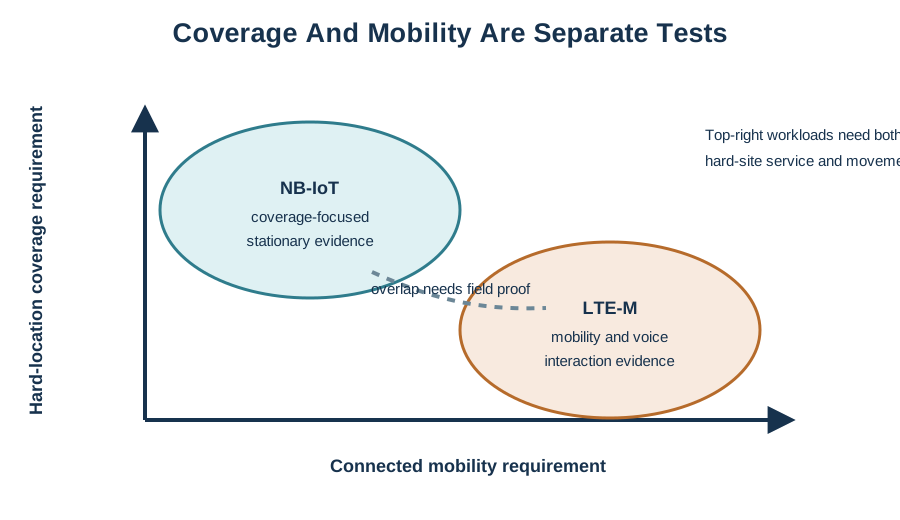
If the command arrives just after a check, the next opportunity is almost 300 s away, before transfer delay.

  • The profile therefore misses the requirement even if the active radio link is fast.
  • Changing the name of the radio does not fix a sleep policy that offers no timely opportunity to receive.

Numbers to remember

12,000 bytesFor a second comparison, suppose each diagnostic payload is 12,000 bytes.
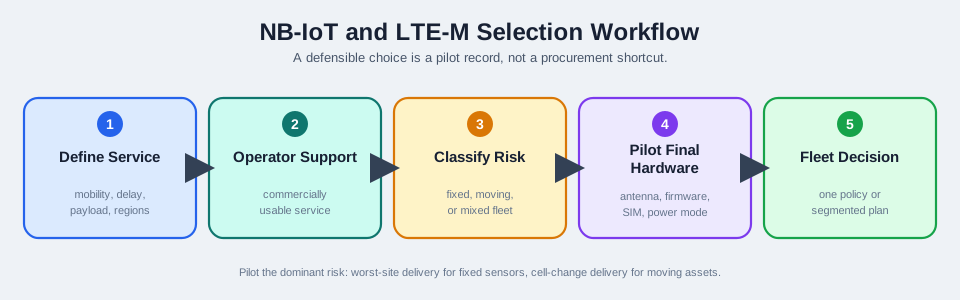
NB-IoT and LTE-M selection workflow: define the service, check operator support, classify risk, pilot final hardware, and approve a fleet decision.
iotclass.org

Major section

Compare the Cold-Chain Command Window (continued)

For a second comparison, suppose each diagnostic payload is 12,000 bytes.

  • At an illustrative measured useful transfer rate of 2,000 bytes per second, the transfer alone takes 6 s.
  • At 500 bytes per second it takes 24 s.
  • The moving service also needs route coverage and power evidence.
iotclass.org

Major section

Compare the Cold-Chain Command Window (continued)

The receiving workflow should show the event time and the delayed arrival.

  • Route tests then establish delivery continuity while moving; a stationary signal reading cannot supply that evidence.
  • Conversely, a slow but reliable fixed logger may meet its own delayed-reporting requirement.
  • It should not replace the old timestamp with the upload time.
iotclass.org

Major section

Summary

NB-IoT and LTE-M are complementary cellular IoT choices.

  • NB-IoT is often the first pilot for fixed, compact, delay-tolerant telemetry where operator support exists and coverage depth dominates the risk.
  • LTE-M is often the first pilot for connected mobility, bounded response, richer diagnostics, update traffic, or verified voice-capable service.
  • Mixed fleets may need dual-mode hardware, regional variants, or segmented policy.
iotclass.org

Deck summary

Key takeaways

A payload is the useful content carried in a message.

  • The deeper sections compare the radio methods, power behaviour, mobility, and retest triggers when the fleet or service changes.
  • The mathematical gist.: A 128-repeat baseline has 21.1 dB of ideal combining gain, consistent with the chapter's 20 dB extended-coverage comparison.
  • If the command arrives just after a check, the next opportunity is almost 300 s away, before transfer delay.
  • For a second comparison, suppose each diagnostic payload is 12,000 bytes.
iotclass.org

Retrieval practice

Recall check 1 of 3

Radio Remi says: answer from memory, then check your reasoning.

Q1A fixed basement meter sends a small reading a few times per day, and commands can wait until the next scheduled wake. The target operator supports NB-IoT at the pilot sites. What is the most defensible first test?

AStart with NB-IoT; prove worst-site delivery and current traces.
BStart with LTE-M to preserve connected mobility for later deployments.
CUse whichever technology appears on a coverage map without installed-device testing.
DChoose dual-mode hardware and skip per-mode validation.
Show answer

Answer: A Fixed compact telemetry with delayed downlink and difficult coverage is a strong NB-IoT first-test case when operator support exists.

iotclass.org

Retrieval practice

Recall check 2 of 3

Radio Remi says: answer from memory, then check your reasoning.

Q2A logistics tracker must report exceptions while moving through multiple cells. What is the strongest reason to evaluate LTE-M first?

ALTE-M fits first because mobility and bounded response are requirements.
BLTE-M should be accepted after one operator route because the modem stayed registered during that drive.
CNB-IoT cannot send location data at all.
DLTE-M can skip sleep-current tests because route exceptions are more important than battery life.
Show answer

Answer: A The service contract includes movement and bounded response, so the pilot should test behavior during movement.

iotclass.org

Retrieval practice

Recall check 3 of 3

Radio Remi says: answer from memory, then check your reasoning.

Q3A prototype registers in the lab on both NB-IoT and LTE-M. The team wants to approve the final fleet from that result alone. What is the safest review response?

AApprove both modes and defer site checks until deployment, since lab registration confirms network compatibility.
BApprove NB-IoT after a sleep-current trace, without checking retries, coverage depth, or attach behavior.
CDelay approval until final hardware, service, power, payload, and site evidence.
DApprove LTE-M after one downlink test while awake, without checking the promised sleep-state reachability.
Show answer

Answer: C Lab registration is useful, but it does not prove deployment behavior across installed RF path, service profile, current trace, and operations evidence.

iotclass.org

Print reference

Answers

Answer key.

  1. A · Fixed compact telemetry with delayed downlink and difficult coverage is a strong NB-IoT first-test case when operator support exists.
  2. A · The service contract includes movement and bounded response, so the pilot should test behavior during movement.
  3. C · Lab registration is useful, but it does not prove deployment behavior across installed RF path, service profile, current trace, and operations evidence.
iotclass.org