Cellular IoT · Study deck
Practice: LTE-M Power Modes and Coverage
Picture a mobile medical case that reports temperature while travelling.
Radio Remi is your guide for this deck.
After studying this chapter
Learning objectives
You will be able to:
- Trace an LTE-M device from cell search through registration and packet-data readiness.
- Explain why LTE-M is often selected for mobile or more responsive IoT devices.
- Compare PSM and eDRX as design choices rather than fixed battery-life guarantees.
- Decide when a compact uplink should use a control-plane style path and when a user-plane data session is a better model.
Major section
Start With the Story
This opening does not predict every operator or battery.
- Its radio must wake, find service, send one small record, wait for any reply, and return to deep sleep.
- The field team must know whether the message arrives soon enough without draining the battery.
- Each state costs time and current, so the lab should make the trade-off visible.
Major section
Phoebe's Field Notes: Why a Moving Tracker Should Distrust a High-Gain Antenna
An 8 dBi patch reaches 31 dBm on-axis, but the Kraus estimate gives only an 80.9° symmetric beam.
- That pattern estimate is a route-test hypothesis, not an antenna certificate.
Major section
Overview: LTE-M Claims Need A Session Record
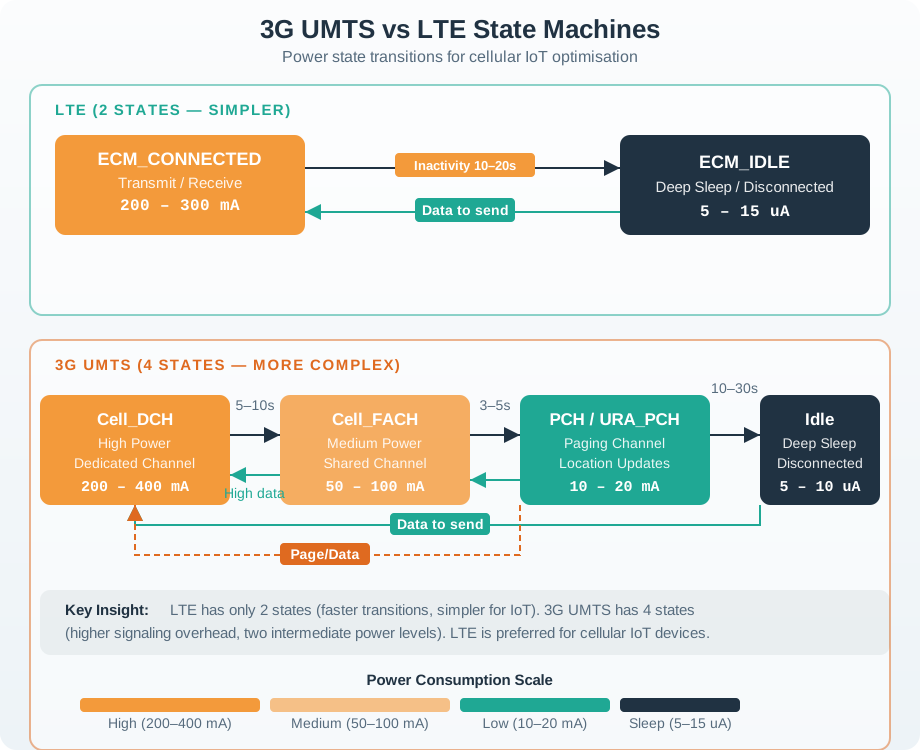
A live link passes through more states before idle.
- The delay and current bands show why a low sleep value cannot describe the full session.
- The field record adds times for attach, traffic, release, and idle entry.
- This reveals a slow release, a failed state change, or a sound sleep period.
Major section
Key Concepts
EPS bearer / packet data context: The network data session that gives the device an IP path through the LTE packet core.
- User-plane data: A normal IP data path that is better for larger payloads, frequent transfers, or longer sessions.
- PSM (Power Saving Mode): A deep sleep state that reduces energy use but makes the device unreachable until it wakes or performs a network update.
- Control-plane optimization: A method for small data where payloads can be carried with signaling to reduce setup overhead in supported deployments.
Deck summary
Key takeaways
This opening does not predict every operator or battery.
- An 8 dBi patch reaches 31 dBm on-axis, but the Kraus estimate gives only an 80.9° symmetric beam.
- A live link passes through more states before idle.
- EPS bearer / packet data context: The network data session that gives the device an IP path through the LTE packet core.
Retrieval practice
Recall check 1 of 3

Radio Remi says: answer from memory, then check your reasoning.
Q1An LTE-M lab shows a modem attaching and sending one payload. What record should the team build before treating that result as deployment evidence?
Show answer
Answer: B LTE-M lab approval should connect attach evidence, RRC and packet-context state, SIM or eSIM identity, power-mode timing, payload success, mobility condition, and measured current before the result is used beyond the bench.
Retrieval practice
Recall check 2 of 3
Radio Remi says: answer from memory, then check your reasoning.
Q2A tracker moves between cities and must report route exceptions while it is in motion. Why is LTE-M a defensible first technology to test?
Show answer
Answer: C LTE-M is usually tested first for mobile or more responsive devices, but real behavior must be measured with the intended hardware, SIM profile, antenna, operator, and power mode.
Retrieval practice
Recall check 3 of 3
Radio Remi says: answer from memory, then check your reasoning.
Q3Complete the state transition helper for the LTE-M lab model:
Show answer
Answer: A The helper follows the lab model: search leads to registration, registration leads to data readiness, compact payloads can use a compact path where supported, and larger payloads use a normal data session.
Print reference
Answers 1 of 2
Answer key.
- B · LTE-M lab approval should connect attach evidence, RRC and packet-context state, SIM or eSIM identity, power-mode timing, payload success, mobility condition, and measured current before the result is used beyond the bench.
- C · LTE-M is usually tested first for mobile or more responsive devices, but real behavior must be measured with the intended hardware, SIM profile, antenna, operator, and power mode.
Print reference
Answers 2 of 2
Answer key.
- A · The helper follows the lab model: search leads to registration, registration leads to data readiness, compact payloads can use a compact path where supported, and larger payloads use a normal data session.