Cellular IoT · Study deck

Building Cellular IoT Devices

Picture a flood gauge that wakes every hour, joins a mobile network, sends a level, and returns to sleep.

Radio Remi is your guide for this deck.

implementations
Radio Remi, the module guide, in a scene from this chapter.
iotclass.org

After studying this chapter

Learning objectives

You will be able to:

  • Translate a cellular IoT plan into hardware, firmware, SIM, and cloud implementation tasks.
  • Select a module capability class without depending on stale product or price claims.
  • Bring up a modem with a measured power rail, antenna path, SIM or eSIM profile, serial interface, and AT-command state machine.
  • Configure network registration, packet data context, APN, diagnostics, and payload delivery in a repeatable order.
iotclass.org

Major section

Start With the Story

On the bench it works from a strong supply.

  • In the field it restarts during the first radio burst and loses the reading.
  • The device team must prove the whole loop under the real power and signal range.
  • A successful network join does not prove message delivery, a correct cloud record, or safe field life.

Key terms

Building a cellular device
Building a cellular device means turning a modem, firmware task, SIM profile, antenna, payload, and cloud endpoint into one reliable path.
iotclass.org

Major section

Phoebe's Field Notes: What "Unattached or Mismatched" Actually Costs

The mathematical gist.: At VSWR 1.5:1, the reflection coefficient is 0.200, so 4.00% of forward power reflects and mismatch loss is 0.177 dB.

  • At 3:1, 25.0% reflects and loss is 1.25 dB.

Numbers to remember

4.00%so 4.00% of forward power reflects
0.177 dBmismatch loss is 0.177 dB.
25.0%25.0% reflects and loss is 1.25 dB.
iotclass.org

Major section

Repeatable Bring-Up Evidence Flow
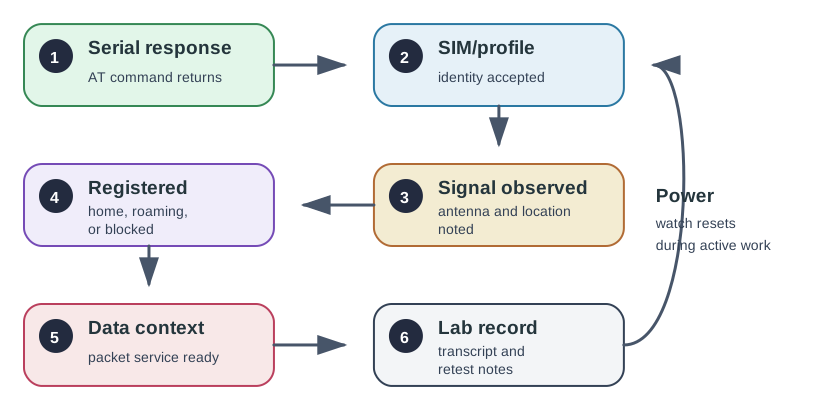
Pilot readiness means the same hardware, firmware, identity, antenna, power rail, and network path can be brought up repeatedly with bounded timeouts and useful diagnostics.

  • The implementation job is to turn a radio module into an operated system: a device that can register, authenticate, send data, sleep, recover, update, and explain failures after it leaves the lab.

Key terms

SIM/profile
SIM/profile is the next observable state, and Signal observed is the later gate or destination.
Signal observed
Signal observed is the later gate or destination.
Cellular modem bring-up evidence flow showing serial response, SIM or profile readiness, signal observation, registration, data context, power observation, and lab record.
iotclass.org

Major section

Repeatable Bring-Up Evidence Flow (continued)

The progression represents cellular modem bring-up evidence flow showing serial response, SIM or profile readiness, signal observation, registration, data context, power observation, and lab record.

  • The chapter’s repeatable bring-up evidence flow narrative uses that order to localise failures and assign retest evidence.
  • That order protects the team from false fixes.
  • If the module resets during a burst, an APN edit is irrelevant.
iotclass.org

Major section

URC State-Machine Review

A robust host moves through power, SIM readiness, registration, packet context, transport, payload, sleep, and recovery states with bounded timeouts.

  • Cellular modules do not behave like simple serial sensors.
  • It records both the command response and the modem events that happened around the command.
  • For example, a registration wait should not block forever.

Why it matters

URCs make this especially important because the modem can report a network change while the host is preparing a payload or waiting for a socket response.

iotclass.org

Deck summary

Key takeaways

On the bench it works from a strong supply.

  • The mathematical gist.: At VSWR 1.5:1, the reflection coefficient is 0.200, so 4.00% of forward power reflects and mismatch loss is 0.177 dB.
  • Pilot readiness means the same hardware, firmware, identity, antenna, power rail, and network path can be brought up repeatedly with bounded timeouts and useful diagnostics.
  • The progression represents cellular modem bring-up evidence flow showing serial response, SIM or profile readiness, signal observation, registration, data context, power observation, and lab record.
  • A robust host moves through power, SIM readiness, registration, packet context, transport, payload, sleep, and recovery states with bounded timeouts.
iotclass.org

Retrieval practice

Recall check 1 of 3

Radio Remi says: answer from memory, then check your reasoning.

Q1A prototype board sends one sensor payload through a cellular module. What implementation record should exist before the design moves to pilot?

ARecord module, firmware, antenna, power, SIM/eSIM, APN, retries, and owner.
BChoose a cellular option because coverage exists on a map or a phone works nearby.
CUse one lab modem session as proof for coverage, mobility, sleep behavior, data cost, and recovery behavior.
DPostpone operator, SIM, certification, and support records until devices are installed.
Show answer

Answer: A A cellular implementation record should connect the module build, antenna and power design, SIM/APN provisioning, modem state machine, payload delivery, current trace, update plan, and diagnostic ownership before pilot rollout.

iotclass.org

Retrieval practice

Recall check 2 of 3

Radio Remi says: answer from memory, then check your reasoning.

Q2A utility meter is installed in basements, sends a small reading four times per day, and should sleep most of the time. The local operator supports both NB-IoT and LTE-M at the pilot sites. Which first implementation path is easiest to defend?

AUse NB-IoT and prove basement delivery plus current traces
BUse broadband LTE because it gives the largest throughput margin
CChoose the lowest-priced development module and copy its example sketch
DUse LTE-M to shorten the response time for meter commands
Show answer

Answer: A A fixed low-data meter with basement coverage requirements usually starts with an NB-IoT-focused implementation when local operator support exists.

iotclass.org

Retrieval practice

Recall check 3 of 3

Radio Remi says: answer from memory, then check your reasoning.

Q3Complete the Python skeleton for a simple modem bring-up state machine:

Amodem.expect_ok('AT', timeout=2)
Bmodem.send_payload('AT')
Cmodem.disable_power_rail('AT')
Dmodem.open_cloud_socket('AT')
Show answer

Answer: A A defensible modem driver confirms basic command response, SIM readiness, network registration, packet context configuration, and context activation before returning diagnostics to the application.

Q4A cellular IoT prototype works when an engineer types AT commands manually, but field units sometimes stop uploading after weak coverage. What should be fixed before pilot release?

AAdd firmware state handling and recovery
BRemove diagnostics to reduce every payload
CTrust carrier coverage maps for the site
DSkip SIM and APN checks after one upload
Show answer

Answer: A Manual terminal success does not prove pilot readiness.

iotclass.org

Print reference

Answers 1 of 2

Answer key.

  1. A · A cellular implementation record should connect the module build, antenna and power design, SIM/APN provisioning, modem state machine, payload delivery, current trace, update plan, and diagnostic ownership before pilot rollout.
  2. A · A fixed low-data meter with basement coverage requirements usually starts with an NB-IoT-focused implementation when local operator support exists.
  3. A · A defensible modem driver confirms basic command response, SIM readiness, network registration, packet context configuration, and context activation before returning diagnostics to the application.
iotclass.org

Print reference

Answers 2 of 2

Answer key.

  1. A · Manual terminal success does not prove pilot readiness.
iotclass.org