Cellular IoT · Study deck
eSIM and Global IoT Deployment
A refrigerated container may cross three mobile networks without anyone opening its sealed tracker.
Radio Remi is your guide for this deck.

After studying this chapter
Learning objectives
You will be able to:
- Explain: The radio may still work, yet the device can lose service if it has the wrong mobile profile, no allowed network, or no safe way to change its account.
- Explain: A global device can occupy one state in the eSIM platform and another in the operator or asset service, so reconciliation must use timestamps and identifiers.
- Explain: For overview: esim moves sim work into operations, this ordering tells the team where to capture logs and where to stop on failure.
- Explain: The eSIM hardware, downloaded deployment profile, modem, tracker asset, and cloud record each have an identifier.
Major section
Follow a Container Through Its Deployment profile Change
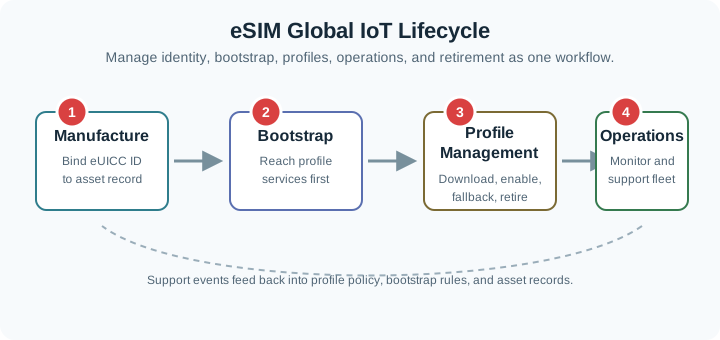
End at steady service, later change, and retirement.
- The eSIM platform verifies that U is authorized for this global device, installs it, and reports the result.
- Operations enable U only after the download is complete, then check data registration and one application message.
- Operator coverage, roaming agreements, modem firmware, and eSIM platform behavior vary.
Major section
Follow a Container Through Its Deployment profile Change (continued)
If that check fails, policy keeps B available for recovery rather than deleting the only working route.
- The eSIM hardware, downloaded deployment profile, modem, tracker asset, and cloud record each have an identifier.
- Bind them in an inventory so an operator can answer which physical container used which deployment profile at a given time.
- A deployment profile download receipt without the tracker mapping is not enough to investigate traffic or revoke access.
Major section
Follow a Container Through Its Deployment profile Change (continued)
Global policy should name allowed countries or networks, roaming limits, data ceilings, deployment profile priority, and who may trigger a change.
- It should also state what happens when the global device is offline, asleep, low on power, or unable to attach.
- A mass switch sent to an unreachable fleet is a pending operation, not a completed migration.
- With B active, expect CT-204 to download U and keep B installed.
Major section
Follow a Container Through Its Deployment profile Change (continued)
Fleet rollout should begin with a small named cohort.
- A global device can occupy one state in the eSIM platform and another in the operator or asset service, so reconciliation must use timestamps and identifiers.
- Retirement should prevent the old tracker from attaching or reaching its application while preserving required audit records.
- Switching operator access should not duplicate cloud identities or leave an old global device token active.
Major section
Overview: eSIM Moves SIM Work into Operations
The radio may still work, yet the device can lose service if it has the wrong mobile profile, no allowed network, or no safe way to change its account.
- The support team must be able to tell which state failed.
- An eSIM stores mobile access profiles in built-in secure hardware.
Major section
Overview: eSIM Moves SIM Work into Operations (continued)
Profile changes, monitoring, and retirement then remain operational responsibilities after shipment.
- A remote change can also strand a device if the old and new paths both fail.
- Under the Hood follows remote profile control and the events that should trigger a new test.
- The device needs a first path to profile-management services.
Major section
Overview: eSIM Moves SIM Work into Operations (continued)
Bind eUICC ID creates the identity-to-product record before: Bootstrap connectivity can obtain or activate the intended profile.
- The sequence explains why eSIM removes a physical swap without removing lifecycle ownership or evidence.
- For overview: esim moves sim work into operations, this ordering tells the team where to capture logs and where to stop on failure.
- Without that path, the target profile cannot be downloaded or enabled in the field.
Deck summary
Key takeaways
End at steady service, later change, and retirement.
- If that check fails, policy keeps B available for recovery rather than deleting the only working route.
- Global policy should name allowed countries or networks, roaming limits, data ceilings, deployment profile priority, and who may trigger a change.
- Fleet rollout should begin with a small named cohort.
- The radio may still work, yet the device can lose service if it has the wrong mobile profile, no allowed network, or no safe way to change its account.
Retrieval practice
Recall check 1 of 3

Radio Remi says: answer from memory, then check your reasoning.
Q1A vaccine-fridge vendor plans unattended cellular sensors for clinics in three countries. The modem data sheet says eSIM, and one factory unit attached on the home network. What should still block release?
Show answer
Answer: A A global eSIM design is accepted by lifecycle proof: bootstrap, provisioning model, policy, routing, recovery, and retirement.
Retrieval practice
Recall check 2 of 3

Radio Remi says: answer from memory, then check your reasoning.
Q2A cross-region tracker attaches after activation, but the asset database still lists the bootstrap profile as active. What is the best next action?
Show answer
Answer: A Operational profile state has to agree across device, platform, operator, and asset systems.
Retrieval practice
Recall check 3 of 3

Radio Remi says: answer from memory, then check your reasoning.
Q3A device has an operational profile installed and enabled, but telemetry still fails after a profile change. Which distinction matters most?
Show answer
Answer: A Remote SIM provisioning controls subscription profile state, but operational acceptance also needs attachment, route, telemetry, and recovery checks.
Print reference
Answers
Answer key.
- A · A global eSIM design is accepted by lifecycle proof: bootstrap, provisioning model, policy, routing, recovery, and retirement.
- A · Operational profile state has to agree across device, platform, operator, and asset systems.
- A · Remote SIM provisioning controls subscription profile state, but operational acceptance also needs attachment, route, telemetry, and recovery checks.