Cellular IoT · Study deck

Cellular IoT Deployment Planning

A street of water meters regains power at the same instant.

Radio Remi is your guide for this deck.

deploymentplanning
Radio Remi, the module guide, in a scene from this chapter.
iotclass.org

After studying this chapter

Learning objectives

You will be able to:

  • Explain: If all firmware timers fire within 10 s, the average initial attempt rate is 600 divided by 10 s = 60 attempts per second.
  • Explain: This makes cellular IoT deployment review workflow from requirements and site classes through measurements, connectivity selection, pilot, operations, and release decision actionable.
  • Explain: The later measurement, pilot, and operations gates preserve why a chosen connectivity path was accepted and what change would force a retest.
  • Explain: For example, a meter fleet that sends one small reading per day may look negligible in a data-plan spreadsheet.
iotclass.org

Major section

Overview: Deployment Evidence Comes Before Procurement
Its final home is a steel box in a basement.

  • Buying ten thousand units before that site test would turn one guess into a fleet risk.
  • Firmware is the software stored on the device.
  • A payload is the useful data carried in a message.
  • One good site does not approve every site.

Key terms

payload
payload is the useful data carried in a message.
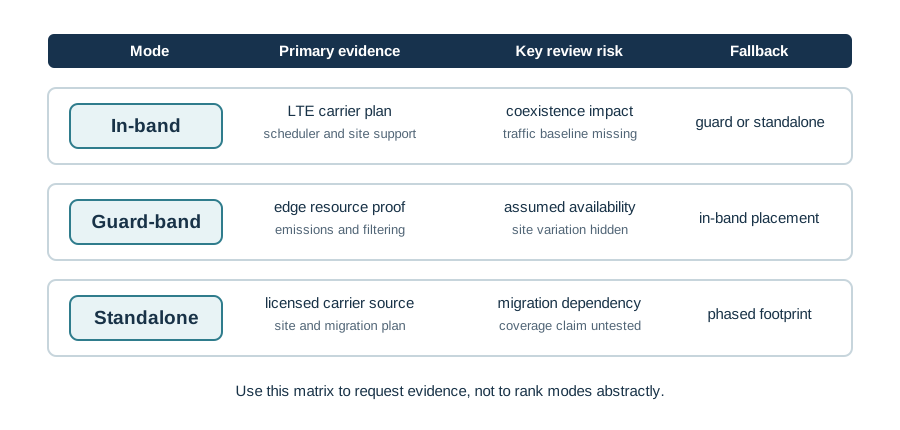
Cellular IoT deployment evidence matrix linking site survey, radio behavior, connectivity lifecycle, data budget, operations, and rollout gate evidence.
iotclass.org

Major section

Overview: Deployment Evidence Comes Before Procurement (continued)

The plan must name its limits and retest triggers.

  • Practitioner builds the rollout and support record.
  • Under the Hood covers radio load, control traffic, power states, and operator change.
  • Those details can narrow the approved class.
  • They do not make a coverage map proof of an installed device.
iotclass.org

Major section

Practitioner: Build the Deployment Release Record
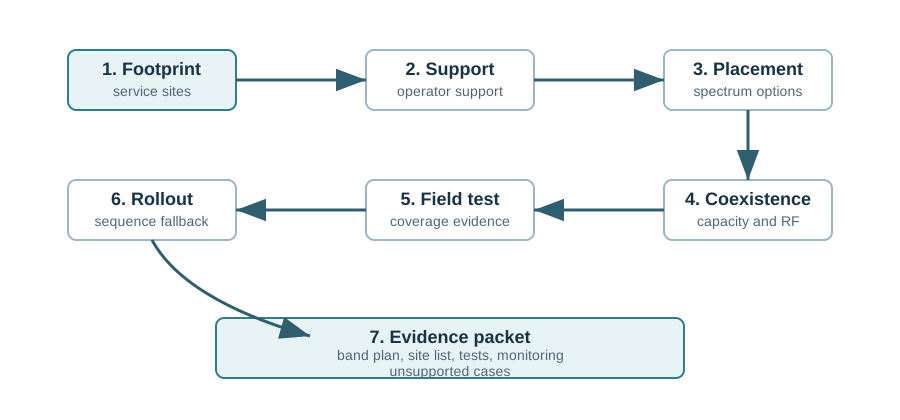
Placement then tests the installed antenna and enclosure context.

  • The later measurement, pilot, and operations gates preserve why a chosen connectivity path was accepted and what change would force a retest.
  • The decision starts with 1.
  • Placement is one consequence of that answer.
Cellular IoT deployment review workflow from requirements and site classes through measurements, connectivity selection, pilot, operations, and release decision.
iotclass.org

Major section

Practitioner: Build the Deployment Release Record (continued)

This makes cellular IoT deployment review workflow from requirements and site classes through measurements, connectivity selection, pilot, operations, and release decision actionable.

  • The result is cellular IoT deployment risk record showing dominant risk, evidence required, accepted mitigation, owner, and retest trigger.
  • A cellular fleet can overload signalling resources even when every application payload is small.
  • For example, a meter fleet that sends one small reading per day may look negligible in a data-plan spreadsheet.
iotclass.org

Major section

Under the Hood: Why Cellular Plans Fail in the Field
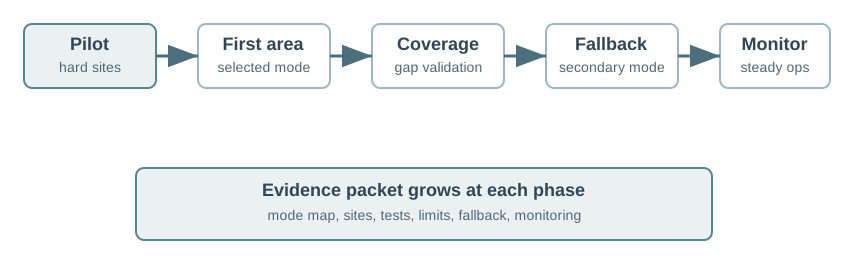
Survey, pilot, provisioning, and observability evidence follow before release, with explicit stop or rollback points.

  • The move to: Requirements & shortlist creates the next obligation, and: Set mobility / update limits. Shows the downstream acceptance point.
Evidence-led cellular IoT rollout loop from bounded requirements and survey through pilot, provisioning, observability, staged stop-or-rollback decisions, named operations handoff, and explicit change-triggered rechecks.
iotclass.org

Major section

Phoebe's Field Notes: Why the Basement Cabinet Antenna Can Afford to Aim

The mathematical gist.: A 23 dBm module with a cabinet-detuned −2 dBi antenna reaches 21 dBm EIRP.

  • The Kraus estimate gives a 114° symmetric beam and about 57° half-beam.
  • Those figures guide an aiming test; they do not replace the installed pattern or operator limits.
iotclass.org

Major section

Reconnect the Estate without Repeating the Outage

If all firmware timers fire within 10 s, the average initial attempt rate is 600 divided by 10 s = 60 attempts per second.

  • This arithmetic describes the offered load; it does not claim that either rate is acceptable to a particular operator.
  • A test with a different enclosure cannot silently approve the installed fleet.

Why it matters

The plan may reduce the batch size or pause the next cohort while the backlog drains.

Cellular IoT deployment review workflow from requirements and site classes through measurements, connectivity selection, pilot, operations, and release decision.
iotclass.org

Major section

Reconnect the Estate without Repeating the Outage (continued)

In the first case, the cohort could offer 2,400 attempts in a short interval.

  • Buying an operator plan with a larger payload allowance does not solve this control-traffic problem.
  • The firmware needs bounded retries and spacing that persists through the failure being tested.
  • If every reboot resets the timer to the same value, a power fault can recreate the burst after each restart.
iotclass.org

Major section

Reconnect the Estate without Repeating the Outage (continued)

Footprint identifies the affected site class; support establishes who can interpret network failures; placement fixes the antenna configuration.

  • Measurement and pilot evidence then show whether the recovery schedule works for that class.
  • The firmware may report an attached modem while the application path still fails to deliver.
  • The example rates are test inputs; operator limits must come from the service actually purchased.
iotclass.org

Deck summary

Key takeaways

Its final home is a steel box in a basement.

  • The plan must name its limits and retest triggers.
  • Placement then tests the installed antenna and enclosure context.
  • This makes cellular IoT deployment review workflow from requirements and site classes through measurements, connectivity selection, pilot, operations, and release decision actionable.
  • Survey, pilot, provisioning, and observability evidence follow before release, with explicit stop or rollback points.
iotclass.org

Retrieval practice

Recall check 1 of 3

Radio Remi says: answer from memory, then check your reasoning.

Q1A smart-meter team has a successful lab demo and public carrier coverage maps, but the devices will be mounted inside basement utility cabinets. What evidence is still missing before procurement?

AA site survey and pilot with the final device in representative cabinet locations
BA decision to increase telemetry frequency so each device sends more packets
CA claim that any cellular option is acceptable because cellular coverage exists nearby
DA procurement shortcut that orders the cheapest plan before the pilot
Show answer

Answer: A Deployment planning accepts coverage with installed evidence, not with a map or a bench test alone.

iotclass.org

Retrieval practice

Recall check 2 of 3

Radio Remi says: answer from memory, then check your reasoning.

Q2A cross-border fleet has mostly predictable low telemetry, but a smaller group of devices needs frequent diagnostics during exceptions. Which deployment record is easiest to defend?

AUse one uniform plan for every device because uniform billing always reduces fleet risk
BSegment by behavior and support needs, then set policies for each segment
CAvoid a pilot because cross-border behavior can be inferred from the plan description
DChoose the lowest advertised data price and postpone support workflow design
Show answer

Answer: B When fleet behavior differs, the deployment record should expose the segments and match policy to evidence.

iotclass.org

Retrieval practice

Recall check 3 of 3

Radio Remi says: answer from memory, then check your reasoning.

Q3A battery cellular device must sometimes receive server commands, but the proposed power policy keeps it in deep sleep most of the day. What should the deployment review do?

AApprove the plan because low sleep current is the only battery-life criterion
BTest reachability under the chosen sleep policy and define queued or delayed commands
CIgnore server commands during pilot testing because radio attach already worked once
DIncrease firmware logging without a data budget so missed commands are easier to debug
Show answer

Answer: B Deployment readiness requires the power policy, reachability requirement, retry behavior, and service workflow to be tested together.

iotclass.org

Print reference

Answers

Answer key.

  1. A · Deployment planning accepts coverage with installed evidence, not with a map or a bench test alone.
  2. B · When fleet behavior differs, the deployment record should expose the segments and match policy to evidence.
  3. B · Deployment readiness requires the power policy, reachability requirement, retry behavior, and service workflow to be tested together.
iotclass.org