Cellular IoT · Study deck

Matching Apps to Cellular Tech

A basement water meter may send a daily total yet need to report a broken seal promptly.

Radio Remi is your guide for this deck.

Radio Remi, the module guide, in a scene from this chapter.
iotclass.org

After studying this chapter

Learning objectives

You will be able to:

  • Explain: Its labelled evidence shows smart metering architecture with utility meter, MCU, NB-IoT module, cellular network, and utility backend, the distinction that anchors practitioner: review use cases as evidence patterns.
  • Explain: A modem that sleeps for long intervals can save energy, but a pending command cannot be assumed to reach it at once.
  • Explain: Those labels make smart metering architecture with utility meter, MCU, NB-IoT module, cellular network, and utility backend concrete.
  • Explain: The worked byte counts are illustrative; operator support and the modem's measured current profile decide the deployed behaviour.
iotclass.org

Major section

Start With the Story

Every cellular Internet of Things (IoT) application has a rhythm.

  • A payload is the useful data inside a message.
  • A gateway is a device that passes data between different networks.
  • A utility meter, asset tracker, industrial gateway, and safety monitor each send different payloads.
  • They also tolerate different delays and need different support when a link fails.
iotclass.org

Major section

Phoebe's Field Notes: Antenna Gain vs. Repetition Count in a Basement Meter

The mathematical gist.: An illustrative 8 dBi installed antenna improvement is a 6.31× ideal combining factor.

  • Starting from 128 repeats gives 20.3 ideal repeats.

Numbers to remember

9.03 dB16 would require 9.03 dB
8 dBand would underpay the stated 8 dB margin.
iotclass.org

Major section

Practitioner: Review Use Cases As Evidence Patterns
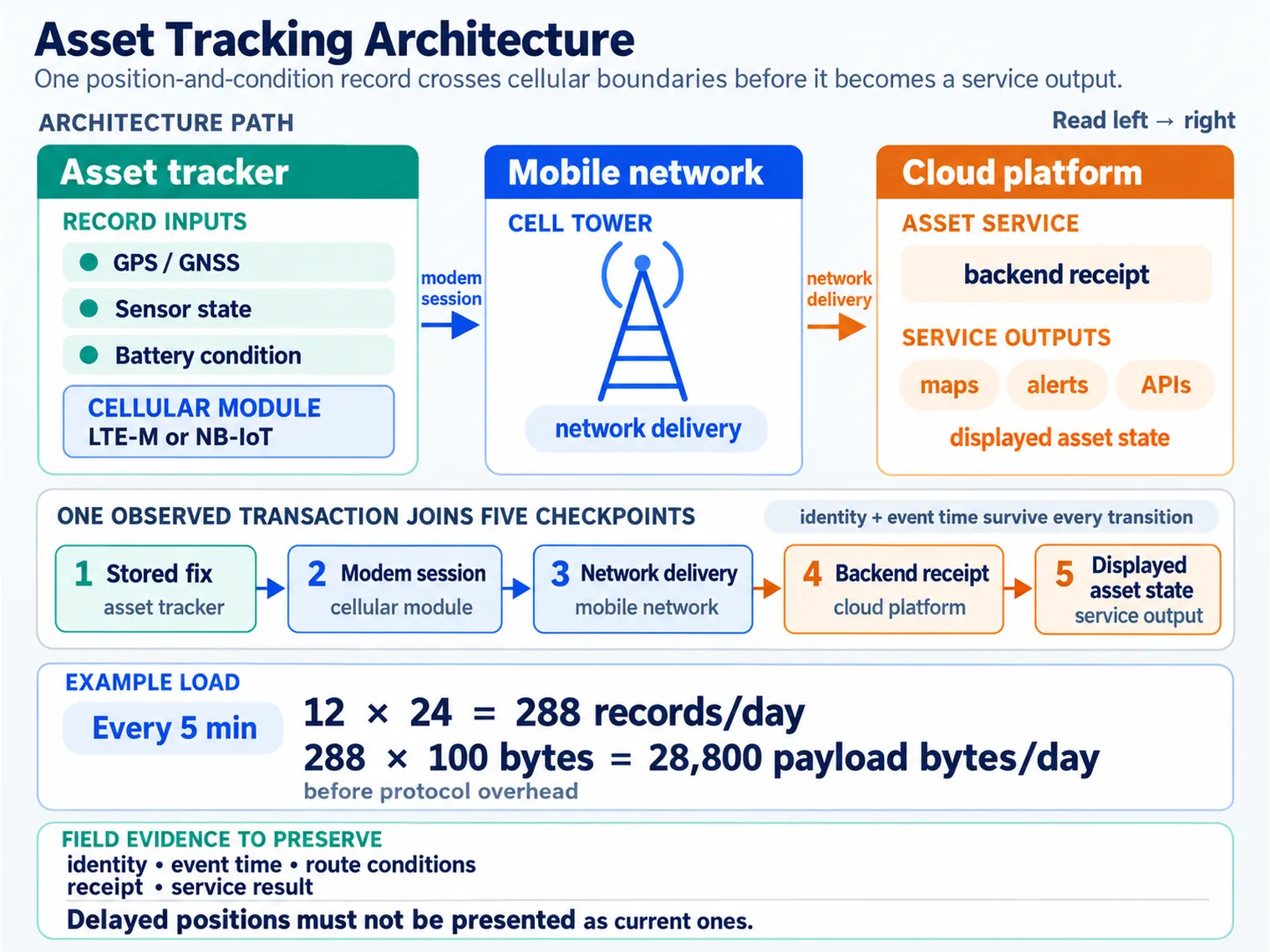
Its labelled evidence shows smart metering architecture with utility meter, MCU, NB-IoT module, cellular network, and utility backend, the distinction that anchors practitioner: review use cases as evidence patterns.

  • Those labels make smart metering architecture with utility meter, MCU, NB-IoT module, cellular network, and utility backend concrete.
Asset tracking architecture with GPS, LTE-M cellular module, sensors, battery, cell tower, and cloud platform.
iotclass.org

Major section

Separate a Meter Reading from a Tamper Alarm

A tamper event adds a 32-byte record.

  • They exclude cellular signalling, security, transport headers and retransmissions, which may dominate a small exchange.
  • Six records need 6 × 24 bytes = 144 bytes of local space before metadata.
  • When service returns, the oldest reading is already about 6 hours old.

Why it matters

The platform should preserve the measurement time so that a late upload does not look like a fresh change in water use.

iotclass.org

Major section

Separate a Meter Reading from a Tamper Alarm (continued)

A phone showing service outside the building does not demonstrate that a sealed pit provides the same link.

  • A daily billing total may tolerate this delay; a tamper workflow may not.
  • The battery calculation also changes with the alarm promise.
  • The selection record should therefore distinguish stationary coverage evidence from route evidence.
iotclass.org

Major section

Separate a Meter Reading from a Tamper Alarm (continued)

A modem that sleeps for long intervals can save energy, but a pending command cannot be assumed to reach it at once.

  • The stored meter totals can still be useful after recovery if their timestamps survive.
  • The alarm service has already missed its prompt notification target, even if the same bytes eventually arrive.
  • The worked byte counts are illustrative; operator support and the modem's measured current profile decide the deployed behaviour.
iotclass.org

Deck summary

Key takeaways

Every cellular Internet of Things (IoT) application has a rhythm.

  • The mathematical gist.: An illustrative 8 dBi installed antenna improvement is a 6.31× ideal combining factor.
  • Its labelled evidence shows smart metering architecture with utility meter, MCU, NB-IoT module, cellular network, and utility backend, the distinction that anchors practitioner: review use cases as evidence patterns.
  • A tamper event adds a 32-byte record.
  • A phone showing service outside the building does not demonstrate that a sealed pit provides the same link.
iotclass.org

Retrieval practice

Recall check 1 of 3

Radio Remi says: answer from memory, then check your reasoning.

Q1A city water-meter pilot shows a phone has service near the curb, but the production meters will sit inside cast-metal basement cabinets and send small daily readings. What should the reviewer request first?

AInstalled-device evidence for modem, antenna, enclosure, SIM, firmware, basement sites, payload, retries, current, and retest owner.
BApproval, because phone coverage at the curb proves NB-IoT, LTE-M, and broadband modules will behave the same way in the cabinets.
CA larger data plan before checking cabinet reachability, retry behavior, and the small daily payload requirement.
DA decision to postpone SIM lifecycle, support ownership, and weak-site retesting until after installation.
Show answer

Answer: A Cellular application selection should be grounded in device and service evidence, not general coverage branding.

iotclass.org

Retrieval practice

Recall check 2 of 3

Radio Remi says: answer from memory, then check your reasoning.

Q2A city water-meter project has stationary devices, small scheduled readings, hard-to-access batteries, and many meters in basements. Which evidence best supports the cellular category decision?

ANB-IoT coverage and power evidence for real meter sites, interval, operator profile, and retention needs.
BA fleet-tracking demo that shows LTE-M handoff on a vehicle.
CA broadband data plan sized for video, because larger plans are safer.
DA decision to use private 5G before checking the operator NB-IoT service profile.
Show answer

Answer: A Use-case selection connects the application pattern to coverage, power, payload, operator, and operations evidence.

iotclass.org

Retrieval practice

Recall check 3 of 3

Radio Remi says: answer from memory, then check your reasoning.

Q3A tracker works in a lab modem session, but the release plan omits roaming rules, SIM ownership, battery measurement, and recovery after missed contact. What should the reviewer do?

AHold until service, SIM, power, reachability, and recovery evidence are recorded.
BApprove the release using the lab session and leave roaming and recovery tests for the field rollout.
CSwitch the tracker to NB-IoT to prioritize sleep current before documenting roaming and recovery behavior.
DIgnore SIM ownership because it is a procurement detail rather than a technical risk.
Show answer

Answer: A A cellular IoT release needs operations evidence, not only a modem connection demonstration.

iotclass.org

Print reference

Answers

Answer key.

  1. A · Cellular application selection should be grounded in device and service evidence, not general coverage branding.
  2. A · Use-case selection connects the application pattern to coverage, power, payload, operator, and operations evidence.
  3. A · A cellular IoT release needs operations evidence, not only a modem connection demonstration.
iotclass.org