Bluetooth & BLE · Study deck
Piconets, Scatternets and Power Classes
Start with the conversation, not the Bluetooth label.
Radio Remi is your guide for this deck.

After studying this chapter
Learning objectives
You will be able to:
- Explain: The record should state what happens when the active-device count grows, a controller is replaced, or the product needs peer-to-peer or many-node behavior outside the piconet.
- Explain: The smallest credible shape is not a Classic piconet: the tags do not need a Classic profile and should not stay scheduled as active members of one controller.
- Explain: A practical Bluetooth architecture record starts from the product job: local setup, sensor collection, audio or legacy profile, gateway handoff, room-scale control, building automation, or diagnostics.
- Explain: A legacy peripheral may require Classic Bluetooth profile behavior.
Major section
Start With the Story
Some may be sent to many listeners.
- Other devices may need a relay to reach the edge of the hall.
- A link that works with two devices on a desk does not prove that thirty devices can share the air.
- A mesh can extend a path, but it adds relay work and delay.
Major section
Start With the Story (continued)
A broadcast can reach many listeners, but it does not create a private reply path by itself.
- Under the Hood explains scheduling, range, and the changes that should trigger a new test.
- A device may hold more than one role, but each role uses time and power.
- A new wall, more tags, a new phone model, or a moved gateway can change the result.
- That trigger tells the team when old proof is no longer enough.
Major section
Choose the Bluetooth Shape That Matches the Job
Bluetooth network architecture review starts by naming the communication shape.
- Classic Bluetooth piconets use one controller to schedule a small set of active devices.
- BLE central-peripheral links are usually better for phone-to-device setup, small sensor reads, notifications, and duty-cycled local exchange.
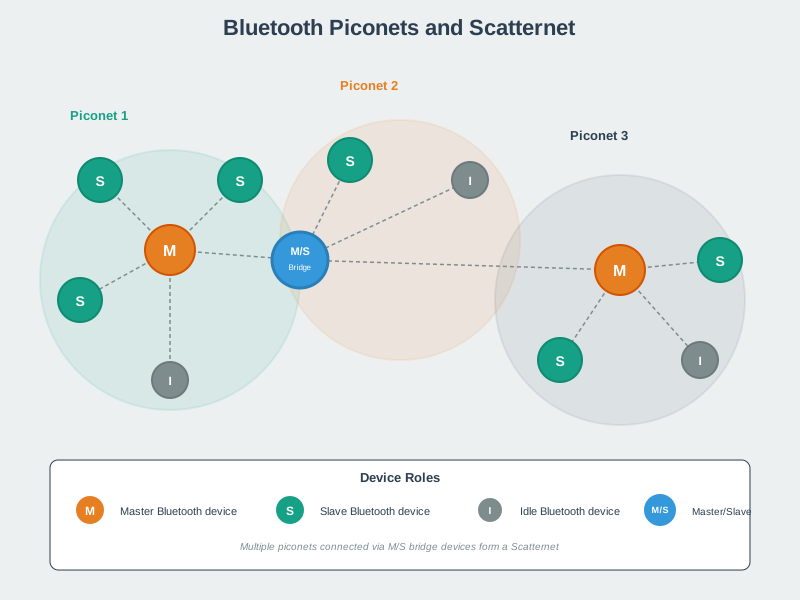
- A piconet diagram does not prove capacity.
Major section
Choose the Bluetooth Shape That Matches the Job (continued)
Bluetooth Mesh is a managed many-node control architecture with provisioning, relay, security, and operations requirements.
- The architecture decision is only valid inside its evidence boundary.
- A phone connection does not prove fleet behavior.
- A mesh label does not prove relay placement, low-power node support, or maintainability after a device moves.
Major section
Choose the Bluetooth Shape That Matches the Job (continued)
“Range, power, and data-rate is a triangle — pick two honestly, then measure the third in the real room.”.
- Worked example - clinic temperature tags: Suppose twenty BLE temperature tags report every five minutes, two hallway gateways are mains-powered, and nurses occasionally use tablets for setup.
- A stronger first architecture is BLE collection.
- One master schedules participating slaves; an idle device may be nearby without becoming an active scheduled member.
Major section
Choose the Bluetooth Shape That Matches the Job (continued)
The smallest credible shape is not a Classic piconet: the tags do not need a Classic profile and should not stay scheduled as active members of one controller.
- Tags advertise or connect briefly; gateways scan known rooms, de-duplicate readings, and forward data upstream; tablets use local BLE setup only during commissioning.
- If later requirements add room-to-room group control for mains-powered devices, that is a new mesh claim with its own relay, key, and operations evidence.
- It belongs to more than one piconet and must time-share those memberships, so it joins networks without merging their slot schedules.
Major section
Choose the Bluetooth Shape That Matches the Job (continued)
It must not be used as the capacity model for BLE gateways or Bluetooth Mesh.
- A Classic piconet can be acceptable for a bounded legacy profile, but the active-device limit and controller dependency should be explicit.
- A mesh claim is strongest when relay placement, low-power node behavior, message scope, and recovery ownership are recorded.
- A small gateway collecting occasional BLE sensor readings does not need a Classic piconet just because both technologies are Bluetooth.
Major section
Build the Bluetooth Architecture Record
A practical Bluetooth architecture record starts from the product job: local setup, sensor collection, audio or legacy profile, gateway handoff, room-scale control, building automation, or diagnostics.
- It then chooses the smallest Bluetooth shape that supports that job and records the evidence that would make the decision stale.
- The record should be specific about roles.
Major section
Build the Bluetooth Architecture Record (continued)
Classic Bluetooth uses a scheduled piconet model.
- BLE connected operation has central and peripheral roles.
- BLE advertising has broadcaster and observer behavior.
- Mesh adds provisioner, relay, friend, low-power, and managed key roles.
- Mixing those roles in one claim makes the review hard to maintain.
Major section
Build the Bluetooth Architecture Record (continued)
The tags send small readings and do not need direct tag-to-tag communication.
- Bluetooth Mesh may still be useful for mains-powered infrastructure if room-to-room relay behavior or group control becomes part of the job.
- Mesh adds provisioning, relay, key, and operations evidence that small battery tags may not be suited to carry.
- A legacy peripheral may require Classic Bluetooth profile behavior.
- Older material may describe this as a master/slave piconet.
Major section
Build the Bluetooth Architecture Record (continued)
The architecture record can accept a bounded piconet claim when the controller role, active-device count, profile behavior, range expectation, and failure recovery are known.
- The record should state what happens when the active-device count grows, a controller is replaced, or the product needs peer-to-peer or many-node behavior outside the piconet.
- The useful engineering point is the scheduling boundary: the controller owns the clock, hopping sequence, and transmission opportunities, so active devices synchronize to that schedule and do not get arbitrary direct slave-to-slave traffic.
- It should not be approved simply because the tag count is large.
Major section
Scheduling, Range, and Architecture Drift
Under the hood, Bluetooth architecture is shaped by scheduling and duty cycle.
- Classic piconets are controlled by a central scheduler, so active member count and controller dependency matter.
- BLE devices can spend much of their life advertising, scanning, connecting briefly, or sleeping, so connection parameters and retry behavior matter.
- Those values are only a start.

Major section
Scheduling, Range, and Architecture Drift (continued)
A case, a person's body, other radios, antenna angle, receiver design, and retries can change the real result.
- The design record therefore needs a measured walk through the site and a checked security boundary.
- A power class alone cannot promise useful or safe range.
- Trade: a power class is a planning input, not acceptance proof — the catalog number and the installed link are different claims.
Major section
Summary
Bluetooth network architecture review starts by naming the topology behavior: Classic piconet, BLE central-peripheral, advertising collection, bridge, gateway, or mesh.
- Classic piconet claims need controller, active-device, scheduling, profile, range, and recovery evidence.
- BLE collection claims need advertising, scanning, connection timing, GATT path, battery, gateway, and phone-scope evidence.
- Bluetooth Mesh claims need provisioning, relay, key, message-scope, low-power node, and operations evidence.
Deck summary
Key takeaways
Some may be sent to many listeners.
- A broadcast can reach many listeners, but it does not create a private reply path by itself.
- Bluetooth network architecture review starts by naming the communication shape.
- Bluetooth Mesh is a managed many-node control architecture with provisioning, relay, security, and operations requirements.
- “Range, power, and data-rate is a triangle — pick two honestly, then measure the third in the real room.”.
Retrieval practice
Recall check 1 of 3

Radio Remi says: answer from memory, then check your reasoning.
Q1A design claims Bluetooth network architecture is ready because one phone connected to one device during a demo. What has the team actually proven?
Show answer
Answer: C A connection demo is useful evidence, but it does not prove capacity, range, mesh behavior, bridge behavior, power, or operations readiness.
Retrieval practice
Recall check 2 of 3
Radio Remi says: answer from memory, then check your reasoning.
Q2A team has twenty slow BLE temperature tags in one area and one mains-powered gateway. Which architecture review response is strongest?
Show answer
Answer: D Slow tags near a gateway often need bounded collection evidence before a mesh architecture is justified.
Retrieval practice
Recall check 3 of 3
Radio Remi says: answer from memory, then check your reasoning.
Q3A BLE gateway is moved from a hallway into a metal cabinet. Some tags are still discovered, but reports arrive late and batteries drain faster. Which review action is strongest?
Show answer
Answer: A The moved gateway changed range and timing evidence, so the collection architecture needs a bounded retest.
Print reference
Answers
Answer key.
- C · A connection demo is useful evidence, but it does not prove capacity, range, mesh behavior, bridge behavior, power, or operations readiness.
- D · Slow tags near a gateway often need bounded collection evidence before a mesh architecture is justified.
- A · The moved gateway changed range and timing evidence, so the collection architecture needs a bounded retest.