Bluetooth & BLE · Study deck
Bluetooth: BLE Profiles and Operations
BLE is the low-power form of Bluetooth.
Radio Remi is your guide for this deck.

After studying this chapter
Learning objectives
You will be able to:
- choose Classic or BLE from rate, delay, and power needs
- map advertising, connection, and GATT operations
- Explain: A small wireless device can stream sound, send a brief signal and return to sleep, or hold a data connection open.
- Explain: The mathematical gist: Across the chapter’s 2402–2480 MHz Classic hop set, wavelength falls from 124.9 to 120.97 mm and quarter-wave length changes by only 0.982 mm.
Major section
Start With the Story
A small wireless device can stream sound, send a brief signal and return to sleep, or hold a data connection open.
- These choices change battery life and speed.
- Latency means the delay between an action and its result.
- A gateway is a device that passes data between a local Bluetooth device and another network.
Major section
Phoebe's Field Notes: Why 79 Channels Share One Antenna Length
The mathematical gist: Across the chapter’s 2402–2480 MHz Classic hop set, wavelength falls from 124.9 to 120.97 mm and quarter-wave length changes by only 0.982 mm.
- At 10 m, the deterministic free-space-loss change is just 0.278 dB—small enough that larger channel differences point to fading or interference, not band-edge range.
Major section
Bluetooth Fundamentals for IoT
Classic Bluetooth usually carries steady streams such as audio and supports older, well-known device profiles.
- A duty cycle is the share of time for which the radio is active.
- Bluetooth Mesh is a managed way for many devices to pass control messages.
- The key idea is that "Bluetooth works" is not one claim.
Major section
Bluetooth Fundamentals for IoT (continued)
Pairing establishes keys and may authenticate the peer, depending on the method.
- Timing, power use, privacy, phone support, and recovery after failure each need their own test.
- “Range, power, and data-rate is a triangle — pick two honestly, then measure the third in the real room.”.
- Their higher-level rules are different.
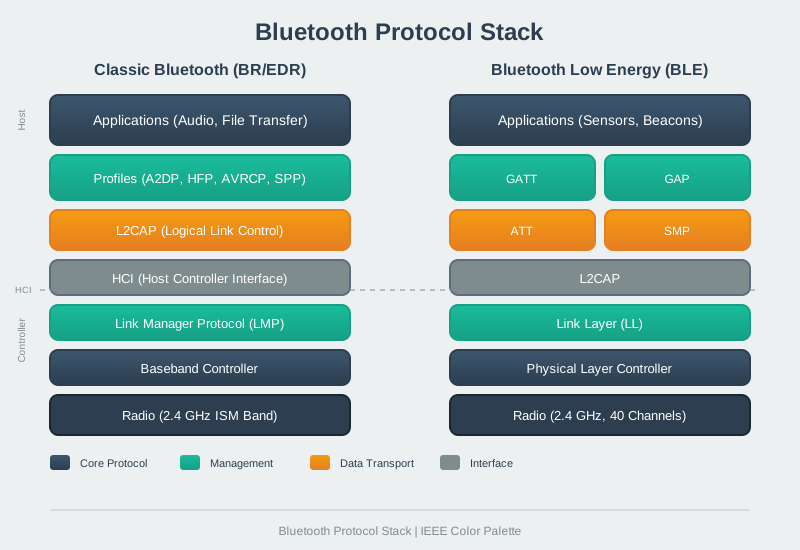
- The controller runs the radio.
Major section
Bluetooth Fundamentals for IoT (continued)
A host interface connects that controller to the main software.
- On the BLE side, L2CAP carries the rules used by ATT/GATT and SMP.
- GAP defines how devices are found and which role each device takes.
- Classic Bluetooth uses different higher-level rules for steady streams.
- This explains a practical choice.
Major section
Bluetooth Fundamentals for IoT (continued)
A shipping logger can send short announcements and offer brief GATT reads, so BLE fits.
- A headset sends steady audio, so it needs different evidence for its profile, timing, compatibility, and power use.
- One product may use several of these behaviours.
- During warehouse setup, a phone may act as the central device and write settings.
Major section
Bluetooth Fundamentals for IoT (continued)
During transport, gateways may only listen for announcements.
- During service, a technician may connect and read fault details.
- Calling all three cases "BLE support" hides important differences.
- Advertising proves visibility; it does not prove connected data exchange.
- A connection proves link setup; it does not prove the correct service, characteristic, permission, or application value.
Major section
Build the Bluetooth Fundamentals Record
"A connection means the right application value was exchanged.".
- A practical Bluetooth fundamentals record explains why the chosen Bluetooth behavior fits the IoT job.
- It should show the device role, traffic pattern, receiver population, service model, timing, security ceremony, power expectation, and retest trigger.
- "BLE means the battery target is automatically safe.".
Major section
Build the Bluetooth Fundamentals Record (continued)
This keeps design review from sliding between Classic, BLE, advertising, connection, GATT, mesh, and gateway claims.
- "BLE, Classic, and mesh are interchangeable because they share the brand.".
- "Phone discovery is enough to prove safe ownership.".
- A battery sensor sends a small reading to a phone app.
Major section
Radio, Link, GATT, and Operations Boundaries
A device may be visible during advertising, connect as the expected role, expose services through GATT, exchange an application value, and then recover after disconnection.
- Each boundary can pass or fail independently.
- A scan problem may involve advertising interval, phone permissions, or RF placement.
- Connection parameters, phone population, controller firmware, bonding rule, or reconnection requirement change.
Major section
Radio, Link, GATT, and Operations Boundaries (continued)
Advertising interval, enclosure, antenna, phone OS, app permission, RF environment, or firmware change.
- A read problem may involve pairing, service discovery, characteristic properties, or app mapping.
- A power problem may involve connection interval, retry behavior, sleep state, or a failed reconnection loop.
- Service schema, characteristic property, app mapping, authorization, firmware, or gateway change.
Major section
Radio, Link, GATT, and Operations Boundaries (continued)
That separation matters because the fix changes by boundary.
- The device can be discovered or observed under the tested advertising, scan, placement, and permission conditions.
- The expected central, peripheral, Classic, or connected BLE behavior occurs under the reviewed conditions.
- The service, characteristic, property, permission, command, notification, or indication evidence matches the product claim.
Major section
Radio, Link, GATT, and Operations Boundaries (continued)
The approved workflow has ownership, reset, reprovisioning, monitoring, lost-device handling, and retest rules.
- That every future phone, enclosure, deployment site, battery condition, or owner will behave the same way.
- Owner transfer, phone app change, site change, support process change, fleet update, or battery change.
- Preserve known-good lower evidence: If the phone can discover the device, do not erase that evidence while debugging GATT access.
Deck summary
Key takeaways
A small wireless device can stream sound, send a brief signal and return to sleep, or hold a data connection open.
- The mathematical gist: Across the chapter’s 2402–2480 MHz Classic hop set, wavelength falls from 124.9 to 120.97 mm and quarter-wave length changes by only 0.982 mm.
- Classic Bluetooth usually carries steady streams such as audio and supports older, well-known device profiles.
- Pairing establishes keys and may authenticate the peer, depending on the method.
- A host interface connects that controller to the main software.
Retrieval practice
Recall check 1 of 3

Radio Remi says: answer from memory, then check your reasoning.
Q1A sensor advertises over BLE and appears in a phone scan. What has the team actually proven?
Show answer
Answer: C Discovery evidence is useful, but it does not prove connection setup, GATT behavior, security, or battery life.
Retrieval practice
Recall check 2 of 3
Radio Remi says: answer from memory, then check your reasoning.
Q2A team chooses BLE for a battery sensor that reports a small value to a phone app. Which review record is strongest?
Show answer
Answer: D This ties the BLE choice to the actual reporting workflow and operational boundary.
Retrieval practice
Recall check 3 of 3
Radio Remi says: answer from memory, then check your reasoning.
Q3A phone sees a BLE sensor but cannot read its measurement, which requires authenticated access. Which test sequence finds the missing step?
Show answer
Answer: B Each stage has its own evidence and can fail alone.
Print reference
Answers
Answer key.
- C · Discovery evidence is useful, but it does not prove connection setup, GATT behavior, security, or battery life.
- D · This ties the BLE choice to the actual reporting workflow and operational boundary.
- B · Each stage has its own evidence and can fail alone.