Cloud, SDN & Production Architectures · Study deck
Blockchain Limitations for IoT
Picture several buildings sharing energy totals from their meters.
Cloud Clara is your guide for this deck.

After studying this chapter
Learning objectives
You will be able to:
- Explain: They may be able to sign a local event, but they should not be expected to store a ledger history, maintain validator state, communicate with every participant, or recover from ledger-level failures.
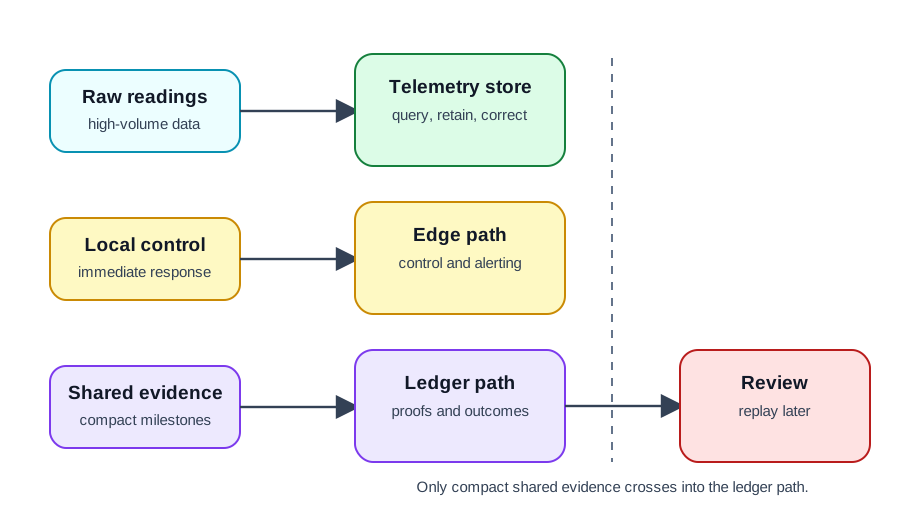
- Explain: A strong implementation writes compact shared records to the ledger, keeps raw telemetry and control off ledger, uses gateways at the resource boundary, and proves that later verification can replay the proof path.
- Explain: A good design keeps raw operational data off ledger, uses gateways for ledger interaction, records only durable shared evidence, and proves that review, outage, and recovery behavior are workable.
Major section
Start With the Stress Test
Telemetry means readings and status sent from equipment for remote use.
- Latency means the time from an event to the result that matters.
- A gateway is a local device or service that joins equipment to wider systems.
- This opening does not approve or reject every ledger.
- The site should keep working through the drill.
Major section
Start With the Stress Test (continued)
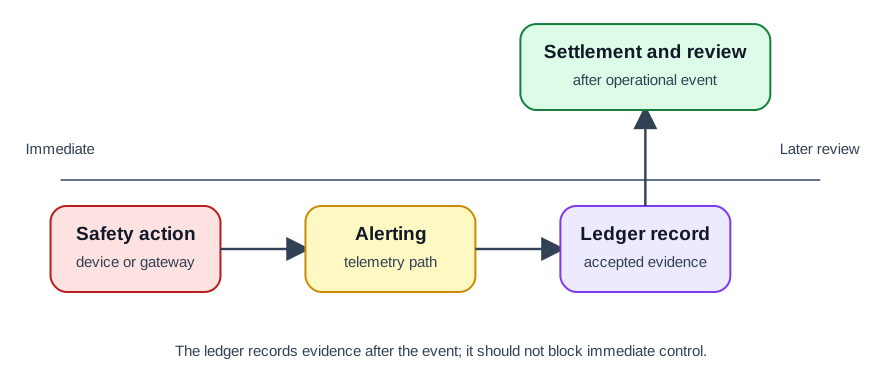
A shared ledger may help the owners check a later total, but it should not become the path for every reading or live charger action.
- A record accepted by several parties can support later trust, but it is not a safe clock for a physical action.
- Under the Hood examines load, ordering, finality, privacy, membership, outages, corrections, and how off-ledger evidence is checked again.
- Close with a plain fit check.
Major section
Start With the Stress Test (continued)
Staff should see which proof is delayed, which value changed, who accepted the change, and when the shared history caught up.
- If any answer is no, move that job out or narrow the claim.
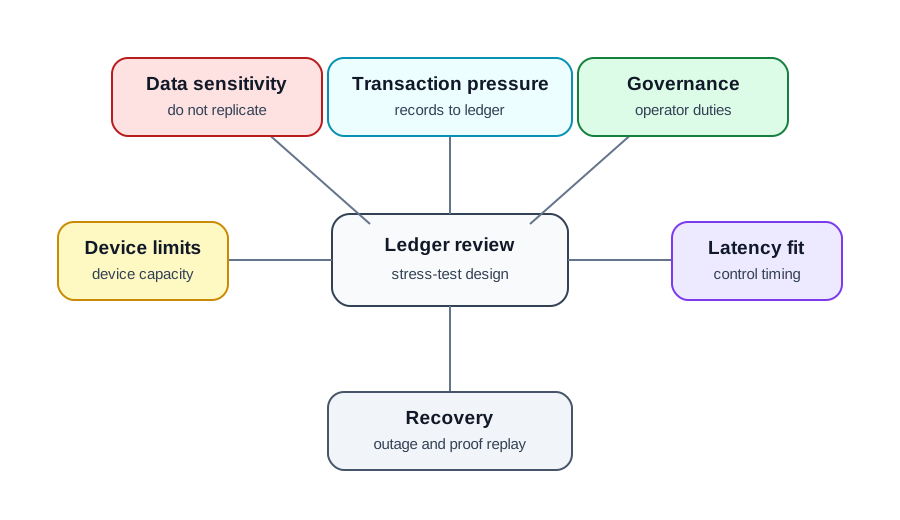
- Blockchain limitations become visible when the IoT workload is made concrete: transaction rate, device resources, latency, privacy, correction, governance, and outage behavior all collide with the ledger promise.
- If the record cannot meet volume, timing, privacy, and recovery needs, the implementation choice has already failed.
Major section
In 60 Seconds · Why Limitations Matter
Blockchain limitations in IoT are mostly architecture limits, not slogans about one platform being fast or slow.
- A good design keeps raw operational data off ledger, uses gateways for ledger interaction, records only durable shared evidence, and proves that review, outage, and recovery behavior are workable.
- The goal is not to reject every ledger.
- Blockchain can add value when several parties need a shared evidence history.
- This chapter stress-tests a proposed IoT ledger design before implementation.
Major section
Key Concepts · Limitation 1: Transaction Pressure
Transaction pressure: The event volume that would reach the ledger if every device event became a ledger record.
- Resource boundary: The line between constrained devices and gateways or services that can handle ledger duties.
- Data placement: The decision about what stays in operational storage and what becomes shared ledger evidence.
- IoT systems can generate many events.
Major section
Limitation 2: Device Resource Boundaries · Limitation 3: Latency And Control Fit
Constrained devices are not good ledger participants.
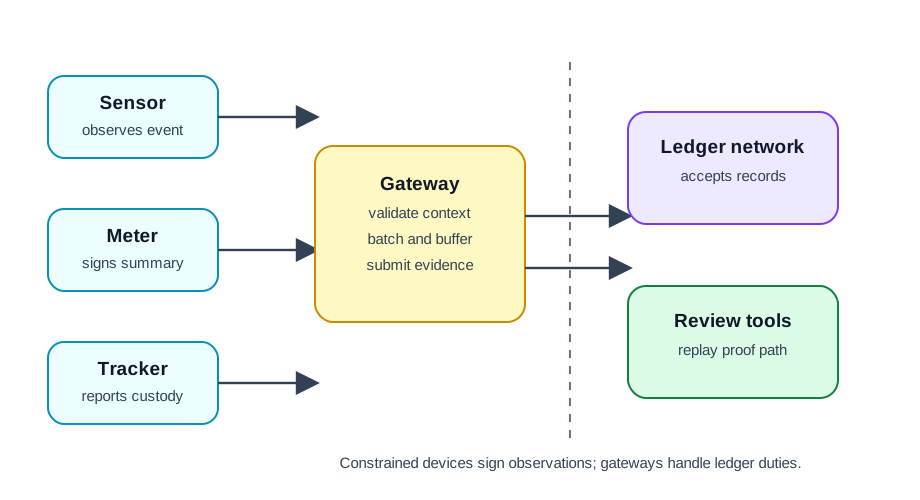
- They may be able to sign a local event, but they should not be expected to store a ledger history, maintain validator state, communicate with every participant, or recover from ledger-level failures.
- The ledger peers accept records under shared rules.
- The device sees and signs an event with work its chip can bear.
Major section
Limitation 4: Privacy And Correctability · Limitation 5: Governance And Operations
Ledger data is deliberately hard to change.
- A shared ledger is also a shared responsibility system.
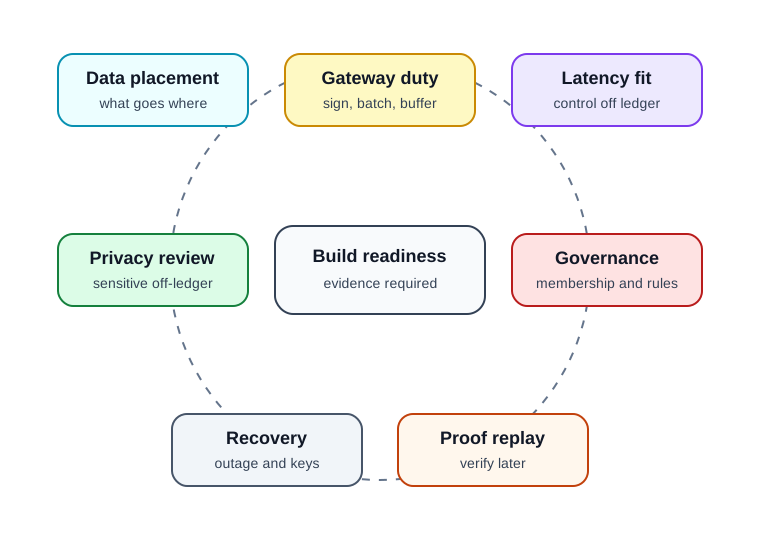
- Data placement keeps raw telemetry and correctable records off ledger; gateway duties cover signing, batching, buffering, and replay.
- Latency fit keeps real-time control and alerts outside ledger acceptance, while privacy review checks replicated data.
Major section
Worked Example: Meter Ledger Stress Test · Implementation Readiness Checklist
A campus energy-sharing system has several building operators, shared meters, and charging points.
- The project team proposes writing every meter reading to a ledger so each operator can trust the totals.
- Transaction pressure: Raw readings are frequent operational data.
- Resource boundary: Meters should not participate in ledger validation.
Major section
Approve Boundaries, Not Ledgers
The safest IoT blockchain decision starts by drawing a boundary.
- The ledger should carry the small facts that several parties must verify later.
- The telemetry store, alert path, gateway buffer, and control loop should keep doing the fast operational work.
- A receipt can prove that a handoff, batch fingerprint, meter period, or exception was accepted.
Major section
Approve Boundaries, Not Ledgers (continued)
It should not become the place where every raw reading waits, every safety action is decided, or every device tries to maintain shared history.
- For a campus energy system, that boundary might put MQTT ingestion, a stream processor, a time-series database, charger-control rules, and operator dashboards outside the ledger.
- That boundary also protects correction and privacy workflows.
- If any stakeholder cannot explain the boundary in one diagram, pause the implementation.
Major section
Approve Boundaries, Not Ledgers (continued)
The ledger receives a signed 15-minute period summary, a SHA-256 fingerprint for the off-ledger batch, the gateway signer, the time window, and the settlement state.
- A wrong meter calibration, missing packet, or privacy redaction can be handled in operational storage with a visible correction record.
- The ledger should preserve the accepted proof trail, not replicate every personal charging event or make every corrected reading permanent across all participants.
- The missing diagram usually means the ledger is carrying jobs that belong to telemetry, control, privacy review, or governance.
Major section
Ledger Readiness Record
A reviewer should be able to test the record by replaying one sample day.
- It should be short enough to review in a design meeting and specific enough to reject vague promises.
- The same record needs operating ownership.
- If that replay cannot be performed from the documented artifacts, the ledger adds permanence without adding trustworthy evidence.
Major section
Load and Replay Break Designs
The load problem appears before the cryptography does.
- If each reading becomes a shared ledger transaction, the architecture has moved an operational telemetry problem into the most expensive path.
- Batch anchoring changes the shape of the problem.
- The internal ledger work is still real work.
- That proof only works when replay metadata is preserved.
Major section
Load and Replay Break Designs (continued)
A robust gateway design uses backpressure and durable queues before the ledger client.
- A gateway can collect many readings, write them to operational storage, compute a hash over the accepted batch, and submit one compact record for the period.
- The ledger proves that the accepted batch has not silently changed; the telemetry store still handles query, correction, retention, and alerting.
- Ledger submission then becomes an idempotent milestone for a bounded period, not a per-packet dependency.
Major section
Load and Replay Break Designs (continued)
In a permissioned deployment, peers or validators must authenticate writers, order accepted transactions, validate rules, persist state, expose monitoring, and recover after outages.
- Those duties may be reasonable for period summaries and custody events, but they are wasteful for raw readings that a telemetry database can ingest, index, compress, expire, and correct more directly.
- The queue keeps the batch id, time window, reading count, previous-batch pointer when needed, canonical sort rule, hash algorithm, signer, and retry state.
- During outage recovery, the gateway submits late evidence with an explicit outage marker so reviewers can distinguish delayed proof from live telemetry.
Major section
Summary · Key Takeaway
Blockchain limitations for IoT are practical design constraints.
- High event volume, constrained devices, latency-sensitive control, sensitive data, governance, and recovery all need explicit handling.
- A strong implementation writes compact shared records to the ledger, keeps raw telemetry and control off ledger, uses gateways at the resource boundary, and proves that later verification can replay the proof path.
- If the design cannot show those records, it is not ready for implementation.
Deck summary
Key takeaways
Telemetry means readings and status sent from equipment for remote use.
- A shared ledger may help the owners check a later total, but it should not become the path for every reading or live charger action.
- Staff should see which proof is delayed, which value changed, who accepted the change, and when the shared history caught up.
- Blockchain limitations in IoT are mostly architecture limits, not slogans about one platform being fast or slow.
- Transaction pressure: The event volume that would reach the ledger if every device event became a ledger record.
Retrieval practice
Recall check 1 of 3

Cloud Clara says: answer from memory, then check your reasoning.
Q1A campus energy-sharing proposal wants every meter reading and charger event written directly to a shared ledger. Which first check keeps the production decision traceable?
Show answer
Answer: B A practical IoT ledger stress test separates high-volume telemetry and immediate control from compact shared evidence, then proves gateway batching, latency fit, privacy, governance, outage recovery, and proof replay before the ledger becomes a system dependency.
Retrieval practice
Recall check 2 of 3
Cloud Clara says: answer from memory, then check your reasoning.
Q2A gateway handles 10,000 meters that report once per minute. The team wants each raw reading to become a ledger transaction. Which redesign keeps the proof useful without turning the ledger into telemetry storage?
Show answer
Answer: D Batch anchoring separates operational telemetry from durable shared proof: the ledger records a compact signed fingerprint, while raw data and replay metadata remain available off ledger.
Retrieval practice
Recall check 3 of 3
Cloud Clara says: answer from memory, then check your reasoning.
Q3A multi-party IoT system wants every raw sensor reading written directly to a shared ledger. What is the strongest architecture response?
Show answer
Answer: B A practical IoT ledger design separates operational telemetry from durable shared evidence.
Print reference
Answers
Answer key.
- A · A practical IoT ledger stress test separates high-volume telemetry and immediate control from compact shared evidence, then proves gateway batching, latency fit, privacy, governance, outage recovery, and proof replay before the ledger becomes a system dependency.
- A · Batch anchoring separates operational telemetry from durable shared proof: the ledger records a compact signed fingerprint, while raw data and replay metadata remain available off ledger.
- B · A practical IoT ledger design separates operational telemetry from durable shared evidence.