Cloud, SDN & Production Architectures · Study deck

When IoT Needs Blockchain

Picture a cold shipment passed from a farm to a carrier and then a shop.

Cloud Clara is your guide for this deck.

blockchain
Cloud Clara, the module guide, in a scene from this chapter.
iotclass.org

After studying this chapter

Learning objectives

You will be able to:

  • Explain: A building owner, a charger operator, and a settlement service can all depend on the same monthly energy summary, yet none of them should be able to rewrite the accepted summary after a billing dispute starts.
  • Explain: That observation connects this visual to the chapter's running narrative: use it to justify the next design decision and to record what evidence would confirm it in operation.
  • Explain: Their combined proposition is: A shared energy system keeps meter readings off ledger, writes signed summaries and fingerprints to the ledger, and lets multiple parties review settlement evidence later.
iotclass.org

Major section

Start With the Shared Evidence Problem

All three need one durable handover history, but none should be able to rewrite it alone.

  • The architect must decide which compact facts they share and which detailed sensor records stay in normal storage.
  • A slow or unavailable group decision must not block a local safe stop.
  • Practitioner builds the fit and reconstruction test.

Key terms

If that story
If that story is weak, a normal IoT architecture is probably stronger.
iotclass.org

Major section

Start With the Shared Evidence Problem (continued)

The ledger is not the sensor database, control loop, or dashboard.

  • Shared history can support review and settlement, but it cannot prove that a sensor was mounted or calibrated correctly.
  • This opening does not choose a chain or settle every legal question.
  • If that story is weak, a normal IoT architecture is probably stronger.
iotclass.org

Major section

Why This Chapter Exists
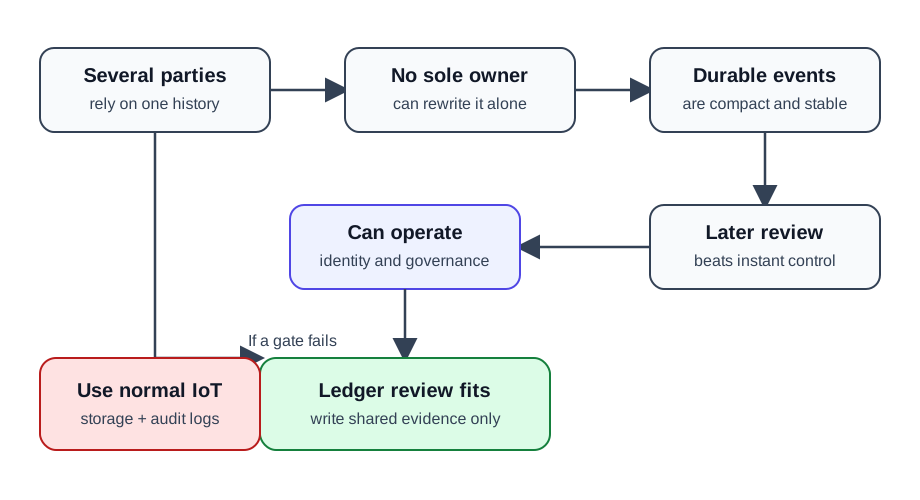
The architecture challenge is to decide which of those facts deserve a shared ledger and which belong in normal IoT systems.

  • This chapter is the gateway for the blockchain series.
  • It gives you the fit test, the system placement, and the review questions before the later chapters go deeper into fundamentals, smart contracts, limitations, and the lab.
A blockchain fit route keeps single-owner telemetry and real-time control outside the ledger path while sending shared, tamper-evident events to ledger review.
iotclass.org

Major section

Key Concepts

Trust boundary: The point where one organization can no longer be the only owner of the event history.

  • Off-ledger telemetry: The operational readings, logs, files, and analytics data kept in normal IoT storage while selected proofs or milestones are written to the ledger.
  • Gateway mediation: The pattern where a gateway or service packages device events, signs records, buffers during outages, and submits ledger transactions.
  • Consensus set: The participating nodes that agree which ledger records are accepted.
iotclass.org

Major section

Where Blockchain Fits

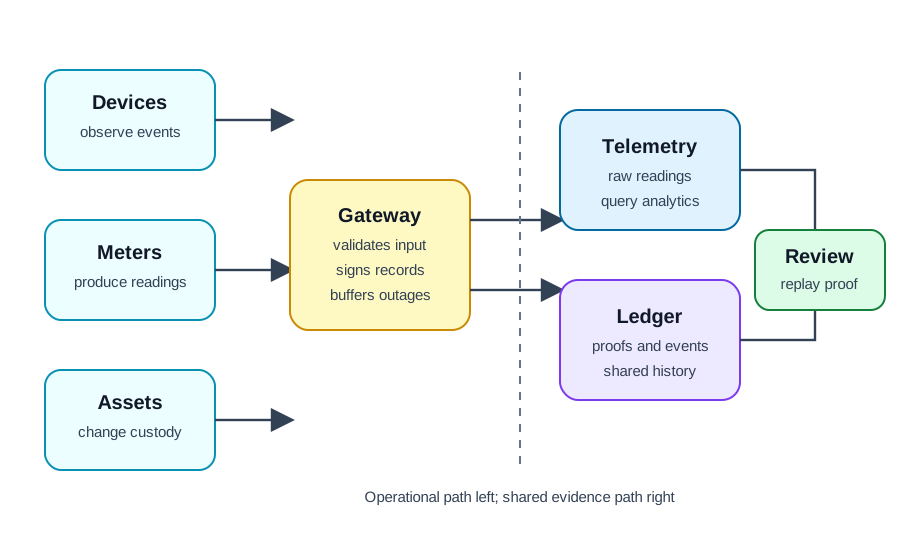
In a practical IoT architecture, the ledger is not placed at the sensor edge.

  • It sits beside the operational system as a shared evidence layer.
  • Devices observe physical events and hold device identity material appropriate to their hardware.
  • Gateways or edge services validate local input, apply buffering rules, attach signatures, and send compact records onward.
An IoT blockchain architecture keeps raw telemetry and control at the device, gateway, and telemetry layers while the ledger records compact shared evidence for later review.
iotclass.org

Major section

Where Blockchain Fits (continued)

Telemetry stores keep raw readings, event streams, files, and analytics-ready data.

  • Distributed ledgers store selected evidence records, such as fingerprints, custody events, identity changes, and agreement outcomes.
  • Verification workflows replay the proof path by comparing off-ledger records with ledger entries.
  • That observation connects this visual to the chapter's running narrative: use it to justify the next design decision and to record what evidence would confirm it in operation.
iotclass.org

Major section

Blockchain for Shared History

The first IoT blockchain question is not whether a ledger can store events.

  • The useful question is whether several parties need the same event history and whether one party owning that history would be a problem.
  • The practical fit test is therefore narrow.
  • Shared evidence answers which compact fact several organizations must agree on later.
iotclass.org

Major section

Blockchain for Shared History (continued)

A building owner, a charger operator, and a settlement service can all depend on the same monthly energy summary, yet none of them should be able to rewrite the accepted summary after a billing dispute starts.

  • The ledger can prove that an accepted record exists; it cannot prove that a physical sensor was calibrated, mounted correctly, or immune to tampering.
  • Governance answers who may join, write, read, rotate keys, and resolve disputes.
  • If the design cannot keep those boxes separate, the ledger will absorb jobs it is bad at and make the system harder to operate.
iotclass.org

Major section

Blockchain Fit Record

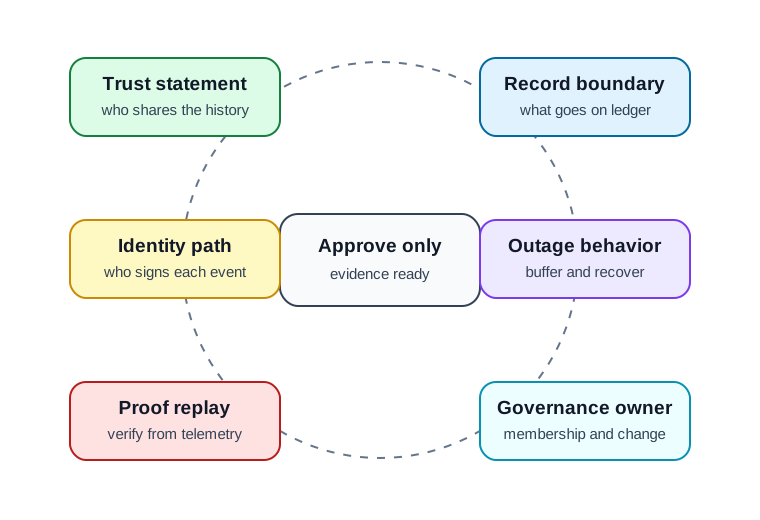
A fit record prevents a ledger from becoming a vague architecture ornament.

  • It names the shared fact, the party boundary, the off-ledger path, and the replay method before implementation starts.
  • The same record also needs failure behavior.
  • It also rejects designs that put personal occupancy traces, raw energy waveforms, or charger-stop commands on chain.

Why it matters

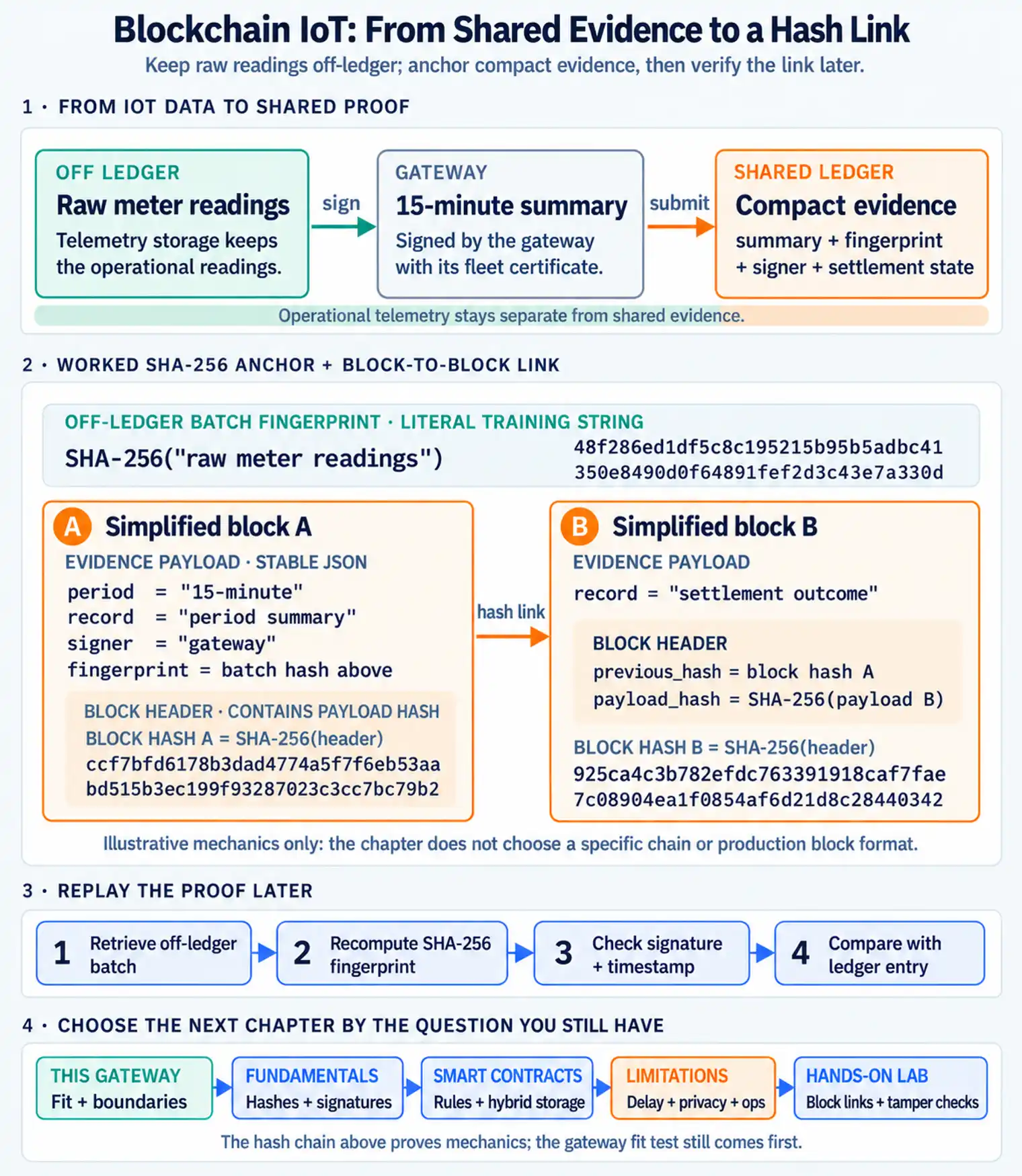
The record should name the canonical serialization used before hashing, such as stable JSON or CBOR, because replay fails if different systems sort fields or round timestamps differently.

iotclass.org

Major section

Blockchain Fit Record (continued)

If the proposal cannot answer those questions, the architecture is not ready for a ledger even if a prototype can write transactions.

  • A strong practitioner review rejects broad claims such as "transparency" or "trustless IoT" unless the team can point to the exact party that verifies the exact record.
  • Those belong in operational systems with retention, access control, correction, and privacy controls; the ledger should preserve the shared proof needed for later dispute review.
  • The record should name the canonical serialization used before hashing, such as stable JSON or CBOR, because replay fails if different systems sort fields or round timestamps differently.
iotclass.org

Major section

Finality Is Not a Deadline

Ledger finality is a settlement concept.

  • A gateway can submit a signed period summary after collecting readings.
  • A settlement partner can wait for finality before accepting a billing outcome.
  • In a permissioned system such as Hyperledger Fabric, finality depends on endorsement, ordering, validation, and commitment by the participating peers.
  • Proof replay is the bridge between those timelines.

Why it matters

The charger-control loop still runs locally or at the edge because it must respond on an operational deadline.

iotclass.org

Major section

Finality Is Not a Deadline (continued)

That process can be appropriate for accepting an energy-summary record, but it is the wrong place to wait before opening a relay or stopping a charger.

  • The ledger receives evidence after the control path has made the safe decision.
  • If the raw telemetry was corrected later, the corrected batch needs its own correction record; silently changing the old batch breaks replay.
  • If the gateway was offline, the outage queue should preserve order, mark the offline interval, and submit records with enough metadata to distinguish late evidence from live evidence.
iotclass.org

Major section

Shared Energy Meter Records

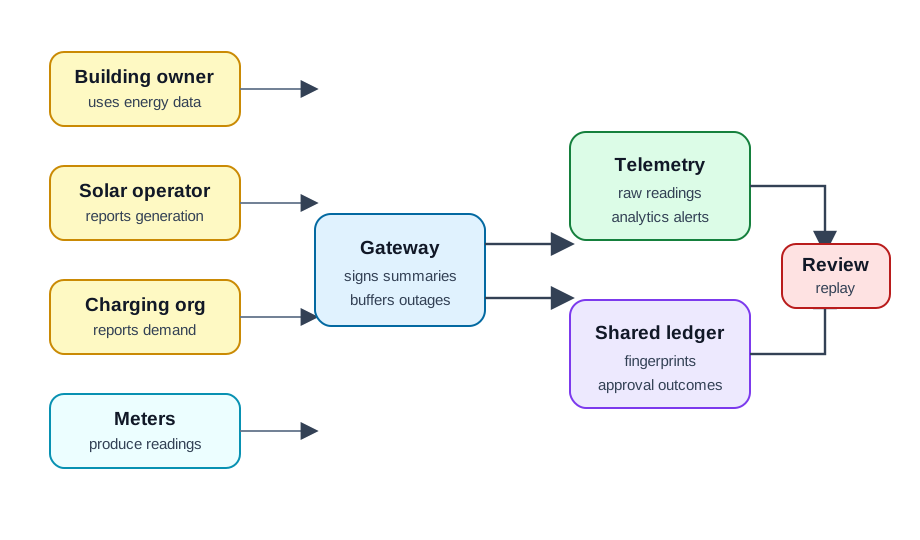
Each operator needs to trust that energy summaries, device ownership changes, and settlement approvals were not rewritten after a disagreement.

  • The architecture should not write every meter pulse to a ledger.
  • It should keep high-frequency readings in the telemetry platform and use the ledger for durable records that several parties need to inspect later.
A shared energy system keeps meter readings off ledger, writes signed summaries and fingerprints to the ledger, and lets multiple parties review settlement evidence later.
iotclass.org

Major section

Shared Energy Meter Records (continued)

At architecture choice, Building owner makes the architecture testable.

  • Their combined proposition is: A shared energy system keeps meter readings off ledger, writes signed summaries and fingerprints to the ledger, and lets multiple parties review settlement evidence later.
  • The ledger gives the parties a shared history for important facts.
  • That boundary is where architecture review should focus.
iotclass.org

Deck summary

Key takeaways

All three need one durable handover history, but none should be able to rewrite it alone.

  • The ledger is not the sensor database, control loop, or dashboard.
  • The architecture challenge is to decide which of those facts deserve a shared ledger and which belong in normal IoT systems.
  • Trust boundary: The point where one organization can no longer be the only owner of the event history.
  • In a practical IoT architecture, the ledger is not placed at the sensor edge.
iotclass.org

Retrieval practice

Recall check 1 of 3

Cloud Clara says: answer from memory, then check your reasoning.

Q1A shared energy-meter project has building owners, charger operators, and a settlement partner. What should the team prove before adding a ledger?

AName the parties, shared records, signer, off-ledger readings, outage queue, replay path, and governance owner.
BApprove the ledger because the diagram shows gateways, dashboards, storage, and shared evidence.
CPut meter pulses, charger commands, dashboards, and raw inspection streams directly on the ledger.
DDefer admission, key recovery, rule changes, outage handling, and replay until after launch.
Show answer

Answer: A Blockchain fits the energy-metering case only when multiple parties need the same tamper-evident history.

iotclass.org

Retrieval practice

Recall check 2 of 3

Cloud Clara says: answer from memory, then check your reasoning.

Q2A shared charging project wants charger stop commands to wait for ledger finality so every partner agrees before power is cut. What is the correct architecture response?

AKeep charger control in the local or edge control path, then record signed summaries and settlement outcomes on the ledger for later review.
BRequire ledger approval before stopping a charger to prevent one partner from cutting power during a billing dispute without the others agreeing.
CStore only dashboard screenshots on the ledger because screenshots are easier to review than signed period records.
DLet each building owner edit the final shared history locally after settlement.
Show answer

Answer: A Blockchain can support shared settlement evidence, but real-time IoT control needs a separate operational path with predictable timing and failure behavior.

iotclass.org

Retrieval practice

Recall check 3 of 3

Cloud Clara says: answer from memory, then check your reasoning.

Q3A building owner controls every sensor, gateway, telemetry database, and dashboard in an energy monitoring system. No outside organization needs to verify the event history. What is the best architecture choice?

AUse a ledger for each meter pulse, alert, dashboard update, and maintenance log
BUse telemetry storage with signed events, access control, backups, and audit logs
CMove charger control onto the ledger so settlement and power actions share timing
DReplicate raw logs to outside partners even though no partner needs verification
Show answer

Answer: B Blockchain fits IoT when several parties need a shared, tamper-evident history.

iotclass.org

Print reference

Answers

Answer key.

  1. A · Blockchain fits the energy-metering case only when multiple parties need the same tamper-evident history.
  2. A · Blockchain can support shared settlement evidence, but real-time IoT control needs a separate operational path with predictable timing and failure behavior.
  3. B · Blockchain fits IoT when several parties need a shared, tamper-evident history.
iotclass.org