Cloud, SDN & Production Architectures · Study deck
How Distributed Ledgers Work
Imagine a food shipment handled by a farm, carrier, warehouse, and shop.
Cloud Clara is your guide for this deck.

After studying this chapter
Learning objectives
You will be able to:
- Explain: Practical designs record the hash algorithm, canonical serialization, batch window, clock source, signer identity, ledger transaction id, and storage location together, because a hash without those details can be impossible to reproduce.
- Explain: That observation connects this visual to the chapter's running narrative: use it to justify the next design decision and to record what evidence would confirm it in operation.
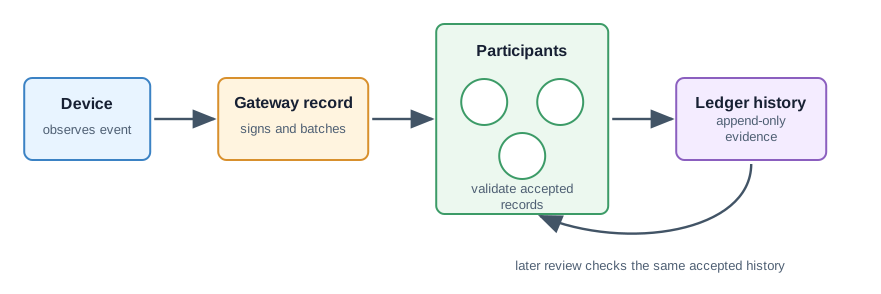
- Explain: A device or gateway observes an event, signs or packages it, sends it to the ledger network, and participating nodes validate the event according to agreed rules.
- Explain: Different ledger patterns make different tradeoffs.
Major section
Start With the Trust Boundary
Each group needs the same handoff history, but no single group should be able to rewrite it alone.
- A distributed ledger is a shared record that several parties check before accepting new entries.
- Telemetry means readings sent from a remote device.
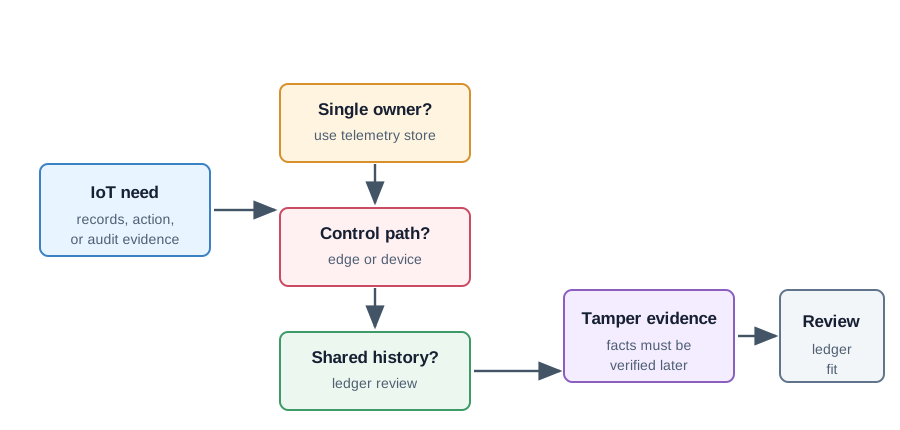
- If one trusted owner can run the record well, a normal database may be simpler.
Major section
Start With the Trust Boundary (continued)
If fast control is the job, keep it off the shared ledger.
- The ledger must solve a real trust boundary.
- This simple chain does not make device data true, private, or fast.
- It only changes how parties share and protect selected records.
- The Practitioner section tests whether the pattern fits.
Major section
In 60 Seconds · Why This Matters
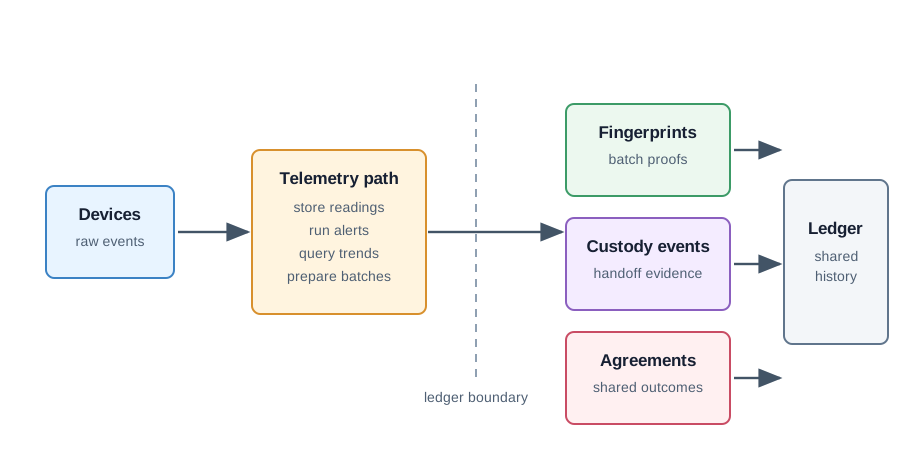
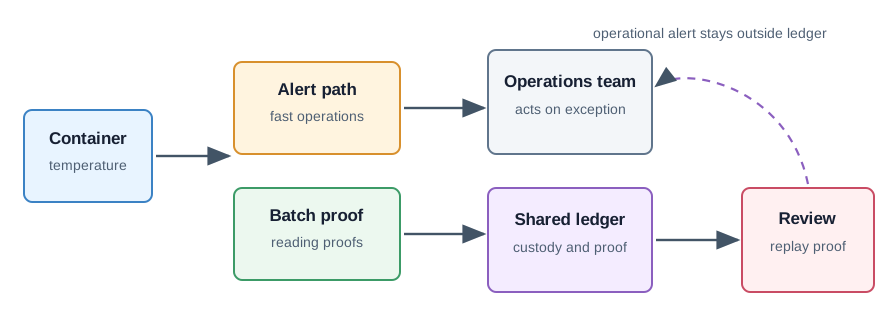
In practical IoT architecture, raw telemetry usually stays off ledger; the ledger records proofs, custody events, identity actions, and agreement outcomes.
- A shipment may move through a manufacturer, carrier, warehouse, clinic, and insurer.
- A building may contain devices maintained by different contractors.
- Distributed ledgers can help with that narrow trust problem.
Major section
Key Concepts · The Trust Boundary
Append-only history: A record structure where new events are added without editing earlier accepted entries.
- Hash link: A cryptographic fingerprint that connects an entry or batch to prior records, making later alteration detectable.
- Consensus: The process by which ledger participants agree which records are accepted.
- It usually does not need a distributed ledger.
Major section
How a Ledger Record Is Created
The basic flow is simple, even though production ledgers add many details.
- A device or gateway observes an event, signs or packages it, sends it to the ledger network, and participating nodes validate the event according to agreed rules.
- Once accepted, the event becomes part of an append-only history.
Major section
How a Ledger Record Is Created (continued)
That boundary must be explicit because it determines key storage, replay handling, outage behavior, and who can prove what happened.
- That observation connects this visual to the chapter's running narrative: use it to justify the next design decision and to record what evidence would confirm it in operation.
- The important architecture detail is that the device is rarely a full ledger participant.
- Resource-constrained devices normally send signed observations to a gateway or service.
Major section
Ledger Patterns for IoT · What Goes On Ledger
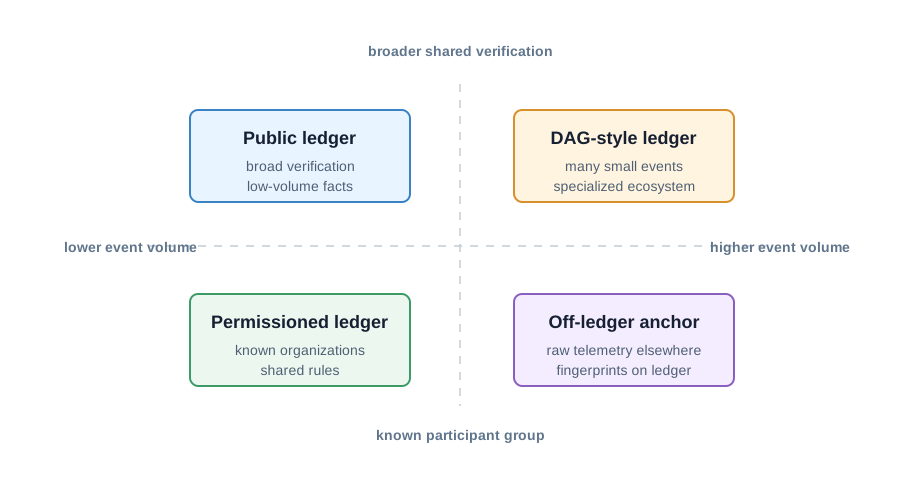
Different ledger patterns make different tradeoffs.
- A checklist alone cannot settle ledger patterns for iot.
- Their relevance to many small events is: Public, permissioned, off-ledger anchoring, and DAG-style ledger patterns serve different IoT trust and throughput needs.
- Most IoT telemetry should not be written directly to a ledger.
Major section
The Trust Boundary Creates the Ledger · Route Facts to the Right Store
The raw signal, the operational alert, and the shared proof are different artifacts.
- A distributed ledger is useful only when the record owner is part of the problem.
- A cold-chain shipment may pass through a manufacturer, carrier, warehouse, and clinic.
- The ledger is therefore not the whole IoT architecture.
Major section
Consensus Accepts Records
Hashing, signatures, consensus, and finality solve a narrow problem: they make an accepted record hard to alter without detection.
- They do not prove that the sensor was calibrated, that the gateway was honest, or that the business rule was fair.
- A replayable proof chain has several links.
- The raw batch remains retrievable off ledger.
- Participants accept the compact record.
Major section
Consensus Accepts Records (continued)
A hash is computed with a known method and ordering rule.
- Consensus and finality also need context.
- Public blockchains, permissioned ledgers such as Hyperledger Fabric, and DAG-style systems make different assumptions about membership, throughput, settlement, privacy, and governance.
- Break any link and the ledger still contains an entry, but the architecture loses proof value.
Major section
Consensus Accepts Records (continued)
IoT architecture usually favors permissioned or anchored designs because participants are known, telemetry is high volume, and raw data often cannot be replicated to every node.
- Even then, finality is not a substitute for operational safety: control commands, alarms, and device recovery must work without waiting for ledger agreement.
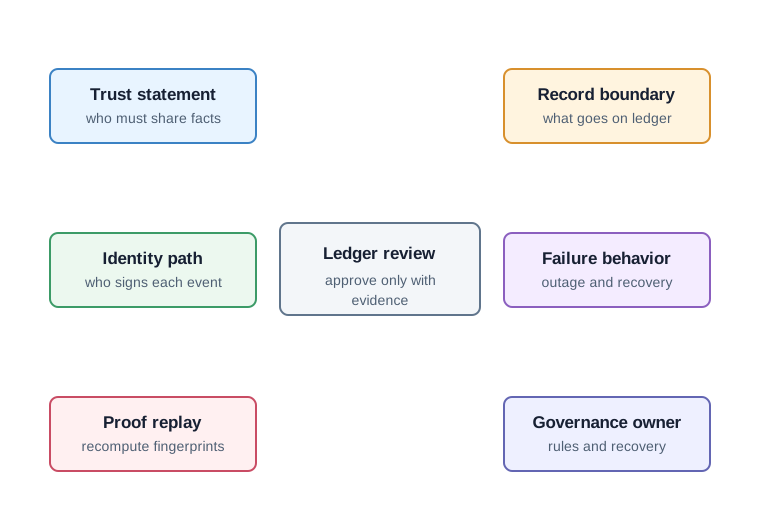
- A missing raw batch, unknown hash method, lost signing key, disputed timestamp source, or unassigned governance owner can make an immutable record operationally weak.
- Practical designs record the hash algorithm, canonical serialization, batch window, clock source, signer identity, ledger transaction id, and storage location together, because a hash without those details can be impossible to reproduce.
Major section
Cold-Chain Ledger Records
Each party needs confidence that handoff times, container identity, and temperature records were not quietly rewritten after a dispute.
- The temperature stream is frequent, and alerts must be handled quickly.
- It changes data placement, identity handling, outage recovery, and dispute handling.
- This supports architecture decision record.
Major section
Security Limits · Do Not Put Control Loops On Ledger
Blockchain is not an IoT security shortcut.
- It records what authorized participants submit.
- If a device key is stolen, a sensor is physically manipulated, or a gateway signs bad data, the ledger may preserve a false event very reliably.
- Real-time control needs predictable local response.
Deck summary
Key takeaways
Each group needs the same handoff history, but no single group should be able to rewrite it alone.
- If fast control is the job, keep it off the shared ledger.
- In practical IoT architecture, raw telemetry usually stays off ledger; the ledger records proofs, custody events, identity actions, and agreement outcomes.
- Append-only history: A record structure where new events are added without editing earlier accepted entries.
- The basic flow is simple, even though production ledgers add many details.
Retrieval practice
Recall check 1 of 3

Cloud Clara says: answer from memory, then check your reasoning.
Q1A cold-chain shipment moves through a manufacturer, carrier, warehouse, and receiving site. What must be proven before choosing a distributed ledger?
Show answer
Answer: A A cold-chain ledger decision starts with the multi-party trust boundary, the exact custody and fingerprint records to share, the off-ledger temperature and alert path, and the signing, replay, recovery, and governance rules.
Retrieval practice
Recall check 2 of 3

Cloud Clara says: answer from memory, then check your reasoning.
Q2A cold-chain consortium stores batch fingerprints on a permissioned ledger. During a dispute, the original telemetry batch cannot be retrieved. What does the ledger still prove?
Show answer
Answer: A A ledger entry is only one link in the proof chain.
Retrieval practice
Recall check 3 of 3

Cloud Clara says: answer from memory, then check your reasoning.
Q3A company owns every sensor, gateway, database, and dashboard in its building monitoring system. No outside party needs to verify the records. What is the strongest architecture choice?
Show answer
Answer: C Distributed ledgers solve shared trust problems across parties.
Print reference
Answers
Answer key.
- A · A cold-chain ledger decision starts with the multi-party trust boundary, the exact custody and fingerprint records to share, the off-ledger temperature and alert path, and the signing, replay, recovery, and governance rules.
- A · A ledger entry is only one link in the proof chain.
- C · Distributed ledgers solve shared trust problems across parties.