Bluetooth & BLE · Study deck
BLE Encryption: Key Management
Bluetooth encryption protects data by scrambling it so that only devices with the right key can read it.
Radio Remi is your guide for this deck.

After studying this chapter
Learning objectives
You will be able to:
- Explain BLE Encryption Architecture: Describe how AES-CCM-128 encryption and key generation methods work together in BLE
- Analyze Key Hierarchy: Distinguish the roles of LTK, IRK, and CSRK in BLE security and justify when each is applied
- Apply Security Decision Framework: Select appropriate security levels for different IoT application contexts
- Implement Best Practices: Configure secure pairing and key storage for IoT deployments
Major section
In 60 Seconds
A home health device pairs with a nurse's tablet and sends private readings.
- Strong encryption cannot rescue a key that was given to the wrong party or never removed.
- The deeper sections explain the key hierarchy, privacy and signing roles, stored relationships, rotation, removal, and how the chosen pairing method changes the protection achieved.
- BLE encryption uses AES-CCM with 128-bit keys, but security depends on how keys are generated during pairing.
Major section
BLE Key Management Pattern
Encryption protects traffic only after the link has agreed on keys.
- Bonding stores long-term keys so devices can reconnect without repeating pairing.
- IRK supports privacy by resolving rotating private addresses for bonded devices.
- CSRK supports signed data on unencrypted links, but it does not replace encryption for sensitive traffic.
Major section
BLE Encryption Architecture
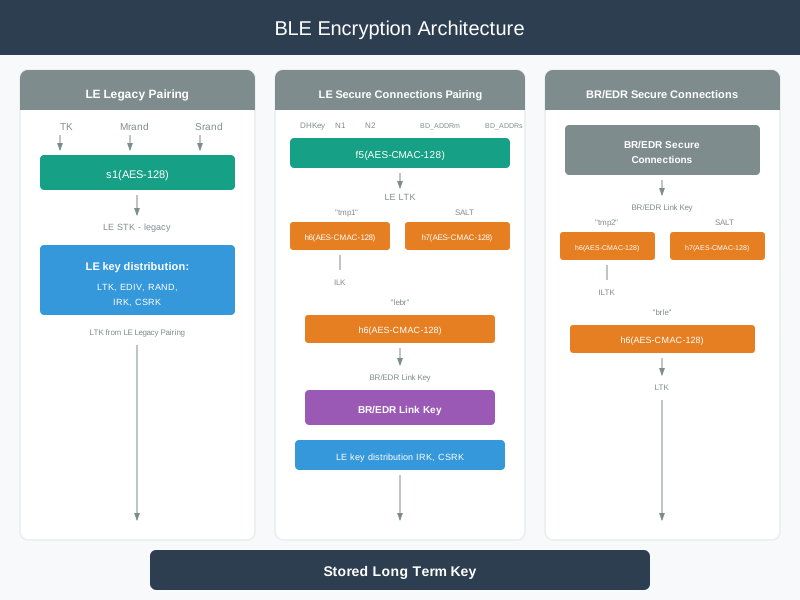
BLE supports multiple encryption architectures depending on pairing method and Bluetooth version.
- The comparison connects protocol choice to threat evidence: modern derivation protects against passive capture, while MITM resistance still depends on the authenticated association method.
- This provides basic protection but can be vulnerable if the temporary key has low entropy or the pairing exchange is captured.
Major section
BLE Key Hierarchy
In an implementation record, map each role to its actual storage owner, creation event, allowed use, reset behavior, and deletion proof.
- That prose-to-inventory connection is what prevents a technically correct key name from becoming an unmanaged credential.
- TK (Temporary Key): Generated during pairing, depends on pairing method.
Major section
Security Decision Framework
Device has no display, keyboard, or NFC.
- Data is already encrypted at application layer.
- Risk acceptance:: Anyone can read data (that's the intent).
- Device has display OR keyboard (not both).
- Both devices have displays.
Major section
Security Decision Framework (continued)
User can verify 6-digit code.
- Device has NFC or can display QR code.
- Security: Attacker must compromise both channels (Bluetooth + NFC/QR).
- Method selection begins with the consequence of impersonation and the I/O that both endpoints can actually support.
- Displayless products still need an authenticated commissioning choice.
Major section
Security Decision Framework (continued)
Security depends on that channel being hard for the attacker to observe or modify.
- Public, read-only broadcasts may accept an unauthenticated path; owner control, safety-relevant commands, or sensitive records need user-authenticated proof.
- A printed static value also has a different observation and reuse risk from a fresh displayed passkey, a two-display comparison, or a protected out-of-band channel.
- OOB:: Security depends on the out-of-band channel and the secret you exchange.
Deck summary
Key takeaways
A home health device pairs with a nurse's tablet and sends private readings.
- Encryption protects traffic only after the link has agreed on keys.
- BLE supports multiple encryption architectures depending on pairing method and Bluetooth version.
- In an implementation record, map each role to its actual storage owner, creation event, allowed use, reset behavior, and deletion proof.
- Device has no display, keyboard, or NFC.
Retrieval practice
Recall check 1 of 2

Radio Remi says: answer from memory, then check your reasoning.
Q1A reviewer is checking the Bluetooth security decision for this topic. Which evidence keeps the claim bounded?
Show answer
Answer: A Bluetooth security review should separate pairing, encryption, key management, authorization, and recovery evidence.
Retrieval practice
Recall check 2 of 2

Radio Remi says: answer from memory, then check your reasoning.
Q2In BLE legacy pairing, which two values are used by the Central to identify and retrieve the correct LTK during reconnection?
Show answer
Answer: B In legacy pairing, the Peripheral distributes the LTK together with its EDIV and Rand.
Print reference
Answers
Answer key.
- A · Bluetooth security review should separate pairing, encryption, key management, authorization, and recovery evidence.
- B · In legacy pairing, the Peripheral distributes the LTK together with its EDIV and Rand.