Design Methodology · Study deck
Automotive Qualification: Mission Profiles
A part may pass an automotive test and still fail in its exact place in a car.
Blueprint Bina is your guide for this deck.
After studying this chapter
Learning objectives
You will be able to:
- Read an automotive sensor datasheet as evidence for a specific vehicle function, not as a generic feature list.
- Distinguish component qualification evidence from system safety evidence.
- Check AEC-Q qualification, temperature grade, lifetime, EMC, environmental, interface, and diagnostic claims.
- Build a release packet for seat, crash, TPMS, and ADAS sensing examples without relying on unsupported cost or performance shortcuts.
Major section
Start With the Vehicle Claim
A table may say it can bear heat and shock.
- The team must link each part claim to the real place, task, and harm.
- A datasheet is the maker's list of part limits and test facts: Qualification is proof that a part passed a named set of tests.
- Parts can change while a product is sold.
Major section
Start With the Vehicle Claim (continued)
AEC-Q is one set used for car parts.
- Qualification helps the case, but it does not test the whole vehicle feature.
- The maker may prove a chip at a set heat range.
- The team must still prove its board, case, wires, code, mounting, and full vehicle path.
- A datasheet row is not a bench result.
Major section
Start With the Vehicle Claim (continued)
A pass for a cabin comfort sensor is not a pass for a crash sensor.
- Seat sensing, tyre pressure, radar, and crash sensing each need a different record.
- Retest after a part, factory, package, board, code, or mission changes.
- This Overview uses clear pass limits for one part in one vehicle job.
Major section
Start With the Vehicle Claim (continued)
Real safety work also needs system analysis, standards, and tests run by the right experts.
- Under the Hood checks timing, power, faults, supply change, and safety limits.
- The part must tell an empty seat from a person and from a heavy bag.
- The unit spins, heats, cools, shakes, and runs from a small cell.
Major section
Start With the Vehicle Claim (continued)
Rain, dirt, another vehicle, mounting angle, and a changed bumper can alter the view.
- A chip range in a table does not prove the full view.
- The time path is short and the harm is high.
- For each case, start with the maker's limits.
- A bench result is not a road result.
Major section
Start With the Vehicle Claim (continued)
A supplier note is not a safety sign-off.
- This makes gaps plain before the release meeting.
- A replacement with the same short name may have a new die, package, test, or build.
- A top heat value may apply for a short time or only at low load.
Major section
Start With the Vehicle Claim (continued)
A time value may depend on power, mode, or bus speed.
- They should find the limit, test terms, source file, full-system check, owner, and open gap.
- If the trail breaks, the part is not ready for that claim.
- The datasheet helps the case; it is not the whole case.
Major section
Qualify Vehicle Claim, Not Part
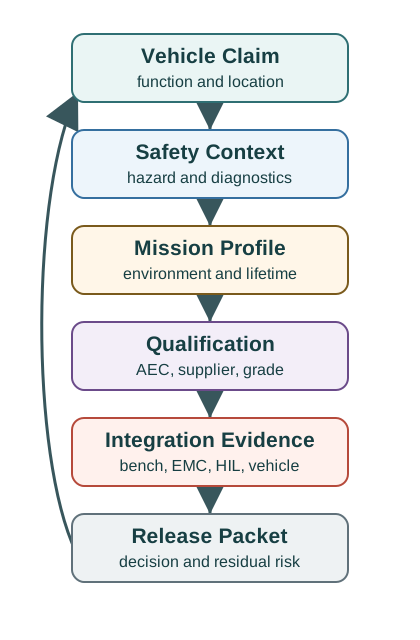
The route in Figure: Automotive datasheet review turns component rows into qualification starts with the vehicle claim, then checks its safety context and mission profile before component data can support qualification alongside integration evidence.
- That choice changes the evidence burden.
- A cabin temperature reading may need supply tolerance, airflow, response time, and user-comfort checks.
- A TPMS pressure reading adds battery derating, wheel-temperature exposure, RF link evidence, regional frequency variants, and missed-message behavior.
Major section
Qualify Vehicle Claim, Not Part (continued)
A radar or crash-sensing path adds latency, synchronization, diagnostics, plausibility, redundancy, scenario evidence, and a safety-analysis boundary.
- The practical habit is to separate proof layers before the team chooses a part.
- The assembled ECU and harness must then prove power sequencing, bus timing, timestamping, fault reactions, current draw, EMC behavior, and mechanical mounting.
- The vehicle program must decide hazard context, release risk, service strategy, monitoring, and supplier-change response.
Major section
Qualify Vehicle Claim, Not Part (continued)
Keeping those layers separate prevents a qualified component from being promoted into a full vehicle claim.
- Component claim: AEC-Q status, grade, package, operating limits, diagnostics, and supplier controls support the selected component.
- Vehicle claim: ISO 26262 work, scenario validation, HIL, EMC, environmental testing, and release governance decide whether the function can ship.
- The same row can be acceptable in one location and unacceptable in another because temperature, vibration, moisture, electromagnetic exposure, lifetime, mounting, and service access change the interpretation.
Major section
Build Automotive Qualification
Useful rows include recommended operating conditions, absolute maximum ratings, accuracy across temperature, supply range, startup timing, current modes, interface timing, diagnostic flags, package notes, lifetime notes, and product-change controls.
- AEC-Q100, AEC-Q101, AEC-Q103, AEC-Q104, or AEC-Q200 can matter depending on the component family.
- IATF 16949, PPAP, approved vendor lists, and supplier change notifications may shape production control.
- A pressure accuracy row without temperature, compensation, and calibration conditions is not enough for a TPMS claim.
Major section
Build Automotive Qualification (continued)
A radar range row without target assumptions, field of view, mounting, radome material, weather limits, update rate, and timestamp behavior is not enough for ADAS.
- A self-test row without ECU fault reaction, diagnostic trouble code behavior, degraded-mode policy, and fault-injection evidence is not enough for a safety mechanism.
- The release packet should be reproducible.
- If a claim depends on a typical value, mark it as a risk unless the final board measurement proves the margin.
Major section
Why Datasheet Rows Fail in Cars
A credible datasheet review keeps those owners separate.
- A radar module may meet range and update-rate rows, while the feature still depends on bumper material, radome contamination, calibration, time synchronization, object tracking, and fusion confidence.
- The hidden boundary is usually state ownership.
- Electrical and timing margins are another common failure path.
Major section
Why Datasheet Rows Fail in Cars (continued)
Environmental and EMC evidence also changes the meaning of a row.
- The vehicle program owns hazard analysis, PPAP or part-approval flow, supplier change notification, service strategy, cybersecurity assumptions, and release acceptance.
- Temperature range does not prove calibration drift in the installed package.
- Shock survival does not prove mounting integrity after a vehicle event.
Major section
Why Datasheet Rows Fail in Cars (continued)
A sensor can satisfy its recommended operating conditions while the assembled board violates startup sequencing, ground offset, pullup sizing, bus loading, interrupt polarity, sample timestamping, or reset recovery.
- A LIN or CAN FD message that looks correct on a bench trace may still miss the diagnostic timing budget after gateway load, sleep transitions, clock drift, or fault handling.
- A SENT or PSI5 path may need different capture evidence from a register-based SPI or I2C sensor because the diagnostic and timing information is carried differently.
- EMC immunity guidance does not prove the harness, connector, filtering, shielding, and software recovery path.
Major section
What This Chapter Adds
Automotive datasheet review adds qualification pressure.
- The question is not only "does the sensor measure the value?" The question is "can this component support this vehicle function under the required safety, environmental, electrical, EMC, lifetime, diagnostic, and supplier-control assumptions?".
- Function Start from the vehicle claim Seat occupancy, crash detection, TPMS, radar, or camera support different evidence needs.
- Qualification Check automotive status AEC-Q qualification, temperature grade, package, and supplier controls support component use, not the full safety case.
- Environment Use a mission profile Temperature, vibration, humidity, supply transients, EMC, and lifetime must match where the sensor is installed.
Deck summary
Key takeaways
A table may say it can bear heat and shock.
- AEC-Q is one set used for car parts.
- A pass for a cabin comfort sensor is not a pass for a crash sensor.
- Real safety work also needs system analysis, standards, and tests run by the right experts.
- Rain, dirt, another vehicle, mounting angle, and a changed bumper can alter the view.
Retrieval practice
Recall checks 1–2 of 3

Blueprint Bina says: answer from memory, then check your reasoning.
Q1A cabin sensor is proposed for a wheel-mounted TPMS module. What should the qualification review reconsider?
Show answer
Answer: A Temperature, vibration, moisture, mounting, and lifetime change the meaning of component limits.
Q2A TPMS review cites a pressure-accuracy row without its temperature conditions. What should be added?
Show answer
Answer: A The chapter requires conditions attached to the number for the vehicle claim.
Retrieval practice
Recall check 3 of 3
Blueprint Bina says: answer from memory, then check your reasoning.
Q3An automotive sensor carries a component qualification mark. What can the vehicle team infer?
Show answer
Answer: B Part qualification supports use but does not prove the system behavior.
Print reference
Answers
Answer key.
- A · Temperature, vibration, moisture, mounting, and lifetime change the meaning of component limits.
- A · The chapter requires conditions attached to the number for the vehicle claim.
- B · Part qualification supports use but does not prove the system behavior.