Design Methodology · Study deck

Automotive Qualification: Evidence Gates

A datasheet row is evidence only inside its stated limit and test.

Blueprint Bina is your guide for this deck.

specsheetautomotive
Blueprint Bina, the module guide, in a scene from this chapter.
iotclass.org

After studying this chapter

Learning objectives

You will be able to:

  • Explain: The datasheet rows for pressure range, temperature compensation, current, wake behavior, RF interface, and package must be evaluated against a wheel mission profile, not a room-temperature demo.
  • Explain: That progression connects Automotive release review combines datasheet evidence with qualification, safety, environmental, EMC, integration, and residual-risk evidence to the next: Release Evidence Gate check.
  • Explain: The datasheet may state range and error, but the system must classify occupants under seat foam variation, temperature, mounting tolerance, aging, electrical noise, and unusual loads.
  • Explain: AEC-Q status, temperature grade, package, reliability notes, product status, and change-control path.
iotclass.org

Major section

Extract the Automotive Evidence Rows
The first pass should produce a compact evidence table.

  • AEC-Q status, temperature grade, package, reliability notes, product status, and change-control path.
  • Diagnostics, self-test, fault flags, redundancy support, plausibility paths, and failure modes.
  • Operating temperature, storage temperature, vibration, shock, humidity, chemical, and mechanical limits.
  • Supplier evidence, part approval record, and change-control owner.
iotclass.org

Major section

Four Application Patterns

Automotive examples are useful when they show different evidence needs.

  • A part specification alone cannot establish that the application works.
  • Classify occupancy state to support warnings or restraint decisions.
  • Range, accuracy, drift, response, diagnostics, mounting, and temperature limits.
  • Seat build variation, calibration, misuse cases, plausibility, HIL, and vehicle tests.
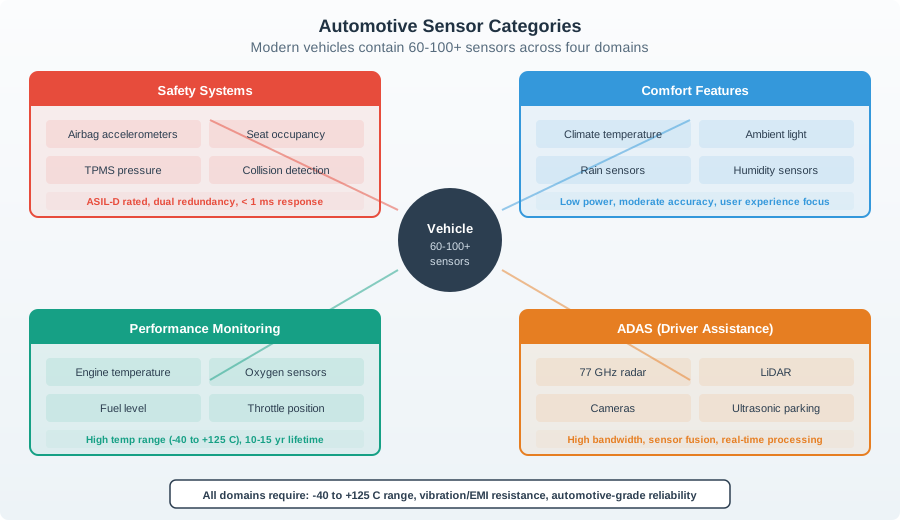
Automotive sensor categories carry different evidence burdens: safety systems demand redundancy and response-time proof, while comfort, performance monitoring, and ADAS add their own power, lifetime, and processing constraints.
iotclass.org

Major section

Incremental Examples

A front radar module review cannot stop at range and update rate.

  • A cabin HVAC sensor is a lower-risk starting point than a restraint or ADAS sensor, but it still needs automotive qualification discipline.
  • A TPMS review connects the pressure row to the wheel mission profile.
  • The datasheet supports component capability; the perception and control claim requires system validation.
iotclass.org

Major section

Seat Occupancy Example

Seat sensing is a good example of why accuracy rows cannot be read in isolation.

  • The datasheet may state range and error, but the system must classify occupants under seat foam variation, temperature, mounting tolerance, aging, electrical noise, and unusual loads.
  • Integration Seat stack matters Foam, upholstery, rails, mounting, vibration, and aging can shift the measured signal.
  • Evidence Calibrated decision Release needs calibration, classification logs, fault handling, and borderline-state review.

Why it matters

Claim Classification Name the required seat states and what each state allows the vehicle to do.

iotclass.org

Major section

Crash and Restraint Sensing Example

Crash sensing cannot be reduced to a high acceleration range.

  • The review needs latency, bandwidth, shock survival, self-test, diagnostics, redundancy, plausibility checks, and algorithm evidence.
  • The sensor can represent expected acceleration without saturating under the target scenario.
  • The system will deploy correctly, avoid nuisance deployment, or classify crash severity correctly.
iotclass.org

Major section

TPMS Example

TPMS is a useful low-power automotive IoT pattern.

  • The datasheet rows for pressure range, temperature compensation, current, wake behavior, RF interface, and package must be evaluated against a wheel mission profile, not a room-temperature demo.
  • Range, accuracy, compensation, response, and overpressure limit.
  • Typical current assumptions fail over service life.
  • Temperature, shock, vibration, package, sealing, and storage limits.
iotclass.org

Major section

Release Evidence Gate

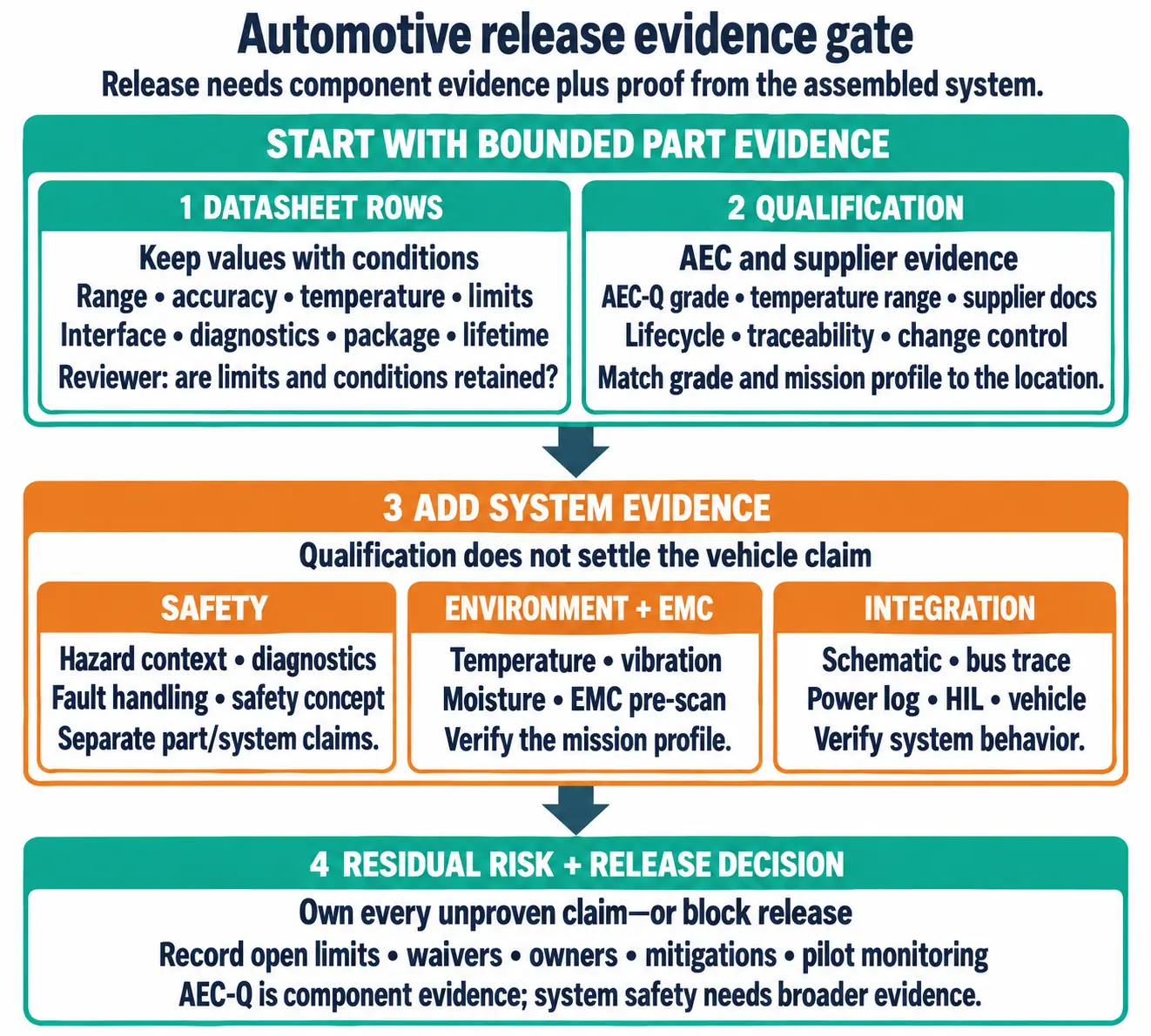
That progression connects Automotive release review combines datasheet evidence with qualification, safety, environmental, EMC, integration, and residual-risk evidence to the next: Release Evidence Gate check.

  • Rows for range, accuracy, temperature, electrical limits, interface, diagnostics, package, and lifetime.
  • AEC-Q grade, supplier documents, lifecycle status, traceability, and change-control path.
Automotive release review combines datasheet evidence with qualification, safety, environmental, EMC, integration, and residual-risk evidence.
iotclass.org

Deck summary

Key takeaways

The first pass should produce a compact evidence table.

  • Automotive examples are useful when they show different evidence needs.
  • A front radar module review cannot stop at range and update rate.
  • Seat sensing is a good example of why accuracy rows cannot be read in isolation.
  • Crash sensing cannot be reduced to a high acceleration range.
iotclass.org

Retrieval practice

Recall check 1 of 3

Blueprint Bina says: answer from memory, then check your reasoning.

Q1Place each automotive evidence artifact where it lives so you can separate a qualified component from a safe, serviceable vehicle function.

AVehicle Claim
BSafety Context
CMission Profile
DComponent Qualification
EIntegration Evidence
FRelease Packet
Show answer

Answer: A Place each automotive evidence artifact where it lives so you can separate a qualified component from a safe, serviceable vehicle function.

iotclass.org

Retrieval practice

Recall check 2 of 3

Blueprint Bina says: answer from memory, then check your reasoning.

Q2A sensor datasheet says the component is AEC-Q qualified. What is the strongest conclusion for a safety-relevant vehicle function?

ATreat AEC-Q as component evidence; still build safety analysis, diagnostics, integration tests, and release packet.
BTreat AEC-Q as ISO 26262 approval if the supplier lists the part in an automotive catalog.
CUse AEC-Q to skip EMC and bench testing once the part is soldered on the production board.
DThe sensor can be used in any vehicle location without checking temperature or vibration.
Show answer

Answer: A AEC-Q qualification supports component-level confidence, while system safety and release claims need broader evidence.

iotclass.org

Retrieval practice

Recall check 3 of 3

Blueprint Bina says: answer from memory, then check your reasoning.

Q3A TPMS pressure sensor datasheet lists a very low typical sleep current. What evidence is still needed before accepting a service-life claim?

AMission-profile current budget with measured sleep, active, RF, temperature, battery derating, and final wake behavior.
BUse the typical sleep-current row with nominal battery capacity and skip RF burst or wake measurements.
CUse final product photos plus a packaging check to confirm the module supports the claimed lifetime.
DUse only the CAN database and assume message timing proves battery draw during parking states.
Show answer

Answer: A Automotive low-power claims need mission-profile evidence, measured current by state, battery derating, and integration logs.

iotclass.org

Print reference

Answers

Answer key.

  1. A · Place each automotive evidence artifact where it lives so you can separate a qualified component from a safe, serviceable vehicle function.
  2. A · AEC-Q qualification supports component-level confidence, while system safety and release claims need broader evidence.
  3. A · Automotive low-power claims need mission-profile evidence, measured current by state, battery derating, and integration logs.
iotclass.org