Authentication & Access · Study deck
Operating Access Control
Picture a service engineer who receives extra rights for a repair and closes the screen without signing out.
Shield Shelly is your guide for this deck.

After studying this chapter
Learning objectives
You will be able to:
- Explain: A design needs both: absolute alone lets an abandoned terminal stay open until its hard limit, and idle alone lets an attacker keep a hijacked session alive forever with periodic activity.
- Explain: Elevation is not the same as changing someone's role: it is temporary, bounded, and recorded, which keeps a precise audit trail of exactly when extra authority was used and why.
- Explain: Idle and absolute timeouts therefore govern the lifetime of this continuing authority, which is why the refresh path needs separate protection rather than being treated as an unlimited extension.
Major section
Overview: Access Control That Lives Over Time
The system must end those rights even if the person forgets.
- A gateway means the boundary system that joins local devices to another network or service.
- A login is not the end of the security story.
- Operating access control is the discipline that keeps those ordinary events from becoming standing access.
Major section
Overview: Access Control That Lives Over Time (continued)
“Security is not a wall, it’s a list of who can do what — and the proof that the list is enforced.”.
- A technician leaves a console open, a token leaks into a log file, a gateway needs emergency rights for five minutes, or a refresh token keeps minting new access after the human has gone home.
- Four moving parts carry that process.
- Around all of it, audit records what happened.
Major section
Overview: Access Control That Lives Over Time (continued)
A token is short-lived proof of a prior authentication, not a standing key to the kingdom.
- A real system must keep deciding, continuously, as users log in and walk away, as tokens age out, as a device temporarily needs more rights and then gives them back, and as credentials are revoked.
- A session is the server's record that a principal authenticated and is currently active.
- Tokens expire and can be revoked.
Major section
Overview: Access Control That Lives Over Time (continued)
A guard can escort them into a restricted room for a few minutes (elevation), and cameras record the whole visit (audit).
- In this chapter she audits time itself — every session, token, and elevated right must show when it expires and who can end it early.
- Session versus token: A session is the server-side record of an active, authenticated principal.
- If you can separate sessions, tokens, timeouts, and elevation, you have the overview.
Major section
Practitioner: Run Sessions, Tokens, and Elevation
Operating access control means setting a handful of lifetimes and limits well, and coordinating them across the tiers of a system.
- The central trade-off is constant: shorter lifetimes shrink the window an attacker has with a stolen credential, but they cost more frequent refreshes, which on a battery device means more radio time and energy.
Major section
Practitioner: Run Sessions, Tokens, and Elevation (continued)
Tune each lifetime to the risk it carries.
- An absolute timeout caps the total session length so a session cannot live indefinitely, even for an active user.
- Verification can reject an expired or revoked token without repeating the original login.
- Who: whoever presents a refresh token; each one is single-use and invalidated when exchanged.
Major section
Practitioner: Run Sessions, Tokens, and Elevation (continued)
A design needs both: absolute alone lets an abandoned terminal stay open until its hard limit, and idle alone lets an attacker keep a hijacked session alive forever with periodic activity.
- Idle and absolute timeouts therefore govern the lifetime of this continuing authority, which is why the refresh path needs separate protection rather than being treated as an unlimited extension.
- Rotate them on every use and make each one single-use: when a refresh token is exchanged, invalidate it and issue a fresh one.
- Undetected refresh-token theft remains bounded by refresh expiry and detection policy.
Major section
Practitioner: Run Sessions, Tokens, and Elevation (continued)
Who: the operator who walked away — the gateway’s idle limit already says the human is gone.
- Elevation is not the same as changing someone's role: it is temporary, bounded, and recorded, which keeps a precise audit trail of exactly when extra authority was used and why.
- If their timeouts are not coordinated, a "zombie session" appears: an operator walks away, the dashboard sits open, and because its refresh token is still valid it keeps acting even though the human is gone.
- Refresh tokens are powerful because they mint new access tokens, so they need their own discipline.
Major section
Under the Hood: Lifecycle, Revocation, and the Stateless Trade-Off
The deeper layer shows how each request is actually validated, how escalation is detected, and why statelessness and instant revocation pull against each other.
- The details are where defense in depth either holds or quietly fails.
- A token arrives as untrusted bytes, and the validation order matters.
- Refresh has its own guards.
Major section
Under the Hood: Lifecycle, Revocation, and the Stateless Trade-Off (continued)
In parallel, compare now with session start for the absolute limit and with last activity for the idle limit.
- Who: rights are clamped to the principal’s ceiling the moment a token is minted.
- Escalation detection compares what was attempted against the ceiling.
- Encoding is not signing.
Major section
Under the Hood: Lifecycle, Revocation, and the Stateless Trade-Off (continued)
Proof: the request acts only after every layer passes, then success updates last activity while absolute and idle limits remain enforced.
- Any requested right that lies outside the principal's maximum authority is a forbidden bit, and a single forbidden bit marks an escalation attempt: it is audited and denied.
- Repeated attempts within a short window are treated as probing and can trigger a lockdown that terminates the session.
- The counter resets after the window passes, so a stray mistake does not permanently lock out a legitimate user.
- A compact encrypted JWT carried as JWE has five parts.
Major section
Under the Hood: Lifecycle, Revocation, and the Stateless Trade-Off (continued)
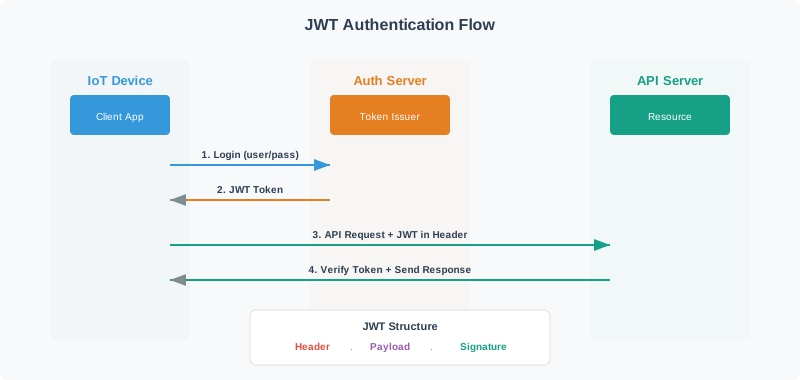
A compact signed JWT carried as JWS normally has three base64url parts: a protected header, a payload, and a signature.
- In this chapter, "signed token" means a compact JWS whose allowed algorithm, trusted key, and signature are all verified.
- Likewise, authoritative permission flags in a client-held token need that verification and a revocation plan; for prompt revocation, keep authoritative rights server-side or consult server-side state.
- A signed token can be verified using only the signing key, with no session store -- the appeal of stateless authentication is exactly this scalability.
Major section
Under the Hood: Lifecycle, Revocation, and the Stateless Trade-Off (continued)
But that same property is the cost: a stateless token remains valid until it expires, so there is no built-in way to revoke it early.
- If a token has total lifetime T and is stolen with time t already elapsed, the fraction of its life still usable to the attacker is (T − t) / T.
- Calling an unsigned payload a token: Without a verified signature it is forgeable; encoding is not signing.
- Long-lived tokens with no revocation: A leaked token is then a standing breach until it expires.
Deck summary
Key takeaways
The system must end those rights even if the person forgets.
- “Security is not a wall, it’s a list of who can do what — and the proof that the list is enforced.”.
- A token is short-lived proof of a prior authentication, not a standing key to the kingdom.
- A guard can escort them into a restricted room for a few minutes (elevation), and cameras record the whole visit (audit).
- Operating access control means setting a handful of lifetimes and limits well, and coordinating them across the tiers of a system.
Retrieval practice
Recall check 1 of 4

Shield Shelly says: answer from memory, then check your reasoning.
Q1In a well-designed system, what does an access token fundamentally represent?
Show answer
Answer: C The token conveys authorization within its scope and validity; it does not by itself prove a particular user logged in.
Retrieval practice
Recall check 2 of 4
Shield Shelly says: answer from memory, then check your reasoning.
Q2An operator console session is configured with an 8-hour absolute timeout and a 10-minute idle timeout. The operator authenticates, works briefly, then leaves the terminal unattended for 15 minutes. What happens on their return, and why?
Show answer
Answer: A The idle timeout exists exactly to reclaim unattended terminals.
Retrieval practice
Recall check 3 of 4
Shield Shelly says: answer from memory, then check your reasoning.
Q3A refresh token that was already exchanged appears again. What should the service do?
Show answer
Answer: B Reuse of an invalidated refresh token is a replay signal.
Retrieval practice
Recall check 4 of 4
Shield Shelly says: answer from memory, then check your reasoning.
Q4A service uses purely stateless, signed JWTs with a one-hour lifetime and keeps no server-side session state. Security requires that a user's access end immediately when they log out. What must change?
Show answer
Answer: C Statelessness trades away instant revocation.
Print reference
Answers
Answer key.
- C · The token conveys authorization within its scope and validity; it does not by itself prove a particular user logged in.
- A · The idle timeout exists exactly to reclaim unattended terminals.
- B · Reuse of an invalidated refresh token is a replay signal.
- C · Statelessness trades away instant revocation.