Sensor Applications · Study deck
Sensing Across Domains
Picture one temperature part used in a home, a food store, and a machine.
Physics Phoebe is your guide for this deck.

After studying this chapter
Learning objectives
The application purpose determines what counts as adequate measurement evidence.
- The same sensor family can need different evidence across domains.A greenhouse humidity reading and an archive-room humidity reading need separate placement, alert, maintenance, and validation boundaries.
- Application review needs condition, decision, data quality, and an evidence record.A tank-level value must have context and an allowed use before it can justify attention or an automatic refill command.
- The decision and measurement requirement set the hardware-selection basis.Range, power, water resistance, and replacement access matter when they support the stated field job rather than merely extending a feature list.
- Missing, stale, impossible, and valid extreme readings need distinct states.A tank value that stopped updating cannot establish a stable current level, even when the dashboard still has its last observation.
Major section
Start With the Domain Story
A temperature part can serve several jobs, each with a different evidence requirement.
- A home, food store, and machine can need different temperature responses.The physical property stays the same, while the people, timing, danger, and useful action change with the application.
- The application needs a condition, measurement location, and acceptable error.Those requirements connect the reading to its field purpose before a candidate part’s range or precision is compared.
- The required response time depends on how the condition can change.The chapter’s food-store claim warns the worker before food has been too warm for ten minutes.
- A hardware feature matters when it supports the stated field job.Low power, water resistance, or easier replacement can be useful only in relation to the same application card and installation needs.
Major section
A food warning needs a completed response
A useful application claim names the person, condition, timing, and response.
- The food-store warning needs to reach the worker within its stated window.The claim names a person, a too-warm condition, and ten minutes, giving the validation exercise a concrete endpoint.
- Warning delivery must reach someone able to complete the required response.A dashboard update cannot establish readiness when the field test has not shown who receives the condition and acts.
- A decision using several readings needs each contribution explained.The greenhouse example can combine humidity, soil moisture, light, and irrigation state before recommending the next action.
- A safe test condition can verify the intended action.The chapter ends field validation by triggering a known condition and checking the response rather than stopping when a number appears.
Major section
Placement, maintenance, and replacement
Installation and maintenance can change what an otherwise working sensor actually represents.
- Placement review needs the installer and maintainer’s knowledge.A door, cleaning spray, cable, dead battery, or hard-to-reach position can expose constraints missed by a desk review.
- Installation details can change what a working sensor represents.A comfortable air reading near the cold-room door may not establish the product temperature required by the handling rule.
- Trusted comparisons test the installed measurement under likely conditions.Moving the part to hot, cold, wet, or noisy spots checks whether the claimed reading survives the actual field arrangement.
- Replacement or relocation can require another measurement-path test.The repair record and retest trigger prevent evidence from the earlier position or part from silently covering a changed installation.
Major section
Units, age, gaps, and checked ranges
An honest display preserves uncertainty instead of making a chart look complete.
- The displayed value needs its unit and measurement time.A number without its sampling context cannot tell the worker whether it represents the condition that matters now.
- A missing report needs a visible gap or old-data state.The chapter delays or removes a report during validation to check that old and uncertain values remain clearly identified.
- Extra displayed digits cannot establish extra measurement accuracy.A more detailed-looking temperature value does not repair uncertain placement, missing observations, or an unvalidated sensor-to-action path.
- For example: "Warn the store worker before food has been too warm for ten minutes." This sentence names the person, the condition, and the time.
Major section
From decision question to retest record
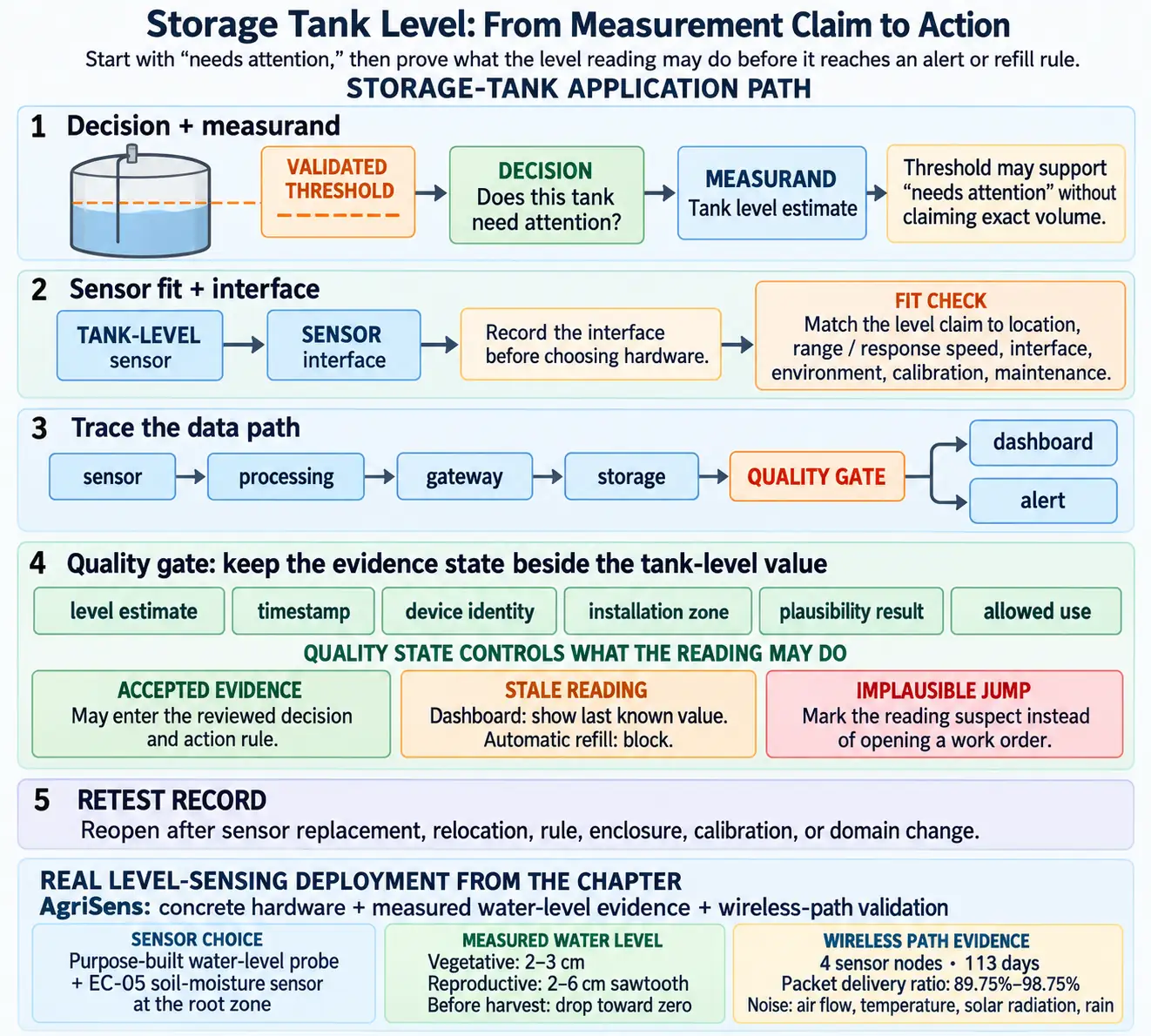
Follow the selection flow from the decision question to the quality gate and retest record.
- The opening decision question determines the measurand and environment.The selection flow begins with what the application must establish, so a broad domain label becomes a concrete measurement requirement.
- Sensor fit is checked before the data path.The diagram connects hardware suitability to the route by which the reading reaches its decision, keeping both evidence questions visible.
- The quality gate controls which readings may reach the action boundary.A tank’s last known value can remain on a dashboard while failed freshness checks prevent automatic refill.
- The retest record names changes that invalidate earlier permission.Relocation, calibration, enclosure, or alert-rule changes can reopen the application claim even when the same sensor family remains installed.
Major section
Cold storage, greenhouses, and machine vibration
A domain label becomes useful when it narrows the measurement claim.
- Cold storage needs evidence for the product’s handling condition.An air sensor near the door can report a comfortable value without establishing that the product temperature stayed within the required rule.
- Greenhouse decisions may need several related measurements.Humidity, soil moisture, light, and irrigation state can contribute different evidence before the application recommends an action.
- Machine vibration needs operating mode, load, mounting, and baseline context.An outlier cannot support diagnosis reliably when the record omits the machine state and trend that give the reading meaning.
- A domain label is useful when it narrows the measurement claim.Greenhouse, archive-room, and bathroom humidity use the same sensor family but require separate placement, alert, maintenance, and validation evidence.
Activity 1 · Draw it
✎ Give one sensor two jobs

I want you to show how context changes the claim even when the sensor family stays the same.
Draw application cards for greenhouse humidity and archive-room humidity. On each card, name the condition, placement, decision, validation check, and retest trigger. Circle the fields that need separate evidence.
4 minutes · Pen and paper · Answer: Activity 1
Major section
Four questions behind the measurement claim
Review axes connect the physical observation with the evidence required for the intended decision.
- The condition names the physical state the application needs to observe.The tank example needs a level-related observation, rather than a generic sensor value detached from its resource and location.
- The decision states whether the reading supports display, diagnosis, or action.A validated threshold may justify attention without establishing exact volume or authorizing an automatic control response.
- Data-quality rules define the evidence acceptable for that decision.Freshness, plausibility, calibration, range, noise tolerance, and missing-data behavior prevent an uncertain reading from looking fully accepted.
- The evidence record connects placement, validation, ownership, and retest conditions.Another reviewer needs the sensor choice, environment, data path, and action rule together to understand the tank application’s limited claim.
Major section
Context changes what a reading can prove
Specific deployments show why context must accompany a sensor reading.
- Room comfort depends on placement, airflow, sunlight, and occupancy.A temperature reading becomes useful when those conditions and the action rule explain which part of the room it represents.
- A tank threshold can justify attention without establishing exact liquid volume.The reviewed decision can be narrow, so a useful alert does not automatically support a more detailed quantity claim.
- Equipment outliers need operating mode and trend context.A vibration observation needs its load, mounting point, and baseline before the application can interpret the departure as meaningful.
- Phone sensing needs permissions, placement, user actions, and missing-sample handling.A phone accelerometer cannot establish a person’s activity from a value alone when placement and context remain unknown.
Major section
The application record comes before hardware
An application record connects hardware selection to a stated and bounded decision.
- The record needs the decision, measurand, unit, location, and range.Response speed and expected variation complete the physical requirement before candidate hardware is judged against the tank’s intended job.
- The data-path record connects preprocessing, timestamps, storage, and the decision.Freshness, plausibility, identity, and context checks are needed before a received reading is trusted by a dashboard, alert, or control rule.
- A tank-level claim does not establish liquid quality.The chapter makes this unsupported claim explicit so a valid measurement is not extended into a different physical property.
- Placement, calibration, enclosure, and decision-rule changes require retesting.A valid pilot record belongs to the reviewed installation and action, so a changed claim needs a new comparison run.
Major section
Missing, stale, impossible, and valid extreme
The value and its quality state must travel together into the decision rule.
- A missing reading is an absence of evidence, not a normal zero.Filling unavailable tank measurements with zeros can turn a data gap into a false condition in reports, alerts, or model training.
- A stale value cannot establish that the current condition stayed stable.The dashboard may show the last known tank level with its age while freshness failure blocks an automatic refill command.
- An impossible value and a valid extreme event need different responses.A jump faster than the tank can physically change can be marked suspect rather than opening an unsupported work order.
- Quality state must travel with the value into the decision rule.Freshness and plausibility checks determine the allowed use, preventing accepted display evidence from silently becoming permission for automation.
Activity 2 · Predict
✎ An old tank reading reaches the rule
I want you to keep the last observation visible without pretending it is current.
A tank level has stopped updating after a gateway outage. The dashboard still has its last value. Predict what the display and automatic refill rule should do, and identify the handoff that must enforce that choice.
3 minutes · Pen and paper · Answer: Activity 2
Major section
Purpose, quality, action, and evidence
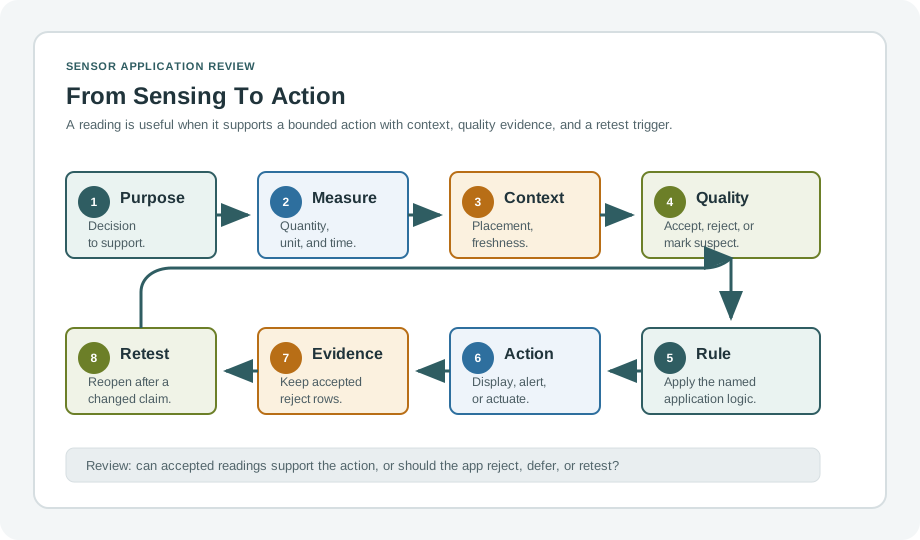
Follow the action chain from purpose through measurement and quality to the recorded outcome.
- The purpose block identifies the decision the application must support.The action-chain diagram starts here because monitoring, alerting, and automation can demand different strengths of measurement evidence.
- Measurement and context can establish what the reading represents.The greenhouse reminder needs the plant bed, probe placement, sample time, and accepted range alongside the soil-moisture value.
- The quality check permits only accepted evidence into the decision rule.An old reading after a gateway outage must retain its stale state instead of triggering a response that requires current evidence.
- Action, evidence, and retest connect the outcome with its reviewed claim.The record preserves why the action occurred, while a moved probe or a new automatic pump command can require another application review.
Major section
Evidence must survive each handoff
Each handoff must preserve the evidence needed by the next stage.
- A measurement record needs source identity, units, timestamps, and installation context.Correct storage proves that the record exists under reviewed conditions, but it does not establish validity for every environment or action.
- Decision rules must enforce the reviewed quality and context requirements.The chapter’s stale-value alert failure points to freshness classification and the quality-state handoff, even when timestamped storage works.
- The action record needs an owner and the rule version behind the response.A display, alert, report, or actuator command must remain connected to the accepted evidence and reviewed decision that produced the outcome.
- Threshold, data-path, firmware, and ownership changes require another claim review.A successful earlier handoff cannot establish that new recipients, action targets, or operating conditions preserve the application’s accepted behavior.
Deck summary
Key takeaways
Application readiness depends on an accepted measurement reaching an appropriate and owned action.
- The application decision determines the sensor-selection requirement.A home, food store, and machine may use the same temperature family while needing different timing, placement, validation, and response rules.
- Installation context determines which measurement claims remain supported.A cold-room air reading near a door cannot automatically establish the product condition required by the handling rule.
- Weak-data states must survive storage, display, analytics, and action rules.Missing zeros, copied stale values, and faults labelled as real events can undermine decisions even when the data pipeline keeps running.
- A successful dashboard update leaves the full response path unproven.The chapter’s field test needs a known condition, an observed recipient, a completed response, and retest rules after relevant changes.
Retrieval practice
Recall check 1 of 6
Physics Phoebe says: answer from memory, then check your reasoning.
Q1Two projects use humidity sensors, one in a greenhouse and one in an archive room. Why can their requirements differ?
Show answer
Answer: A The same measurand can support different domain decisions and validation records.
Retrieval practice
Recall check 2 of 6
Physics Phoebe says: answer from memory, then check your reasoning.
Q2A team wants to monitor whether a storage tank needs attention. Which review question should come before choosing the sensor hardware?
Show answer
Answer: A The application should start with the decision, measurand, context, and evidence boundary before choosing hardware.
Retrieval practice
Recall check 3 of 6
Physics Phoebe says: answer from memory, then check your reasoning.
Q3Why should a sensor application keep missing, stale, impossible, and valid extreme readings as separate states?
Show answer
Answer: D Domain-aware data quality keeps weak evidence from being mistaken for a real condition.
Retrieval practice
Recall check 4 of 6
Physics Phoebe says: answer from memory, then check your reasoning.
Q4A team says a sensor application is ready because readings appear on a dashboard. What should the review ask next?
Show answer
Answer: A Dashboard visibility is useful, but the application claim depends on the decision, quality rule, action, owner, and retest boundary.
Retrieval practice
Recall check 5 of 6
Physics Phoebe says: answer from memory, then check your reasoning.
Q5A cold-storage application sends alerts when temperature readings exceed a threshold, but it does not track sensor placement, freshness, or missing data. What is the strongest next improvement?
Show answer
Answer: C The application needs a bounded evidence path before the alert claim is reviewable.
Retrieval practice
Recall check 6 of 6
Physics Phoebe says: answer from memory, then check your reasoning.
Q6A sensor application stores timestamped readings correctly, but the alert rule still fires on stale values after a gateway outage. Which handoff should be reviewed first?
Show answer
Answer: B Storage worked, but stale readings were allowed into the decision path.
Print reference
Answers 1 of 2
Answer key.
- A · The same measurand can support different domain decisions and validation records.
- A · The application should start with the decision, measurand, context, and evidence boundary before choosing hardware.
- D · Domain-aware data quality keeps weak evidence from being mistaken for a real condition.
- A · Dashboard visibility is useful, but the application claim depends on the decision, quality rule, action, owner, and retest boundary.
- C · The application needs a bounded evidence path before the alert claim is reviewable.
Print reference
Answers 2 of 2
Answer key.
- B · Storage worked, but stale readings were allowed into the decision path.
Print reference
Activity 1 answer
Model answer.
Draw it: Both cards measure humidity, but their location, accepted conditions, response rule, maintenance, and validation need separate review. Each card should name its own action and retest triggers, such as relocation or a changed alert rule.
Print reference
Activity 2 answer
Model answer.
Predict: The display may show the last known value with its stale state and age. The automatic refill command should be blocked when freshness requirements fail. Review the quality-state classification and its handoff into the decision rule.