Sensor Applications · Study deck
Sensor Hardware Selection
Picture a cold room that must warn staff before food warms too far.
Physics Phoebe is your guide for this deck.

After studying this chapter
Learning objectives
You will be able to:
- select sensor hardware from a measurement claim (measurand, range, resolution, placement) rather than wiring convenience
- build a hardware decision record covering measurement fit, interface fit, evidence fit, and lifecycle fit
- check that an installed sensor still measures the target condition rather than an enclosure or mounting artifact
- name the field changes (relocation, enclosure, calibration) that reopen a hardware selection decision

Major section
Start With the Hardware Story
A sensor board may fit the plug and still read the warm case around itself instead of the air beside the food.
- A cheap part may need costly care.
- A precise part may fail in the wrong place.
- This cold-room story cannot choose one sensor for every job.
- A selected part is still a field claim.
Major section
Hardware Selection Starts With a Measurement Claim
Sensor hardware selection is the claim that a physical device can observe the right condition, in the right place, with enough quality for the application decision.
- A shopping list is not a selection record.
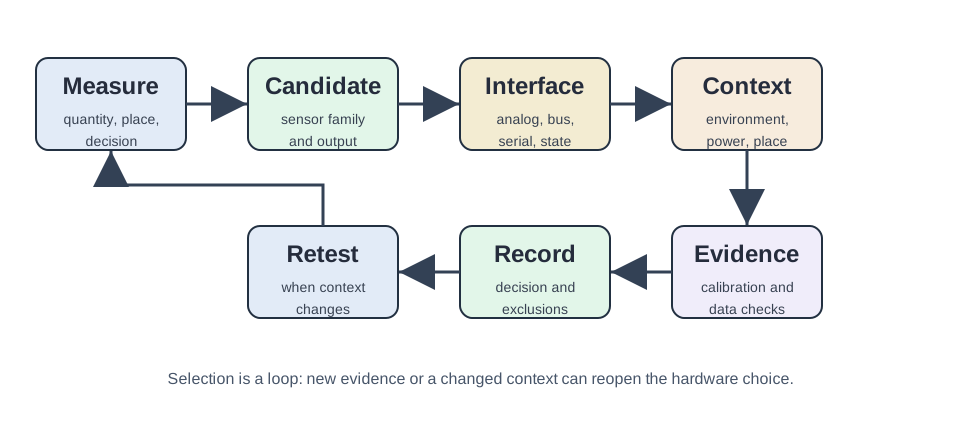
- The selection must connect the measurement need, installed environment, interface, power behavior, calibration plan, maintenance access, and validation evidence.
Major section
Hardware Selection Starts With a Measurement Claim (continued)
Worked example: Suppose a cold-room monitor must alert when product-area air temperature exceeds 8 °C for more than five minutes.
- A convenient board-mounted temperature sensor inside a sealed node may be easy to wire, but it measures enclosure temperature, not product-area air.
- Without those facts, the hardware is only compatible with the controller, not proven for the application decision.
- If you only need the intuition, use this rule: approve sensor hardware only when the selected device fits the measurand, placement, interface, environment, data-quality checks, maintenance plan, known limit, and retest trigger.
Major section
Hardware Selection Starts With a Measurement Claim (continued)
Measurement FitName the quantity, location, expected range, meaningful resolution, response behavior, and decision that depends on the reading.
- Interface FitCheck analog, digital, pulse, I2C, SPI, UART, 1-Wire, GPIO, timing, bus length, address, reference, and parsing assumptions.
- Evidence FitKeep calibration, reference comparison, plausibility checks, noise, drift, saturation, missing values, and quality-state behavior visible.
- Lifecycle FitReview power, enclosure, mounting, cleaning, replacement, firmware, ownership, and what field change reopens the hardware decision.
- Worked example. "Light sensor" is not a measurement claim; photoresistors, photodiodes, and phototransistors are three different transducer families that happen to share a name.
Major section
Build the Hardware Decision Record
A hardware decision record captures why one candidate was accepted and why alternatives were rejected.
- It should be clear enough that another reviewer can repeat the reasoning after procurement, installation, maintenance, or replacement.
- Physical quantity, units, expected span, mounted location, enclosure influence, response need, and decision threshold.
- Rejected candidates are useful evidence.
Major section
Build the Hardware Decision Record (continued)
Controller, firmware, bus layout, sample rate, parser, data schema, or gateway path changes.
- The sensor is placed where wiring is easy instead of where it observes the condition the application needs.
- Location, enclosure, airflow, target material, operating range, threshold, or application decision changes.
- Sensor replacement, reference method, field condition, maintenance interval, firmware, or validation threshold changes.
Major section
Build the Hardware Decision Record (continued)
Electrical interface, addressing, timing, reference voltage, bus length, sample rate, units, timestamps, and error states.
- The controller can read values, but the record loses units, timing, source identity, or invalid-reading state.
- Reference check, calibration date, adjustment, drift check, noise behavior, saturation limits, and field comparison result.
- A factory setting or one bench reading is treated as proof for every environment and maintenance interval.
Major section
Build the Hardware Decision Record (continued)
The device works once but cannot be powered, inspected, cleaned, recalibrated, diagnosed, or replaced in service.
- Battery plan, power budget, enclosure, service access, cleaning need, ownership, or expected deployment life changes.
- Sensor hardware decision record template Measurement claim: what physical condition must be measured, where, and for which application decision.
- Known limit: the claim the selected hardware does not support, such as safety action, precise metrology, outdoor use, or unsupported placement.
Major section
Build the Hardware Decision Record (continued)
This prevents the same unsuitable option from returning later as an undocumented shortcut.
- Retest trigger: the exact sensor, placement, enclosure, interface, sample rate, threshold, environment, power, calibration, or decision change that reopens review.
- Worked example: A wearable motion-capture node makes the interface and lifecycle rows concrete.
- The accepted-evidence row should record which of those two operating points the application actually needs before more nodes get added to the network.
Major section
Hardware Fit Fails at Boundaries
Weak hardware decisions usually fail where the physical world meets the data path.
- A sensor may measure the right quantity but in the wrong location.
- It may have a convenient bus but lose units or error states.
- It may pass calibration in one condition but drift in another.
- False confidence is common.

Major section
Hardware Fit Fails at Boundaries (continued)
It may draw more power after warm-up, stabilization, retries, or environmental stress than the node budget allows.
- Physical BoundaryMounting, airflow, moisture, dust, vibration, sunlight, target material, enclosure, and mechanical stress decide what the sensor actually sees.
- Evidence BoundaryCalibration, drift, noise, missing values, saturation, validity flags, timestamps, and comparison checks decide whether readings can support decisions.
- Service BoundaryCleaning, inspection, replacement, recalibration, firmware, diagnostics, and support ownership decide whether the choice remains trustworthy.
Major section
Hardware Fit Fails at Boundaries (continued)
A hardware module may produce stable numbers while sensing the enclosure temperature instead of room air.
- A digital interface may hide analog front-end noise.
- A low-power sensor may become high-cost when warm-up, radio retries, and frequent validation are included.
- A second sensor can test whether both systems preserve the same dynamics.
Major section
Hardware Fit Fails at Boundaries (continued)
The I2C transaction is still valid and the data may be smooth, but the physical boundary is wrong: the sensor is measuring self-heating plus trapped air.
- The under-the-hood rule is to ask what would make the selected hardware lie, go silent, drift, saturate, or become unserviceable.
- If that change would alter the application decision, it belongs in the decision record as a limit, diagnostic, fallback, or retest trigger.
- Validate a Balance-Sensing Claim, Not Just the CameraA DVS balance experiment becomes evidence only after its event stream is reduced to a repeatable motion measure and compared across controlled conditions.
Major section
Hardware Fit Fails at Boundaries (continued)
Normalization helps comparison, but it does not remove the need to record trial duration, region of interest, distance, lighting, event thresholds, filtering, stance protocol, and missing or saturated events.
- A mean alone can hide a method that works for one stance side or a few participants but fails elsewhere.
- Side-to-side asymmetry may be a real characteristic of the person, a placement or occlusion effect, or processing bias; the validation record should not choose among those explanations without follow-up evidence.
- Hardware acceptance therefore requires both discriminating conditions and agreement limits against a reference—not a single demonstration that the DVS produced data.
Deck summary
Key takeaways
A sensor board may fit the plug and still read the warm case around itself instead of the air beside the food.
- Sensor hardware selection is the claim that a physical device can observe the right condition, in the right place, with enough quality for the application decision.
- Worked example: Suppose a cold-room monitor must alert when product-area air temperature exceeds 8 °C for more than five minutes.
- Measurement FitName the quantity, location, expected range, meaningful resolution, response behavior, and decision that depends on the reading.
- A hardware decision record captures why one candidate was accepted and why alternatives were rejected.
Retrieval practice
Recall check 1 of 3
Physics Phoebe says: answer from memory, then check your reasoning.
Q1A team chooses a sensor module because it is easy to wire, but the review does not state placement, calibration, environment, or the decision it supports. What is the strongest finding?
Show answer
Answer: C Sensor hardware selection should connect the physical measurement, integration path, field context, evidence, ownership, and retest trigger.
Retrieval practice
Recall check 2 of 3
Physics Phoebe says: answer from memory, then check your reasoning.
Q2A soil-moisture sensor works during a classroom demo but degrades after outdoor installation. What should the practitioner add to the hardware decision record?
Show answer
Answer: D A practitioner decision record must preserve the field evidence that makes the hardware choice maintainable and reviewable.
Retrieval practice
Recall check 3 of 3
Physics Phoebe says: answer from memory, then check your reasoning.
Q3What should the team do about the installed sensor measuring board heat?
Show answer
Answer: C Under-the-hood review protects the boundary between physical sensing, electrical integration, evidence quality, and service life.
Print reference
Answers
Answer key.
- C · Sensor hardware selection should connect the physical measurement, integration path, field context, evidence, ownership, and retest trigger.
- D · A practitioner decision record must preserve the field evidence that makes the hardware choice maintainable and reviewable.
- C · Under-the-hood review protects the boundary between physical sensing, electrical integration, evidence quality, and service life.