Applications & Use Cases · Study deck
Wearable IoT: Validation and Design Trade-offs
A wearable fits the chosen body location and users are willing to wear it.
Blueprint Bina is your guide for this deck.
After studying this chapter
Learning objectives
You will be able to:
- Explain: The optical sensor is the small band on the finger, held against the skin by a soft cuff, and a thin cable carries its signal back to the unit on the wrist.
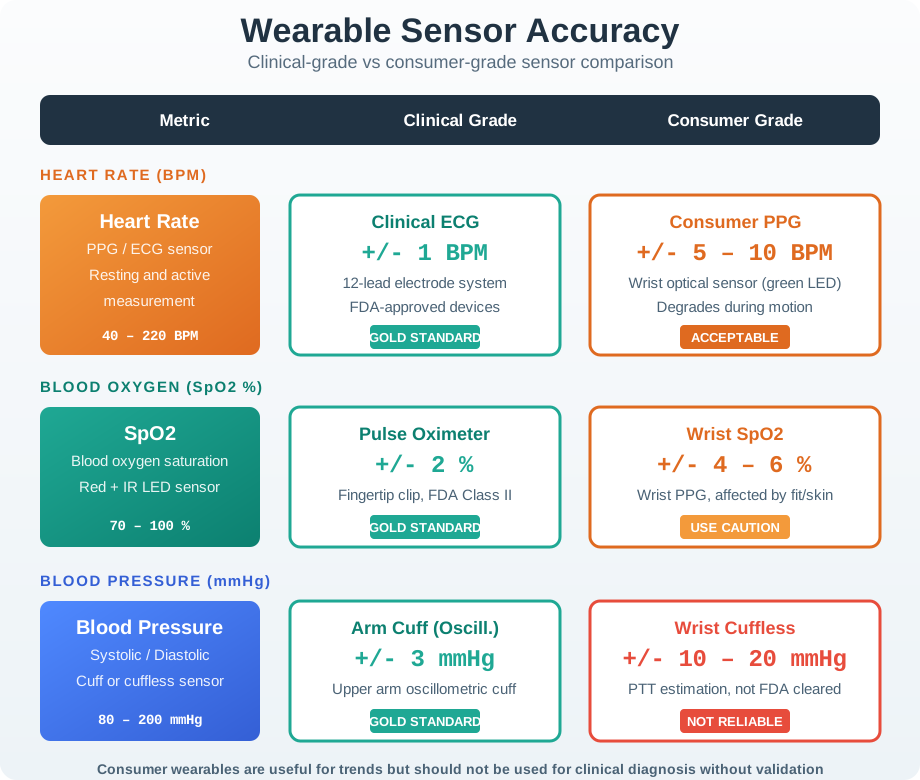
- Explain: Consumer optical heart-rate error may be ±5–10 BPM while the clinical target is ±2 BPM; skin temperature narrows from about ±0.5 °C to ±0.1 °C.
- Explain: A rolling summary may still be useful for wellness, but its performance must be validated directly; the single-night classification accuracy cannot be converted into trend accuracy by averaging.
Major section
PPG Motion Artifact Pitfall
Battery is only one constraint.
- The optical sensor is the small band on the finger, held against the skin by a soft cuff, and a thin cable carries its signal back to the unit on the wrist.
- That gap is the pitfall.
- Running cadence (150-180 steps/min) matches typical exercise heart rates.

Major section
Sleep Accuracy Check
Scenario: A health technology company is launching a sleep tracking feature for their fitness band.
- They must determine appropriate accuracy claims based on validation against polysomnography (PSG), the clinical gold standard.
- Key Insight: The 74% epoch-by-epoch result does not support clinical claims.
- A rolling summary may still be useful for wellness, but its performance must be validated directly; the single-night classification accuracy cannot be converted into trend accuracy by averaging.
Major section
Wearable Sensor Technologies
Consumer optical heart-rate error may be ±5–10 BPM while the clinical target is ±2 BPM; skin temperature narrows from about ±0.5 °C to ±0.1 °C.
- Step counts, oxygen saturation, ECG, and bioimpedance each use different measures and reference methods.
- The clinical column is not a software upgrade label.
Major section
AR Glasses: The Next Frontier
Below the strip the dark visor curves across both eyes, and the display optics have to live inside that thin shell without blocking sight.
- Everything else, from battery to compute to audio, must fit into the arms and the front housing and still be light enough to wear for an hour.

Deck summary
Key takeaways
Battery is only one constraint.
- Scenario: A health technology company is launching a sleep tracking feature for their fitness band.
- Consumer optical heart-rate error may be ±5–10 BPM while the clinical target is ±2 BPM; skin temperature narrows from about ±0.5 °C to ±0.1 °C.
- Below the strip the dark visor curves across both eyes, and the display optics have to live inside that thin shell without blocking sight.
Retrieval practice
Recall check 1 of 6

Blueprint Bina says: answer from memory, then check your reasoning.
Q1Research shows that 33% of wearable device users abandon their devices within 6 months. Which design principle failure is the MOST common root cause of this abandonment?
Show answer
Answer: B Correct!
Retrieval practice
Recall check 2 of 6

Blueprint Bina says: answer from memory, then check your reasoning.
Q2During a morning jog, a user's wearable shows a heart rate spike to 185 BPM during what feels like moderate effort. The user's actual heart rate (chest strap verified) is 142 BPM. What is the MOST likely explanation?
Show answer
Answer: C Correct!
Retrieval practice
Recall check 3 of 6

Blueprint Bina says: answer from memory, then check your reasoning.
Q3A consumer sleep tracker reports 74% epoch-by-epoch accuracy against polysomnography (PSG), with no repeated-night validation. Which communication strategy is MOST appropriate?
Show answer
Answer: B The study supports a bounded wellness statement about epoch agreement.
Retrieval practice
Recall check 4 of 6

Blueprint Bina says: answer from memory, then check your reasoning.
Q4A wearable device advertises 7-day battery life. A user enables continuous heart rate monitoring (-12%/day), uses GPS for a 1-hour daily run (-10%/hour), and activates always-on display (-30% additional). Approximately how many days will the battery ACTUALLY last?
Show answer
Answer: C Correct!
Retrieval practice
Recall check 5 of 6

Blueprint Bina says: answer from memory, then check your reasoning.
Q5Place each wearable responsibility where it lives so you can decide whether a questionable insight came from body sensing, the consent-aware relay, or the trend interpretation.
Show answer
Answer: A A trustworthy wearable path keeps body evidence, personal-data consent, and the final interpretation separate so a convenient score is not mistaken for a clinical fact.
Retrieval practice
Recall check 6 of 6

Blueprint Bina says: answer from memory, then check your reasoning.
Q6Complete the wearable heart-rate confidence gate:
Show answer
Answer: A Wearable metrics should be withheld when battery, skin contact, motion artifact, or model confidence make the sample unreliable.
Print reference
Answers
Answer key.
- B · Correct!
- C · Correct!
- B · The study supports a bounded wellness statement about epoch agreement.
- C · Correct!
- A · A trustworthy wearable path keeps body evidence, personal-data consent, and the final interpretation separate so a convenient score is not mistaken for a clinical fact.
- A · Wearable metrics should be withheld when battery, skin contact, motion artifact, or model confidence make the sample unreliable.