Applications & Use Cases · Study deck
Transportation and Vehicles
Picture two messages from one bus.
Blueprint Bina is your guide for this deck.

After studying this chapter
Learning objectives
You will be able to:
- Explain: Fleet Telematics: OBD-II telematics combined with cellular connectivity and cloud analytics enables 10-15% fuel savings, 20-30% maintenance cost reduction, and 15% fleet utilization improvement through route optimization and predictive analytics.
- Explain: The Basic Safety Message (BSM) broadcast every 100 ms provides continuous position updates, enabling collision prediction 2-3 seconds before impact—enough time for both automated systems and human drivers to react.
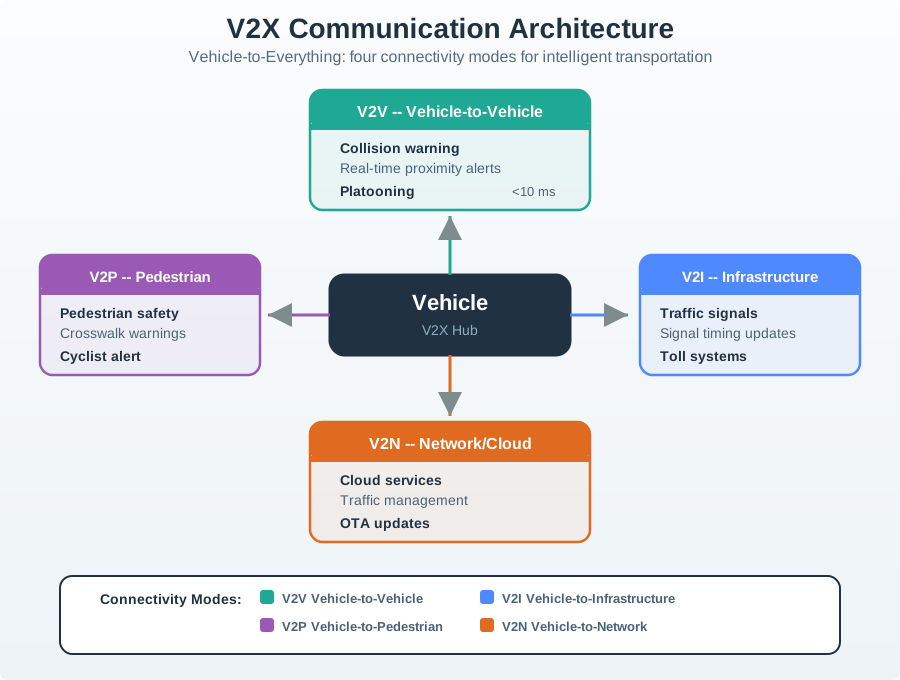
- Explain: With the boundaries in place, the next step is vocabulary: what each V2X path can actually carry, and why the mode choice changes the safety case.
Major section
Start With the Story · Connected Vehicles and V2X Communication · Key Concepts
A crash warning must reach nearby road users at once.
- A fuel report can wait for the fleet office.
- A vehicle link does not prove safe driving.
- A large data set does not remove blind spots, and a fast average does not prove the worst case.
Major section
Minimum Viable Understanding · V2X Communication Basics · Cars That Talk
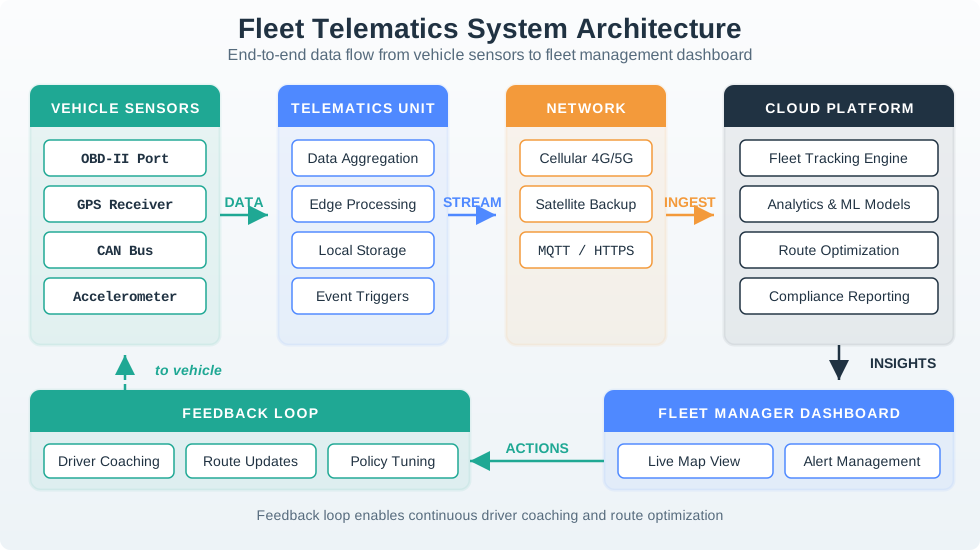
Fleet Telematics: OBD-II telematics combined with cellular connectivity and cloud analytics enables 10-15% fuel savings, 20-30% maintenance cost reduction, and 15% fleet utilization improvement through route optimization and predictive analytics.
- With a projected market of $132 billion and $121 billion wasted annually on unnecessary travel time and fuel, the economic and social impact is staggering.
- That's exactly what V2X does for cars!
- Someone is crossing ahead!".
Major section
Transport IoT Safety Operations · Choose the Data Path by Use Case · Vehicle Safety and Privacy Bounds · Phoebe's Field Notes: Why DSRC's 5.9 GHz Buys Range Its Frequency Alone Shouldn't · Motion Marley's Math Bridge: Frequency, Noise, and Vehicle Range
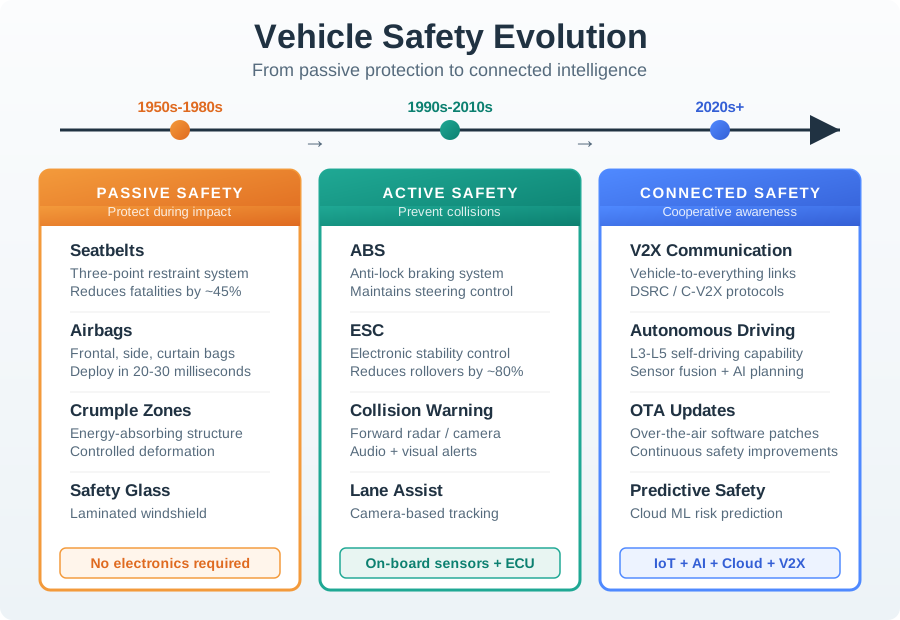
A useful design separates safety-critical messages from operational telemetry.
- The answer determines which data path is allowed.
- A V2V blind-intersection warning needs local, low-latency broadcast and message freshness checks.
Major section
Checkpoint: Transport Boundaries · The Connected Vehicle Revolution · V2X Communication Taxonomy · Answer
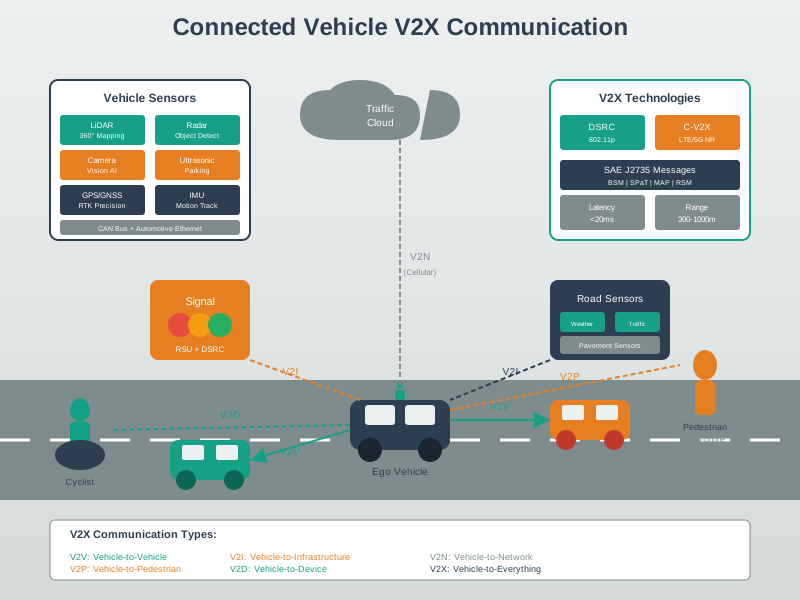
With the boundaries in place, the next step is vocabulary: what each V2X path can actually carry, and why the mode choice changes the safety case.
- The ego vehicle (orange) sits at the center, communicating with all four V2X domains simultaneously.
Major section
The Vehicle Safety Innovation Pyramid · V2X and Autonomy Check · Answer
Cameras fail in fog, heavy rain, direct sunlight.
- Radar can't read traffic signs or distinguish pedestrians from objects.
- Predictive: Knows what traffic signals will do 10-15 seconds ahead.
- V2X is cheaper than LIDAR sensors B.
- V2X can detect objects beyond line-of-sight and predict traffic signal changes C.
Major section
Market Opportunity and Impact · V2X Collision Avoidance Scenario · The 10 V2X Safety Applications
$300+ billion annual crash costs in U.S. (property damage, medical, lost productivity).
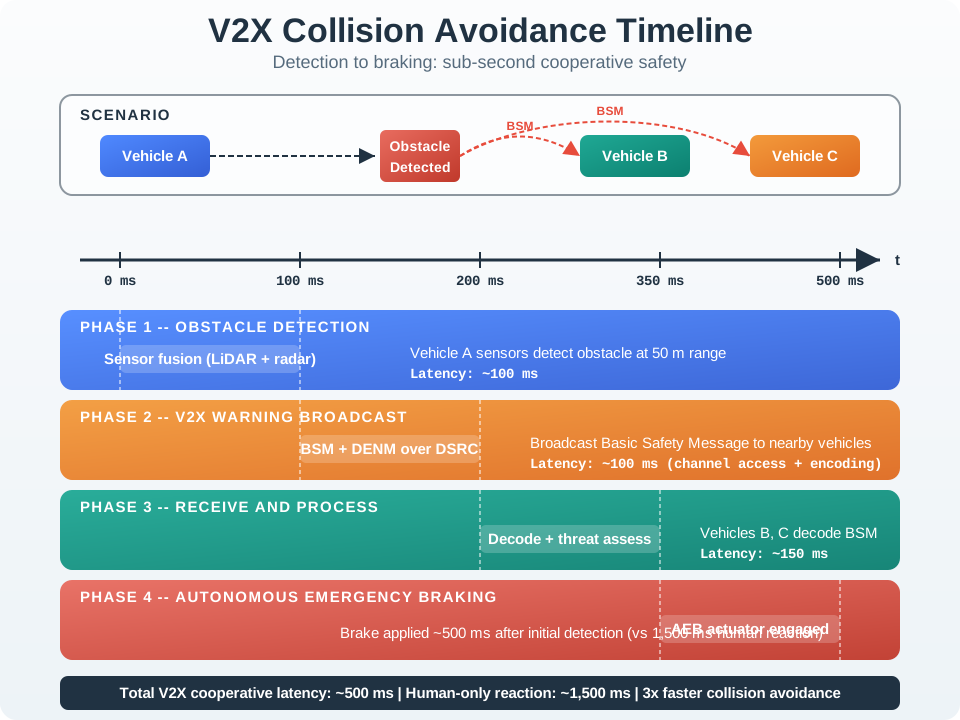
- The Basic Safety Message (BSM) broadcast every 100 ms provides continuous position updates, enabling collision prediction 2-3 seconds before impact—enough time for both automated systems and human drivers to react.
Major section
Checkpoint: V2X Safety Logic · Wireless Technology Comparison for V2X · V2V Without Infrastructure · Answer
Automotive Ethernet: 100 Mbps-1 Gbps, replacing CAN in modern vehicles.
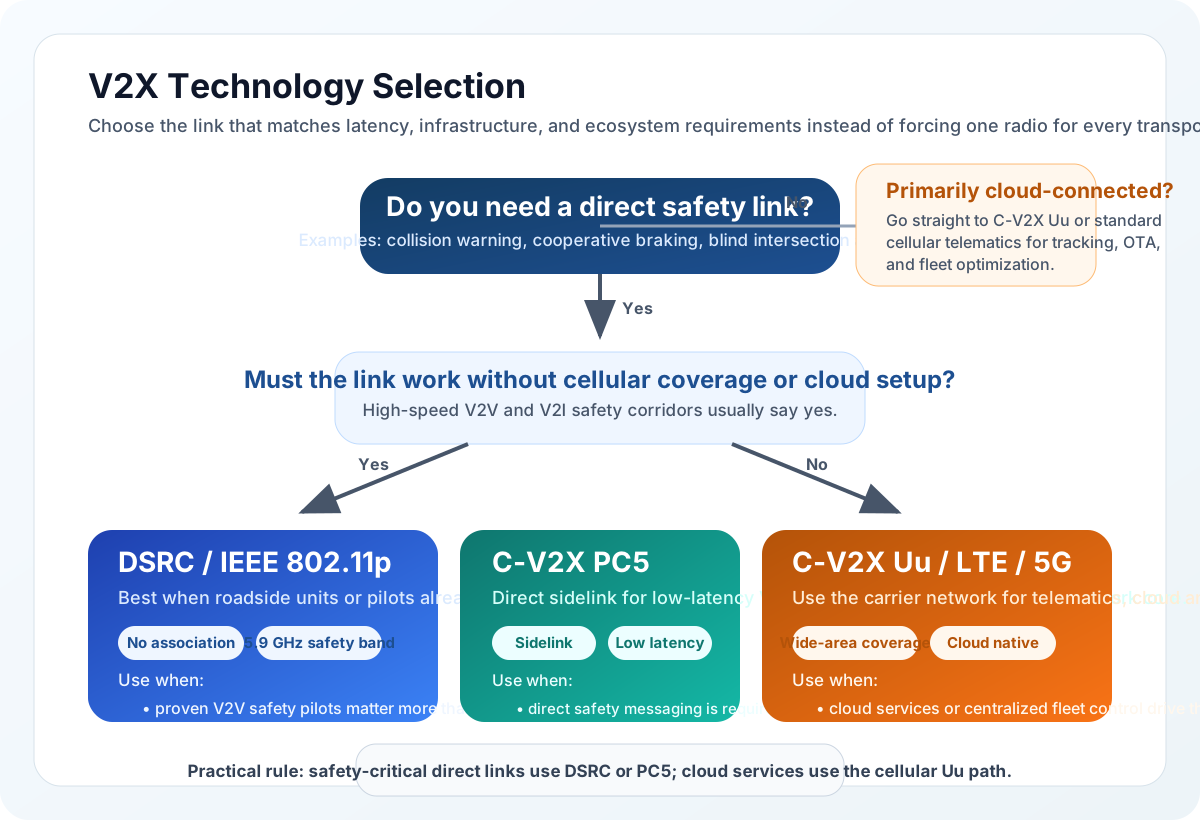
- The technology table is a menu, not a decision by itself.
- The design question is still whether the message must work with no infrastructure, tolerate cloud latency, protect a vulnerable road user, or feed a fleet workflow.
- Question:: Two vehicles are approaching each other at 100 km/h on a rural highway with no cellular coverage.
Major section
DSRC/WAVE Protocol Stack · Answer · Checkpoint: Mode and Protocol Choice · Common Pitfalls
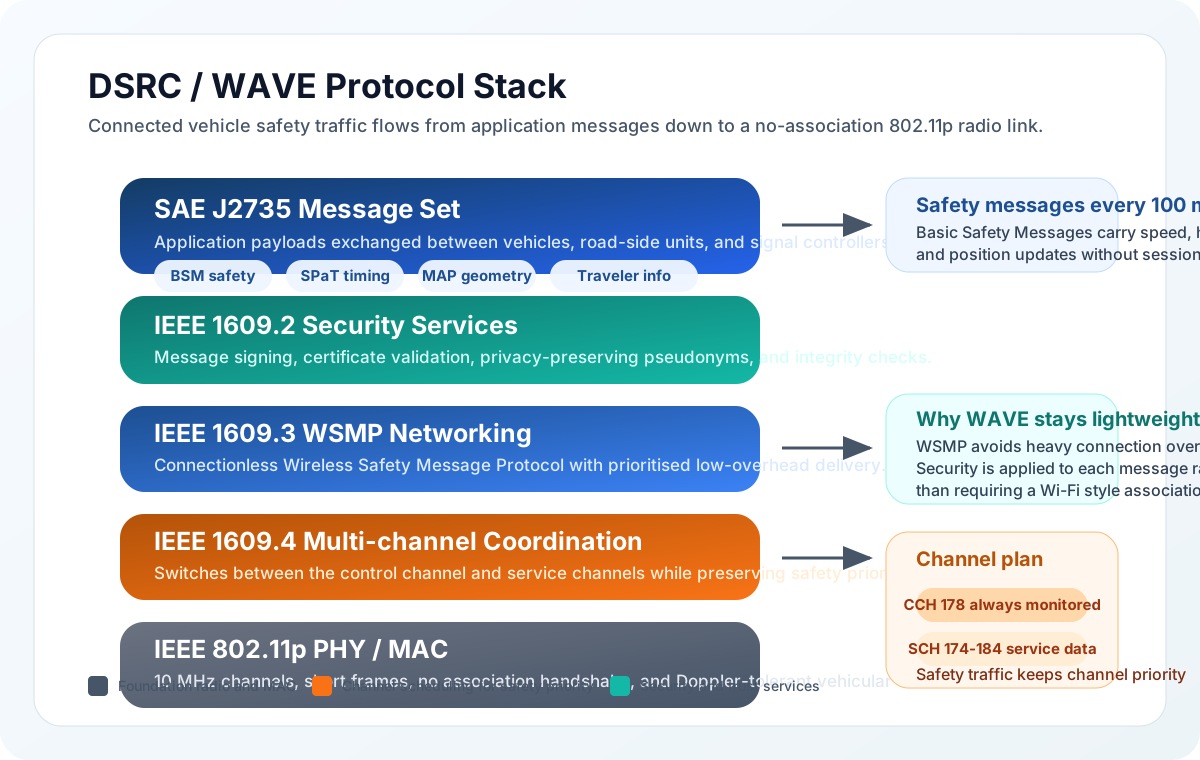
DSRC (Dedicated Short Range Communications) is the foundation technology for V2V and V2I safety applications in North America and Europe.
- Vehicles broadcast safety messages immediately upon entering range - critical when two cars approaching at 100 km/h have only 100 ms to exchange warnings.
Major section
Common Pitfall: GPS Urban Canyon Effect · OBD-II Compatibility Pitfall
Design applications to degrade gracefully when position uncertainty exceeds thresholds.
- Those diagram labels establish the scope of an obd-ii telematics dongle has to fit the vehicle connector physically and behave correctly on that vehicle's bus -- the compatibility pitfall here.

Major section
V2X Misconceptions · Fleet Telematics ROI · Fleet IoT Investment Decision
The industry consensus is "sensor fusion + V2X" for redundancy and maximum safety coverage.
- Misconception 1: "V2X replaces onboard sensors (cameras, LIDAR, radar).": V2X is a complement to onboard sensors, not a replacement.
- Sensors provide high-resolution, real-time perception of the immediate environment (0-200m), while V2X extends awareness beyond line-of-sight (200m-2km).
- DSRC (802.11p) has a critical advantage for safety: it requires zero infrastructure.
Major section
Putting Numbers to It · Checkpoint: Fleet Economics · Fleet Management and Telematics · Fleet Telematics Check · Answer
Given: Fleet drives 3 million miles/year at 8 MPG average, and diesel costs $3.50 per gallon.
- Baseline fuel consumption is 3,000,000 miles divided by 8 MPG, or 375,000 gallons per year.
- Together those labels make fleet telematics system architecture testable.
Major section
Answer · Cross-Hub Connections · How It Works: V2X Collision Avoidance · Interactive Quiz: Match V2X Concepts · Interactive Quiz: Sequence the Steps
Together these can deliver 15-30% total cost reduction.
- Simple GPS tracking alone provides visibility but misses the analytics-driven savings.
- The big picture: Two vehicles approaching an intersection at 100 km/h (28 m/s each) have ~2 seconds before collision.
- A 100 ms delay (like cellular network) means the car travels 2.8 meters before responding.
Try it: Answer · Cross-Hub Connections · How It Works: V2X Collision Avoidance · Interactive Quiz: Match V2X Concepts · Interactive Quiz: Sequence the Steps in the chapter
Major section
Concept Relationships · Try It: Write a V2X Mode Choice
Connection: V2X requires edge processing for <10 ms latency - cloud round-trips (50-200 ms) are too slow.
- Connection: DSRC (802.11p) is a derivative of Wi-Fi optimized for vehicular mobility (no association handshake).
- Connection: BLE enables V2P (vehicle-to-pedestrian) detection via smartphone broadcasts.
Deck summary
Key takeaways
A crash warning must reach nearby road users at once.
- Fleet Telematics: OBD-II telematics combined with cellular connectivity and cloud analytics enables 10-15% fuel savings, 20-30% maintenance cost reduction, and 15% fleet utilization improvement through route optimization and predictive analytics.
- A useful design separates safety-critical messages from operational telemetry.
- With the boundaries in place, the next step is vocabulary: what each V2X path can actually carry, and why the mode choice changes the safety case.
- Cameras fail in fog, heavy rain, direct sunlight.
Retrieval practice
Recall check 1 of 5

Blueprint Bina says: answer from memory, then check your reasoning.
Q1Two vehicles approach a blind intersection at 100 km/h. V2X provides a collision warning at 1.8 seconds before impact. Without V2X, the driver's typical surprise reaction time is 0.6 seconds. By what factor does V2X improve the driver's available reaction time?
Show answer
Answer: B
Retrieval practice
Recall check 2 of 5

Blueprint Bina says: answer from memory, then check your reasoning.
Q2Place each V2X safety responsibility where it lives so you can trace whether a missed warning came from vehicle sensing, the low-latency exchange, or the final safety action.
Show answer
Answer: A A V2X safety path is only as useful as its freshest evidence, time-bounded exchange, and accountable action logic; a fast radio alone does not prove a safe response.
Retrieval practice
Recall check 3 of 5

Blueprint Bina says: answer from memory, then check your reasoning.
Q3Complete the V2X driver-warning freshness gate:
Show answer
Answer: A A V2X driver warning should reject stale or low-confidence messages, keep immediate warnings on local V2V or V2I paths, and alert only when the time-to-collision leaves enough urgency to act.
Retrieval practice
Recall check 4 of 5

Blueprint Bina says: answer from memory, then check your reasoning.
Q4Two vehicles approaching a blind intersection need to exchange safety messages. The vehicles are traveling at 120 km/h and have approximately 100ms to establish communication before passing. Why does 802.11p (DSRC) use a "no association" design for Vehicle-to-Vehicle communication?
Show answer
Answer: C At highway speeds, vehicles have approximately 100ms of communication opportunity as they approach each other.
Retrieval practice
Recall check 5 of 5

Blueprint Bina says: answer from memory, then check your reasoning.
Q5A fleet management company deploys OBD-II cellular dongles on 500 delivery trucks. After six months, they achieve 15% fuel savings and 20% reduction in maintenance costs. Which data source is most responsible for the predictive maintenance savings?
Show answer
Answer: A OBD-II diagnostic codes and engine sensor trends are the primary predictive maintenance data source.
Print reference
Answers 1 of 2
Answer key.
- B
- A · A V2X safety path is only as useful as its freshest evidence, time-bounded exchange, and accountable action logic; a fast radio alone does not prove a safe response.
- A · A V2X driver warning should reject stale or low-confidence messages, keep immediate warnings on local V2V or V2I paths, and alert only when the time-to-collision leaves enough urgency to act.
- C · At highway speeds, vehicles have approximately 100ms of communication opportunity as they approach each other.
Print reference
Answers 2 of 2
Answer key.
- A · OBD-II diagnostic codes and engine sensor trends are the primary predictive maintenance data source.