Smart Places and Infrastructure · Study deck
Smart Home: Needs, Protocols, and Boundaries
This first route begins with the household need, then sets protocol, fallback, safety, privacy, and buy-in boundaries before automation expands.
Ada is your guide for this deck.

After studying this chapter
Learning objectives
You will be able to:
- Calculate return on investment (ROI). ROI compares the money saved with the money spent. You will use it for thermostats, lights, and plug loads.
- Design a home scene, which is a group of actions run together. Latency means the wait between a request and its result. You will account for both reliability and latency.
- Explain the parts of a voice assistant's response time.
- Reduce false security alarms by combining evidence from more than one sensor. This is called multi-sensor fusion.

Major section
Key Concepts · Minimum Viable Understanding
Hub-and-spoke layout: every device communicates through one central hub.
- It helps products work across Apple, Google, Amazon, and Samsung systems.
- Occupancy-based control: heating, ventilation, and air conditioning (HVAC) or lighting changes when a room is occupied, rather than following only a fixed timetable.
- In a mesh, powered devices can pass messages for one another.
Major section
Smartest House on the Block
Your house can be a superhero headquarters where sensors keep everything running perfectly!
- They just moved into a house where the Sensor Squad is already on duty!
- Light Lucy is stationed in every room.
- Mom gets a notification on her phone: "Emma is home safely!".
- The best automations save energy AND make life more convenient.
Major section
Smartest House on the Block (continued)
But here's the clever part - when everyone leaves for school and work at 8:15 AM, Sammy turns the heat DOWN to save energy. "No point heating an empty house!".
- At the end of the month, the electricity bill is 30% LESS than their old house. "We're saving money AND the planet!" says Emma.
- Energy Savings: using less electricity by being smart about when things are on or off.
- For each one, write which sensor would help (motion, temperature, light, time).
- Different times of day need different settings (this is called "scheduling").
Major section
For Beginners: What Is a Smart Home? · Smart Homes Must Stay Livable
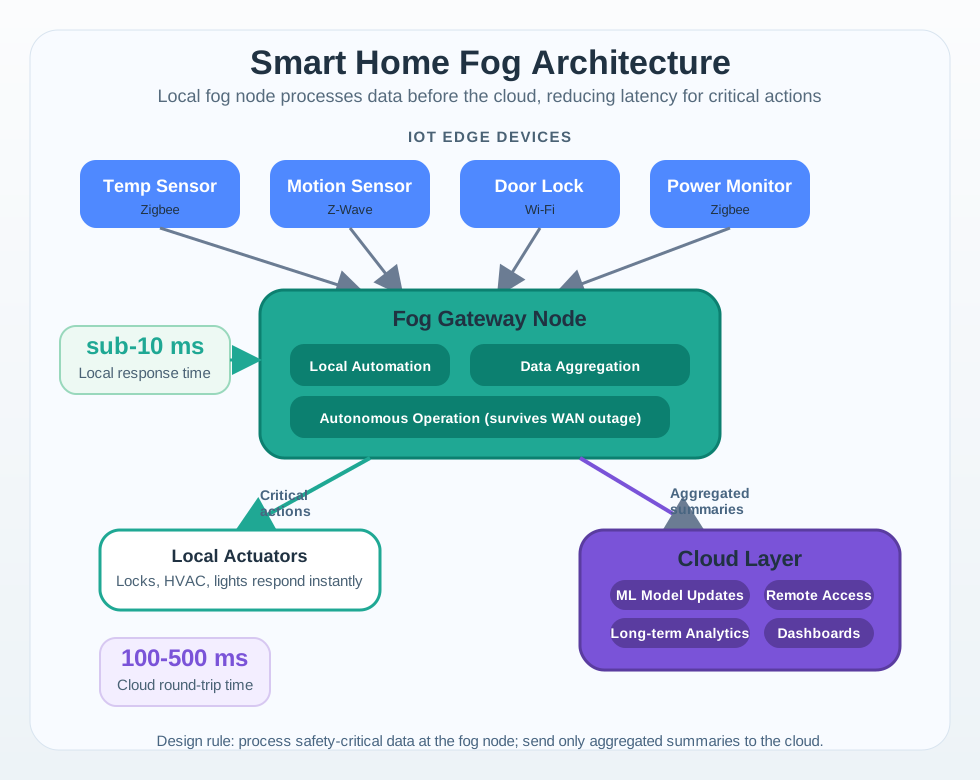
A smart home uses connected sensors and automatic rules to manage lights, heating, security, and appliances.
- A well-designed smart home can waste less energy, improve security, and reduce repetitive tasks.
- It must also leave people in control.
- Your phone's Global Positioning System (GPS) shows that you have left.
Major section
Match Protocols to Home Duties · Home Automation Needs Boundaries
Smart-home prototypes often mix local mesh devices, Wi-Fi appliances, cloud services, and building controls.
- Matter over Thread or Wi-Fi can support multi-admin setup across Apple Home, Google Home, Amazon Alexa, and Samsung SmartThings.
- Zigbee networks may use Philips Hue, SmartThings, Zigbee2MQTT, or Home Assistant.
Major section
Phoebe's Field Notes: What "Pet-Immune" Actually Filters · Motion Marley's Math Bridge: Alarm Rate and Battery Life
The mathematical gist: A 15 mA, 40 ms report at 3.0 V costs 1.80 mJ.
- Over three years, 18 alarms per week use about 1.40 mWh, while 2 microamps of quiet current use about 158 mWh.
Deck summary
Key takeaways
Hub-and-spoke layout: every device communicates through one central hub.
- Your house can be a superhero headquarters where sensors keep everything running perfectly!
- But here's the clever part - when everyone leaves for school and work at 8:15 AM, Sammy turns the heat DOWN to save energy. "No point heating an empty house!".
- A smart home uses connected sensors and automatic rules to manage lights, heating, security, and appliances.
- Smart-home prototypes often mix local mesh devices, Wi-Fi appliances, cloud services, and building controls.
Retrieval practice
Recall check 1 of 4

Ada says: answer from memory, then check your reasoning.
Q1A pet often triggers a home motion alarm. Which change tests the alert with stronger evidence?
Show answer
Answer: C Independent evidence can separate a pet from a person more reliably.
Retrieval practice
Recall check 2 of 4

Ada says: answer from memory, then check your reasoning.
Q2A home’s app becomes unavailable while a guest needs the lights. Which design best meets the chapter’s livability principle?
Show answer
Answer: D Basic household functions should retain a usable manual path when automation or apps fail.
Retrieval practice
Recall check 3 of 4

Ada says: answer from memory, then check your reasoning.
Q3A grid request asks a building to reduce cooling, but a resident has a heat-sensitive health need. What should the automation do?
Show answer
Answer: C Priority rules and an audit trail keep the action safe and explainable.
Retrieval practice
Recall check 4 of 4

Ada says: answer from memory, then check your reasoning.
Q4Two home controllers can issue commands to the same device. What should the design record make explicit?
Show answer
Answer: A The chapter requires named authority and conflict handling across controllers and bridges.
Q5A thermostat costs $200 and saves $50 in its first year, with no other costs. What is its first-year net ROI?
Show answer
Answer: B ($50 − $200) / $200 = −75% first-year net ROI; $50 / $200 = 25% is the gross savings-to-cost ratio.
Print reference
Answers
Answer key.
- C · Independent evidence can separate a pet from a person more reliably.
- D · Basic household functions should retain a usable manual path when automation or apps fail.
- C · Priority rules and an audit trail keep the action safe and explainable.
- A · The chapter requires named authority and conflict handling across controllers and bridges.
- B · ($50 − $200) / $200 = −75% first-year net ROI; $50 / $200 = 25% is the gross savings-to-cost ratio.