Applications & Use Cases · Study deck
Smart Grid: Communications and Operations
A utility can see a growing number of meters, substations, chargers, and flexible loads, but those devices do not share one timing or reliability need.
Blueprint Bina is your guide for this deck.

After studying this chapter
Learning objectives
You will be able to:
- Explain: A smart meter can measure imports and exports, but a home energy management system (HEMS) is the local decision boundary that combines meter data, tariffs, appliance constraints, rooftop generation, storage state, and occupant consent.
- Explain: Opportunity: Smart chargers can defer charging to off-peak hours, participate in demand response programs, and even provide vehicle-to-grid (V2G) services that return stored energy during peak demand.
- Explain: A meter reporting high peak usage has zero impact unless paired with time-of-use rates, demand response programs, or smart thermostats that react to price signals.
Major section
Comm Standards Check
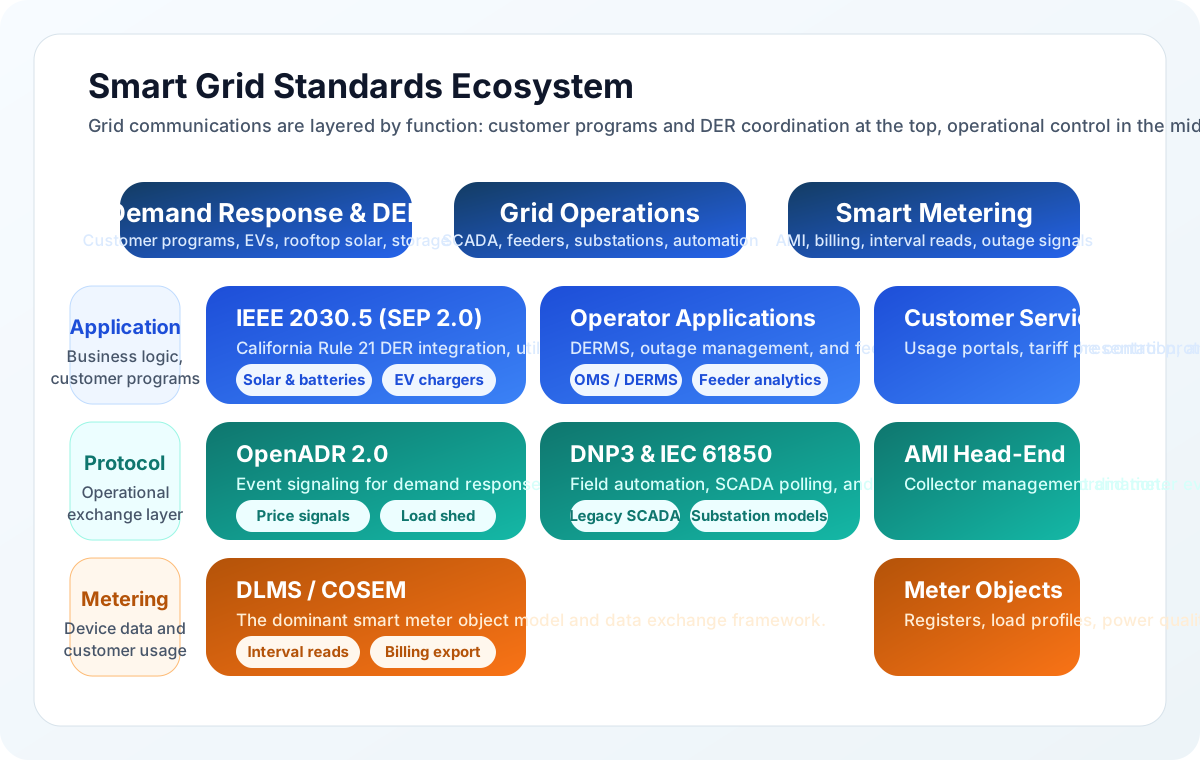
Question 4: A utility needs to send demand response signals to residential customers.
- DNP3 is for distribution automation/SCADA, IEC 61850 is for substation automation, and Modbus is for industrial control systems.
- Zigbee and proprietary RF mesh (like Silver Spring Networks) are common, with LoRaWAN and LTE-M used in rural areas.
- PLC (power line communication) is used in some deployments but RF mesh dominates in North America.
Major section
EV Charging and Grid Integration
With the measurement stack in place, the next stress test is load flexibility.
- EVs show why a grid-IoT system must coordinate customers, devices, tariffs, and transformer limits at the same time.
- Challenge: A single Level 2 EV charger (7.2 kW) can double a home's peak demand.

Major section
EV Charging and Grid Integration (continued)
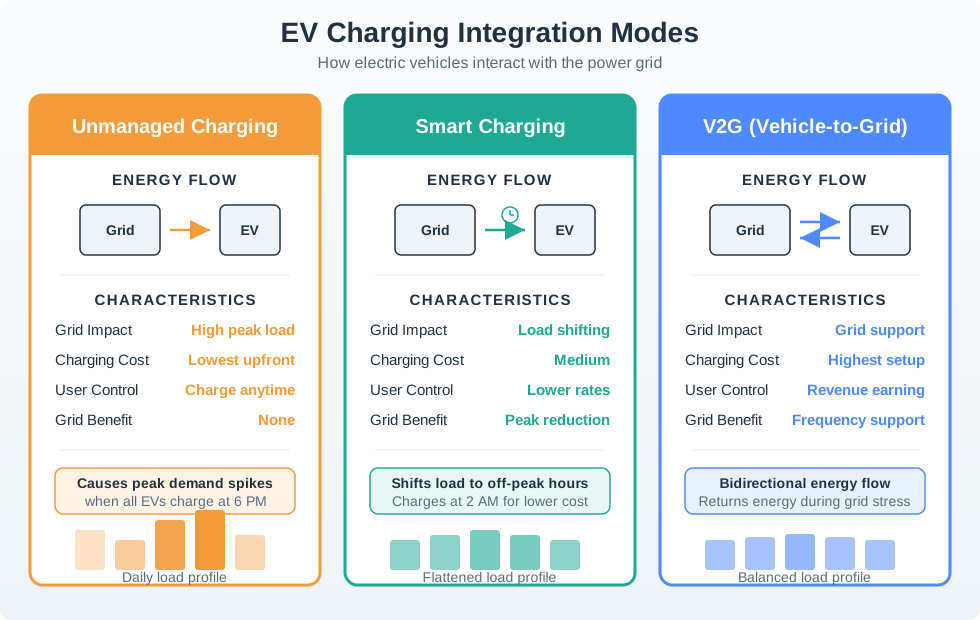
A neighborhood with 20% EV adoption could overload distribution transformers designed for pre-EV loads.
- Opportunity: Smart chargers can defer charging to off-peak hours, participate in demand response programs, and even provide vehicle-to-grid (V2G) services that return stored energy during peak demand.
- The visual evidence for ev charging and grid integration sits in Figure: EV Charging Integration.
- The decision in ev charging and grid integration must preserve that labelled boundary.
Major section
Voltage/VAR Optimization (VVO)
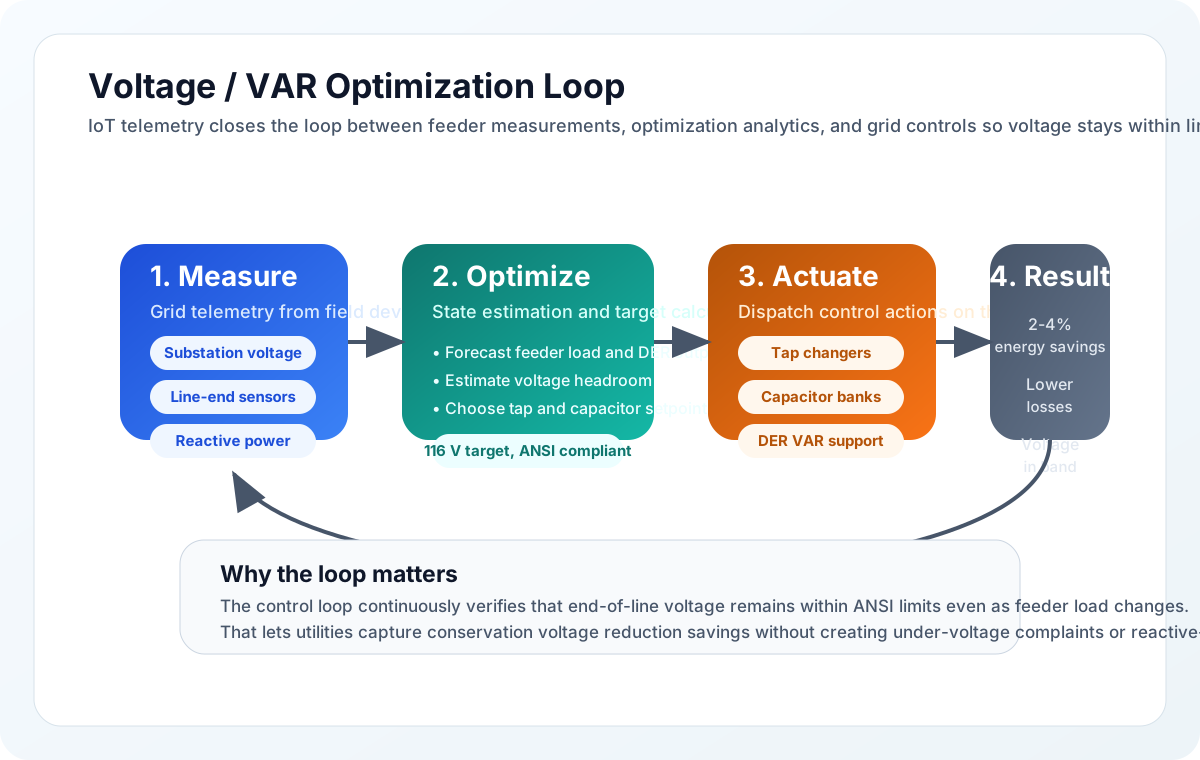
Together: Voltage / VAR Optimization Loop and: The loop keeps voltage within limits while losses fall bound this claim.
- Most resistive loads (heating, incandescent lighting) consume less power at lower voltage without affecting performance.
Major section
Critical Infrastructure Cyber
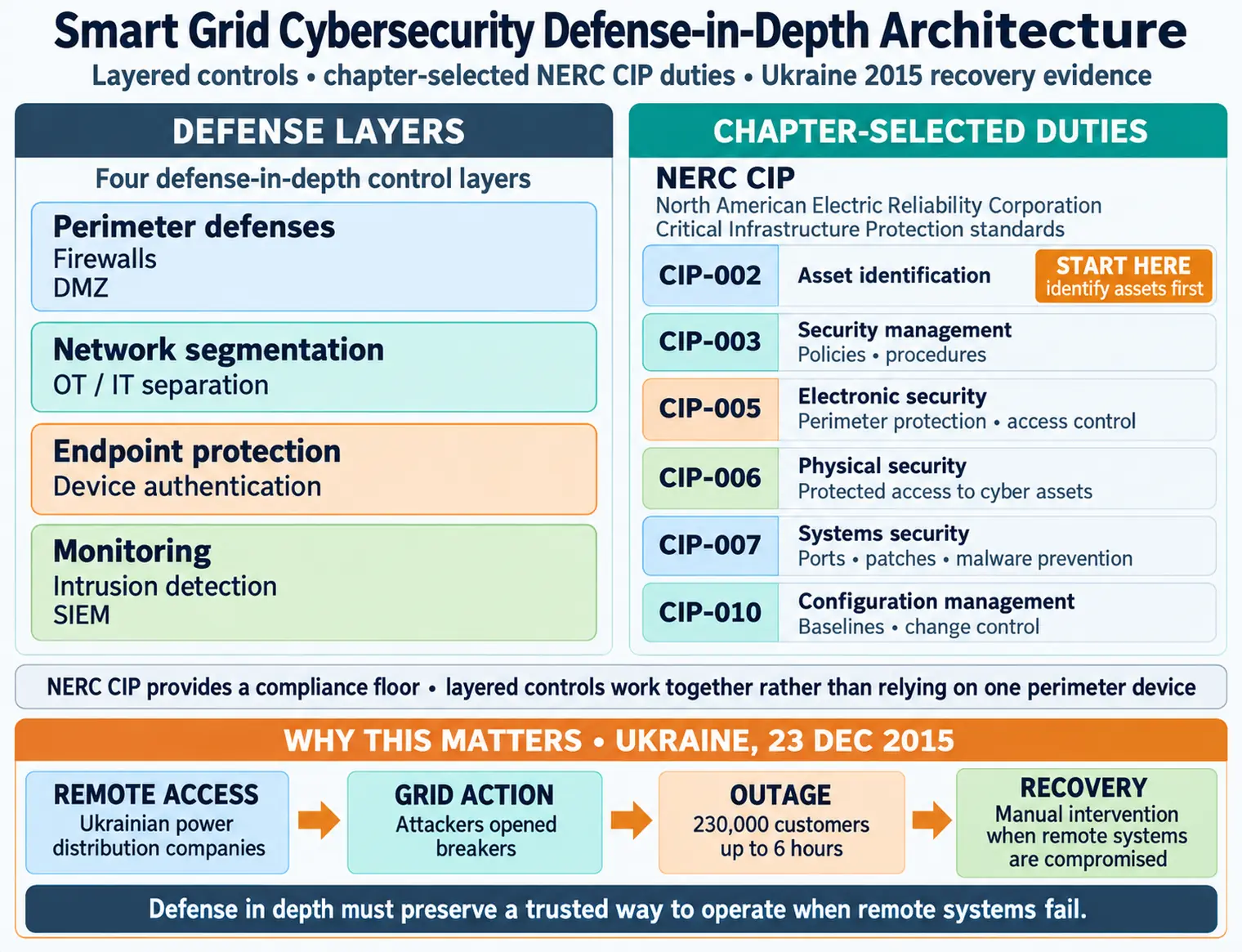
Smart grid IoT systems are designated critical infrastructure under NERC CIP (North American Electric Reliability Corporation Critical Infrastructure Protection) standards.
- A successful cyberattack could cascade into widespread blackouts affecting hospitals, water treatment, financial systems, and emergency services.
- That sequence keeps critical infrastructure cyber tied to what is visibly labelled.
- CIP-010: configuration management through baselines and change control.
Major section
Grid Business Case Check
The 5-8 year payback is typical for mid-sized utilities, with benefits accelerating as more smart grid applications leverage the AMI infrastructure.
- By reducing voltage from 120V to 116V (within ANSI standards), resistive loads consume less energy without affecting performance.
- NERC CIP (Critical Infrastructure Protection) standards mandate specific cybersecurity controls for grid operators.
- Unlike most IoT systems, a smart grid breach could disrupt hospitals, water treatment, financial systems, and emergency services simultaneously.
Major section
Meters vs Load Control
After 2 years, peak demand had dropped only 0.8% because they never launched time-of-use rates or DR programs.
- A meter reporting high peak usage has zero impact unless paired with time-of-use rates, demand response programs, or smart thermostats that react to price signals.
- Key Insight: AMI is a prerequisite for demand response, not a substitute.
- The meter is the sensor; pricing and DR programs are the actuators.
Major section
Smart Grid, HEMS, and Stakeholder Boundaries
A smart grid makes electrical power and operational information flow in both directions.
- A smart meter can measure imports and exports, but a home energy management system (HEMS) is the local decision boundary that combines meter data, tariffs, appliance constraints, rooftop generation, storage state, and occupant consent.
- It may recommend or schedule a flexible load; it must not pretend that every appliance, battery, vehicle, or resident is equally controllable.
- A cloud service may coordinate across those domains, but it does not inherit the authority or safety responsibility of the field controller.
Deck summary
Key takeaways
Question 4: A utility needs to send demand response signals to residential customers.
- With the measurement stack in place, the next stress test is load flexibility.
- A neighborhood with 20% EV adoption could overload distribution transformers designed for pre-EV loads.
- Together: Voltage / VAR Optimization Loop and: The loop keeps voltage within limits while losses fall bound this claim.
- Smart grid IoT systems are designated critical infrastructure under NERC CIP (North American Electric Reliability Corporation Critical Infrastructure Protection) standards.
Retrieval practice
Recall check 1 of 4

Blueprint Bina says: answer from memory, then check your reasoning.
Q1A utility detects voltage instability using PMUs at 60 samples/second. Traditional SCADA samples every 4 seconds. Why does this 240x faster sampling prevent blackouts?
Show answer
Answer: C Why C: Grid instabilities cascade at speeds measured in seconds.
Retrieval practice
Recall check 2 of 4

Blueprint Bina says: answer from memory, then check your reasoning.
Q2A neighborhood of 200 homes adds 50 electric vehicles, each with a 7.2 kW Level 2 charger. Residents typically plug in between 6-8 PM. The local distribution transformer is rated at 500 kVA. What is the primary risk, and how does smart grid IoT address it?
Show answer
Answer: A
Retrieval practice
Recall check 3 of 4

Blueprint Bina says: answer from memory, then check your reasoning.
Q3Smart meters typically use which communication technology for neighborhood-level data collection?
Show answer
Answer: Review the source
Q4A neighborhood of 5 homes shares a 25 kVA transformer. If 3 homes add Level 2 EV chargers (7.2 kW each), what happens to transformer loading?
Show answer
Answer: Review the source
Retrieval practice
Recall check 4 of 4

Blueprint Bina says: answer from memory, then check your reasoning.
Q5What is the primary function of capacitor bank switching in VVO systems?
Show answer
Answer: Review the source
Q6Why is cybersecurity (NERC CIP compliance) especially critical for smart grid IoT?
Show answer
Answer: Review the source
Print reference
Answers
Answer key.
- C · Why C: Grid instabilities cascade at speeds measured in seconds.
- A
- Review the source
- Review the source
- Review the source
- Review the source