Applications & Use Cases · Study deck

Smart Grid: Measurement and Architecture

This first route starts with field measurements, safety boundaries, grid value, and the layered architecture that carries trustworthy observations.

Blueprint Bina is your guide for this deck.

applicationdomainssmart
Blueprint Bina, the module guide, in a scene from this chapter.
iotclass.org

After studying this chapter

Learning objectives

You will be able to:

  • Explain: It should identify the device or system that produced it, the asset and feeder context, the time source, the quality state, the transformation path, and whether it is raw, estimated, validated, operator-confirmed, or settlement-grade.
  • Explain: A DER command, capacitor-bank setting, recloser operation, or demand-response dispatch can change grid behavior and therefore needs stronger validation, authorization, and fallback.
  • Explain: A DER dispatch should show the requested active-power or reactive-power behavior, the inverter capability curve, customer consent, aggregator responsibility, and settlement record.
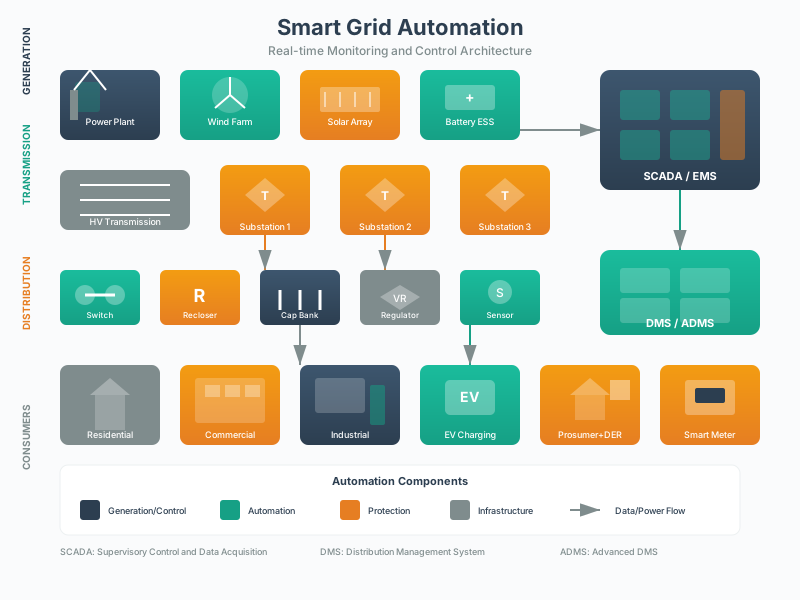
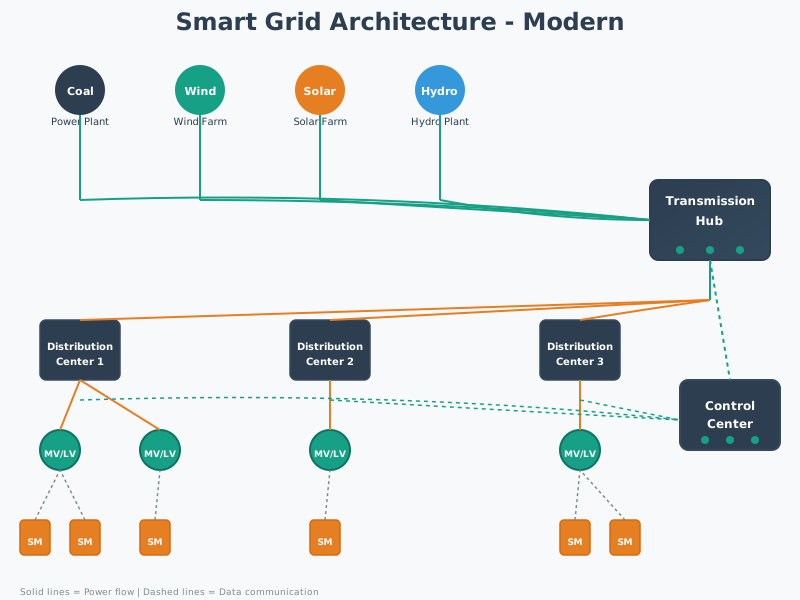
  • Explain the four-layer smart grid architecture (generation, transmission, distribution, consumption)
iotclass.org

Major section

Start With the Story

A local line is near its safe limit.

  • A control-room team must decide whether to change voltage, shift demand, or send a field crew.
  • A dashboard hint may wait for review.
  • A protection action may need a fixed local response.
  • A number without a known source can move the wrong device.

Why it matters

Smart-grid IoT matters because measurements become control evidence: each meter, relay, inverter, and forecast must support a safer, cleaner, and more reliable energy decision.

iotclass.org

Major section

Start With the Story (continued)

An old state can look safe while load is rising.

  • Fine-grained use can reveal daily life.
  • A crew needs the right asset, current isolation state, local contact, and safe return step.
  • A remote command must not erase a physical lock or a worker's control of the site.
  • Each sees a different failure.
iotclass.org

Major section

Start With the Story (continued)

Resolve any gap that can turn a clean-energy gain into an unsafe or unfair outcome.

  • If the answer changed, the release note should say why.
  • A closed order is not proof that a switch moved.
  • A green mark is not proof that a worker is clear.
  • The one-line story cannot describe a whole national grid.
iotclass.org

Major section

Start With the Story (continued)

The review should find it from source, time, unit, or a field check.

  • The system should not reward a smooth chart over a true warning.
  • Practitioner maps devices to grid systems and tests the operating rules.
  • Under the Hood works through timing, power flow, last-gasp energy, and protection limits behind the simple decision.
iotclass.org

Major section

Grid Measurement and Control

Smart-grid devices only help when each reading or command has a clear operating consequence.

  • The system must protect people, equipment, customer trust, and grid stability while still giving operators better visibility.
  • A smart meter interval read supports billing and outage awareness.
  • A PMU stream supports wide-area situational awareness.
  • A distribution management system can propose switching steps.

Why it matters

Smart-grid IoT differs from ordinary telemetry because many readings can affect critical infrastructure decisions: switch a feeder, dispatch a battery, shed load, adjust voltage, confirm an outage, or settle a tariff.

Grid automation boundary: smart-grid IoT connects field equipment, customer resources, and operational control systems across generation, transmission, distribution, and consumer domains.
iotclass.org

Major section

Grid Measurement and Control (continued)

An outage management system can group meter last-gasp messages into likely fault zones.

  • A DER command, capacitor-bank setting, recloser operation, or demand-response dispatch can change grid behavior and therefore needs stronger validation, authorization, and fallback.
  • The practical goal is not to make the grid fully automatic.
  • A meter read may affect a bill.
iotclass.org

Major section

Grid Measurement and Control (continued)

This separation keeps billing data, operational telemetry, market signals, and safety-critical switching from being treated as the same kind of event.

  • A customer portal can show usage and rate choices.
  • A DERMS can coordinate batteries and inverters within export limits.
  • A good smart-grid design can explain customer impact in plain terms.
iotclass.org

Major section

Grid Measurement and Control (continued)

A protection relay must still trip locally when safety requires it, without waiting for a cloud platform.

  • A demand-response event may change a thermostat or charger schedule.
  • A voltage-control action may reduce losses but must stay inside service limits.
  • A feeder automation action may restore most customers while isolating a faulted section for crews.
iotclass.org

Major section

Map Field Devices to Grid Systems

Practitioners also need data governance that respects operational separation.

  • A smart-grid architecture has to connect field devices to operational and market systems without blurring their roles.
  • Smart meters from vendors such as Itron, Landis+Gyr, Sensus, or Honeywell may feed an AMI head-end and MDMS.
  • The integration contract should name these boundaries explicitly.
iotclass.org

Major section

Map Field Devices to Grid Systems (continued)

A FLISR step should show the feeder section, protective device state, crew safety constraint, and rollback action.

  • Substation IEDs, reclosers, relays, capacitor banks, voltage regulators, and RTUs may communicate with SCADA, DMS, ADMS, OMS, EMS, DERMS, or forecasting tools.
  • Customer and DER programs may use OpenADR, IEEE 2030.5, SunSpec Modbus, OCPP, or utility APIs.
  • The test should prove who sees the problem, who can override, and what evidence remains for after-action review.
iotclass.org

Major section

Map Field Devices to Grid Systems (continued)

An AMI outage event should show whether it came from a last-gasp message, periodic read, manual call, or restoration ping.

  • A DER dispatch should show the requested active-power or reactive-power behavior, the inverter capability curve, customer consent, aggregator responsibility, and settlement record.
  • Fast operational events belong in SCADA, DMS, ADMS, historian, or event-stream platforms with tighter timing and access controls.
  • Forecast and market data can inform decisions, but it should not quietly bypass protection settings or operator clearance rules.
iotclass.org

Major section

Grid Data Safety Boundaries

A lost weather sensor may degrade a dashboard; a bad grid command can damage equipment or create unsafe field conditions.

  • The design should define which systems are allowed to observe, recommend, command, block, and override.
  • The same event may have different meanings in protection, operations, billing, customer support, and regulatory evidence.
  • Command paths need the same discipline.
iotclass.org

Major section

Grid Data Safety Boundaries (continued)
A phasor value without clock quality is not equivalent to a validated SCADA point.

  • Under the hood, a grid event should carry provenance.
  • A meter read that passed billing validation is not automatically suitable for fast operational control.
  • A forecast can guide dispatch, but it must not be confused with measured capacity.
  • Some should require operator confirmation.
iotclass.org

Major section

Grid Data Safety Boundaries (continued)

It should identify the device or system that produced it, the asset and feeder context, the time source, the quality state, the transformation path, and whether it is raw, estimated, validated, operator-confirmed, or settlement-grade.

  • A recloser operation, capacitor-bank change, inverter function update, EV charging limit, and customer demand-response signal have different risk profiles.
  • Some actions should remain local and protection-driven.
  • Some may be safe for automated optimisation if they have constraints, rate limits, and rollback.
  • Logs should capture request, authorization, target, previous state, command state, acknowledgement, timeout, failure, and rollback so the control story can be reconstructed.
iotclass.org

Major section

Putting Numbers to It

CVR reduces voltage to 116V while staying within ANSI C84.1 service limits.

  • The voltage reduction ratio is 116 / 120 = 0.9667.
  • For resistive loads, which make up about 40% of this residential example, power consumption scales with voltage squared.
  • Energy savings on the resistive portion are 15 TWh x 0.40 x (1: 0.9345) = 0.393 TWh/year.

Numbers to remember

116VCVR reduces voltage to 116V while staying within ANSI C84.1 service limits.

Why it matters

The new power ratio is (0.9667)^2 = 0.9345, so that portion uses about 6.56% less energy.

iotclass.org

Major section

Smart Meter Data Flow

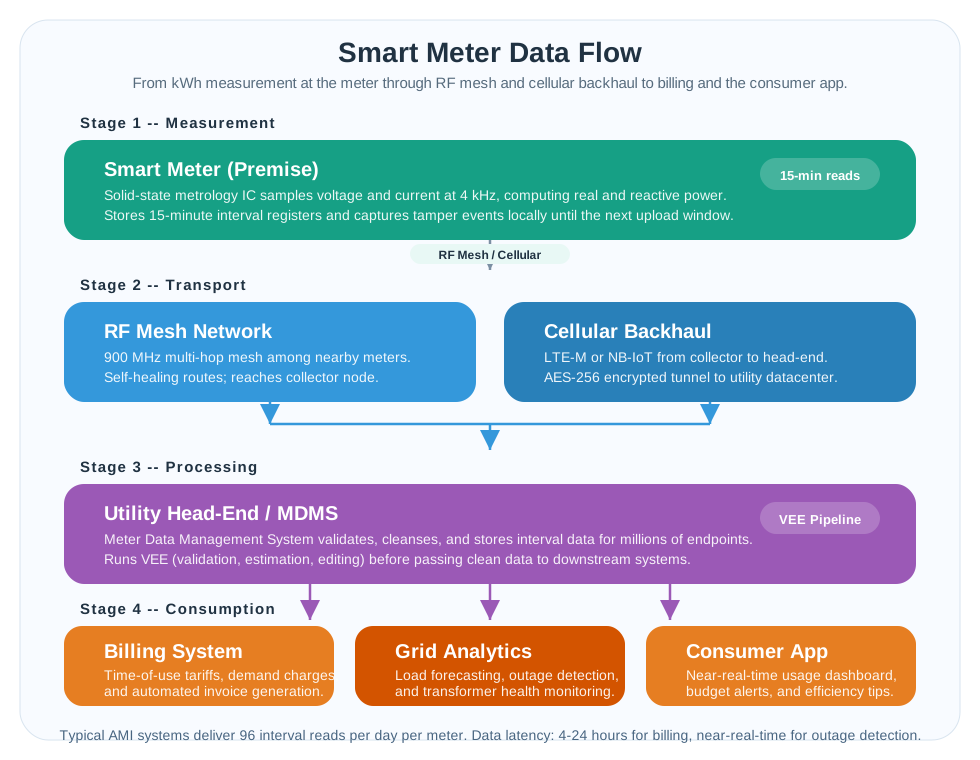
The decision in smart meter data flow must preserve that labelled boundary.

  • Reading frequency: traditional meters are read manually each month; smart meters report automated interval data, often every 15 minutes, for real-time visibility.
  • Outage detection: traditional outage reporting depends on customer calls; smart meters can send last-gasp messages that speed restoration and dispatch.

Why it matters

Billing accuracy: traditional bills often rely on estimates; smart meters provide actual interval usage that reduces disputes.

This installed household smart meter is the endpoint that turns local energy measurements into the interval readings, outage messages, and authorized control data described in the flow below. Photo: RobbieIanMorrison, CC BY 4.0
iotclass.org

Major section

Smart Meter Data Flow (continued)

Billing accuracy: traditional bills often rely on estimates; smart meters provide actual interval usage that reduces disputes.

  • Remote disconnect: traditional service changes require truck rolls; smart meters can receive authorized remote commands, saving about USD 75 per service call.
  • Theft detection: traditional metering makes abnormal consumption hard to detect; smart-meter analytics can flag anomalies and recover billions in lost revenue.
  • That labelled limit reconnects the visual to smart meter data flow.
iotclass.org

Deck summary

Key takeaways

A local line is near its safe limit.

  • An old state can look safe while load is rising.
  • Resolve any gap that can turn a clean-energy gain into an unsafe or unfair outcome.
  • The review should find it from source, time, unit, or a field check.
  • Smart-grid devices only help when each reading or command has a clear operating consequence.
iotclass.org

Retrieval practice

Recall check

Blueprint Bina says: answer from memory, then check your reasoning.

Q1What makes smart-grid IoT different from a simple consumer sensor deployment?

AGrid IoT links measurement, control, safety, timing, and cyber constraints
BSmart grids are mainly about adding more decorative dashboards
CPower systems can ignore latency and safety because sensors are low power
DCybersecurity matters less because grid devices are not connected to homes
Show answer

Answer: A Smart-grid deployments are critical infrastructure, so reliability, safety, latency, and security shape every design choice.

iotclass.org

Print reference

Answers

Answer key.

  1. A · Smart-grid deployments are critical infrastructure, so reliability, safety, latency, and security shape every design choice.
iotclass.org