Smart Places and Infrastructure · Study deck
Smart Cities: Parking and Governance
A parking sensor can report each second and still fail the city.
Ada is your guide for this deck.

After studying this chapter
Learning objectives
You will be able to:
- Calculate parking sensor density, airtime, battery charge, and ROI.
- Define governance rules for parking data and service decisions.
- Explain why smart-city IoT must be designed as a public-service system, not only as a large sensor network.
- Map parking, lighting, waste, environment, traffic, and public-safety sensors to service outcomes and department workflows.
Major section
Radio Remi's Math Bridge: Range, Airtime, and Battery Charge
A 12-byte LoRaWAN payload at SF12 and 125 kHz stays on air for about 1.16 seconds, so a 40 mA transmission costs roughly 46.2 mA·s before retries.
- The same pulse can sag a 15 ohm primary cell by 0.60 V.
Major section
Smart City Service Governance Contracts
The reading reaches the city.
- A working sensor has not delivered a working public service.
- Say what residents should receive.
- Governance is the set of rules and owners around that promise.
- It covers who may collect data.
Major section
Smart City Service Governance Contracts (continued)
Under the Hood examines trust, access, and long-term stewardship when many systems share city evidence.
- It sets how long records stay.
- It also covers faults, complaints, changes, and the end of a supplier deal.
- The light reports a fault.
- A work order reaches a repair team.
Major section
Smart City Service Governance Contracts (continued)
This contract chapter turns smart-city ideas into service governance: the useful story is the handoff from measurement to accountability, response time, public communication, and long-term stewardship.
- The public record then shows the result.
- Each handoff needs an owner and proof.
- This first view uses one clear fault.
- A waste sensor should change collection routing.
Major section
Smart City Service Governance Contracts (continued)
City services often cross departments and serve people with different needs.
- A shared data model can help, but it cannot replace public duty.
- The Practitioner layer maps service measures, data terms, and supplier duties.
- A smart-city deployment is not just a large sensor network.
- A parking sensor should reduce search time or enforcement friction.
Major section
Smart City Service Governance Contracts (continued)
A streetlight controller should improve lighting reliability, energy use, and night-time safety.
- This page isolates the contract underneath those deployments: the public-service outcome, responsible department, data model, governance boundary, and failure behavior that decide whether instrumentation becomes an accountable city service.
- The design has to account for residents, visitors, service crews, city departments, vendors, elected officials, and people who do not use the city's app.
- The integration contract should include non-happy paths.
Major section
Smart City Service Governance Contracts (continued)
Adaptive lighting may need local fail-safe brightness when the backhaul is offline.
- It also has to respect the fact that public-space sensing is rarely optional for the people being observed.
- An air-quality node should support public health decisions with enough calibration and context to be trusted.
- A smart-city design therefore has to be useful at street level and accountable at city level.
Major section
Smart City Service Governance Contracts (continued)
A gateway normalizes the packet, attaches asset identity and location, and sends it over MQTT, HTTPS, AMQP, or a vendor API.
- If the data does not alter a city workflow, a resident service, or a published accountability measure, the deployment is still an instrumentation pilot rather than a smart-city service.
- Smart-city projects often fail when every department buys a separate dashboard.
- Practitioners should map each service as a pipeline, not as a product label.
Major section
Smart City Service Governance Contracts (continued)
Flood, traffic, and air-quality services need a clear rule for when a measurement becomes a field crew task, a public alert, an enforcement action, or a dashboard-only observation.
- A stronger design records events in shared models that traffic, lighting, waste, environment, GIS, emergency management, and open-data teams can use.
- A city platform stores the event with schema, provenance, confidence, and retention metadata.
- A practical service-level agreement covers uptime, battery replacement, calibration frequency, data latency, data-quality flags, API availability, and the support team that owns each failure mode.
Major section
Smart City Service Governance Contracts (continued)
Under the hood, the architecture usually separates field assets, access networks, platform services, department applications, and public release channels.
- Cities should avoid coupling field devices, data schemas, dashboards, and analytics so tightly that switching a vendor requires replacing the whole estate.
- The architecture therefore needs governance, procurement, cybersecurity, accessibility, and maintenance paths from day one.
- Access networks need segmentation between operational systems, public Wi-Fi, vendor maintenance access, and back-office services.
Major section
Smart City Service Governance Contracts (continued)
A field node that works in a pilot but has no spare-parts plan, ownership model, firmware-update route, or data-sharing agreement becomes civic technical debt.
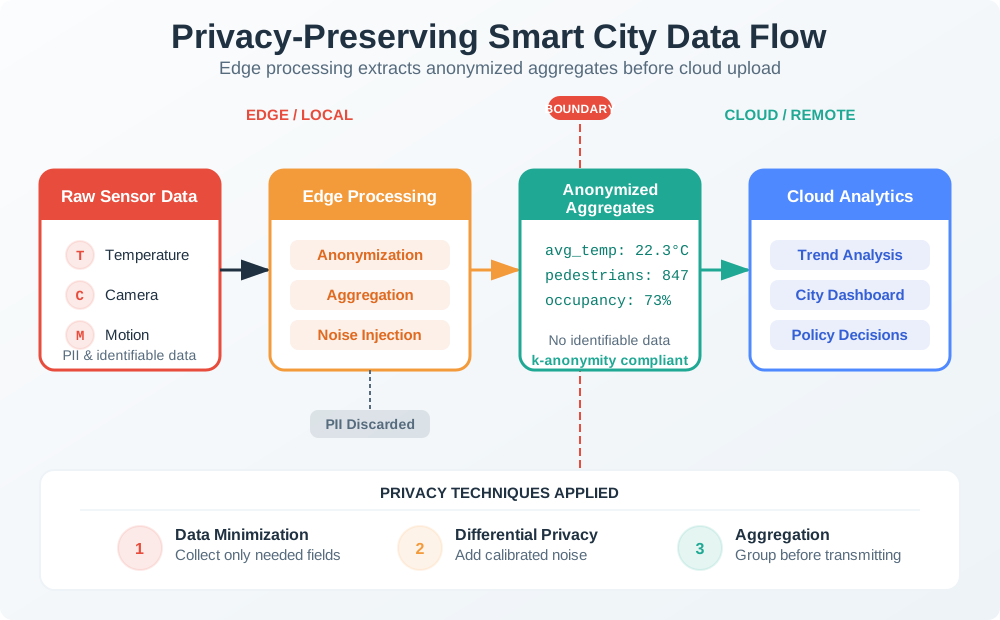
- Field assets need signed firmware, secure boot where available, unique device identity, tamper detection for exposed hardware, and a decommissioning process that removes credentials.
- Platform services need schema validation, time synchronization, deduplication, retention rules, audit logs, and role-based access control.
- Aggregation, blurring, edge redaction, deletion windows, public sensor registries, privacy impact assessments, and independent review boards all reduce the chance that "we already have a pole" becomes a reason to add unrelated sensing later.
Deck summary
Key takeaways
A 12-byte LoRaWAN payload at SF12 and 125 kHz stays on air for about 1.16 seconds, so a 40 mA transmission costs roughly 46.2 mA·s before retries.
- The reading reaches the city.
- Under the Hood examines trust, access, and long-term stewardship when many systems share city evidence.
- This contract chapter turns smart-city ideas into service governance: the useful story is the handoff from measurement to accountability, response time, public communication, and long-term stewardship.
- City services often cross departments and serve people with different needs.
Retrieval practice
Recall check 1 of 3

Ada says: answer from memory, then check your reasoning.
Q1Per this chapter, when is a city sensor deployment still just an 'instrumentation pilot' rather than a smart-city service?
Show answer
Answer: D If the data does not alter a city workflow, a resident service, or a published accountability measure, the deployment is still an instrumentation pilot rather than a smart-city service.
Retrieval practice
Recall check 2 of 3
Ada says: answer from memory, then check your reasoning.
Q2Per this chapter's integration-contract guidance, what should happen to the public and operator view when a LoRaWAN gateway goes down or an air-quality sensor drifts after calibration expires?
Show answer
Answer: A A practical service-level agreement covers uptime, battery replacement, calibration frequency, data latency, data-quality flags, API availability, and the support team that owns each failure mode.
Retrieval practice
Recall check 3 of 3
Ada says: answer from memory, then check your reasoning.
Q3Why should a smart-city IoT contract define governance, privacy, cybersecurity, procurement, and maintenance boundaries before scaling sensors across public space?
Show answer
Answer: C see answers page
Print reference
Answers 1 of 2
Answer key.
- D · If the data does not alter a city workflow, a resident service, or a published accountability measure, the deployment is still an instrumentation pilot rather than a smart-city service.
- A · A practical service-level agreement covers uptime, battery replacement, calibration frequency, data latency, data-quality flags, API availability, and the support team that owns each failure mode.
Print reference
Answers 2 of 2
Answer key.
- C · Sensors deployed across public space collect data from people who never opted in, and scaling that deployment creates long-lived obligations -- for how the data is used and shared, whether the city can move to a different vendor, how devices stay secure over years of operation, and who is accountable to the public.