Smart Places and Infrastructure · Study deck
Retail IoT: Store Value and Smart Shelves
An empty shelf alert matters only when a worker can find the item and correct the stock record.
Ada is your guide for this deck.

After studying this chapter
Learning objectives
You will be able to:
- Explain: A connected store is useful when sensing changes a retail operation: replenish a shelf, correct a price, protect a cold case, shorten a queue, reduce shrinkage, or improve an opted-in customer experience.
- Explain: For customer analytics: prefer aggregate people counts, dwell zones, queue length, and heat maps; use loyalty, app, Wi-Fi, BLE, or video identity only with consent, data minimization, retention limits, and visible disclosure.
- Explain: A smart store is simply a regular store that uses small electronic devices -- sensors, cameras, and wireless tags -- to keep track of what is happening in real time.
Major section
Start With the Story
A worker sees a warning, checks the stock room, and either refills the shelf or corrects a bad count.
- The store owner needs that whole decision to work.
- A device noticing movement is only the first step, and a colourful display is not proof that the right item was found.
- Cost needs the same care.
Major section
Start With the Story (continued)
This small loop does not prove profit, fairness, or customer acceptance across a whole chain.
- The deeper sections compare shelf monitoring, location services, checkout, privacy, cost, and the field evidence needed before wider use.
- A better count does not prove a better shopper experience.
- A faster checkout does not prove fair access.
Major section
Start With the Story (continued)
A useful offer does not prove consent.
- Each result needs its own owner and test.
- Wider use should wait until the store can recover from wrong data, outage, return, and removal without the pilot team present.
- Retail IoT is a story about timing and trust: sense demand or movement, decide what action improves the visit or operation, and avoid collecting data that customers or staff cannot justify.
Major section
Minimum Viable Understanding · What is Smart Retail?
Smart sensors can tell the store workers right away when something runs out, so they can put more on the shelf before you even get there!".
- Out-of-stock detection can be a valuable retail IoT use case: Smart shelf sensors can flag empty shelves sooner than periodic manual checks.
- Temperature Terry says: "Smart retail is like having tiny helpers all around the store!
- Those might be part of a smart retail system!
Major section
Smart Store Basics
These receive wireless updates so the store can change thousands of prices in minutes rather than sending employees to swap labels by hand.
- A smart store is simply a regular store that uses small electronic devices -- sensors, cameras, and wireless tags -- to keep track of what is happening in real time.
- Digital price tags -- Some stores have small electronic screens on the shelf edge instead of paper labels.
- No background in electronics is needed to understand retail IoT.

Major section
Retail IoT Must Create Store Actions
The practical test is whether the system improves a store action that already matters.
- A connected store is useful when sensing changes a retail operation: replenish a shelf, correct a price, protect a cold case, shorten a queue, reduce shrinkage, or improve an opted-in customer experience.
- The sensor reading is only the start.
- A smart shelf should reduce out-of-stock duration, not merely prove that a sensor can measure weight.
Major section
Retail IoT Must Create Store Actions (continued)
RFID should improve receiving, cycle counting, or item-level availability, not simply add tag reads.
- A shelf weight change, RFID read, freezer temperature drift, or queue-length estimate should therefore be treated as the beginning of a decision loop, not as a standalone dashboard event.
- Checkout automation should reduce friction while keeping assistance, age checks, returns, and payment exceptions understandable.
- Retail IoT succeeds when the connected store becomes easier to operate and easier to trust.

Major section
Retail IoT Must Create Store Actions (continued)
The strongest designs separate product, shelf, and equipment telemetry from personal data unless there is a clear consent path, a clear customer benefit, and a retention rule that store staff can explain.
- A good retail IoT proposal states the action, owner, baseline, privacy boundary, and failure mode.
- If a sensor is offline, the shelf should still have a manual replenishment path.
- This keeps the business case tied to store execution instead of to novelty.
Major section
Connect Store Sensors to Retail Systems
Passive UHF RFID readers from Zebra, Impinj, SICK, or Chainway may read EPC tags from Avery Dennison or other label suppliers.
- Electronic shelf labels from VusionGroup, Pricer, or SoluM may update price and promotion data.
- BLE beacons from Kontakt.io or Estimote may support app-based proximity.
- POS is usually authoritative for sales transactions.
Major section
Connect Store Sensors to Retail Systems (continued)
For electronic shelf labels, measure price accuracy, promotion update time, battery replacement, and what happens when the store loses WAN connectivity.
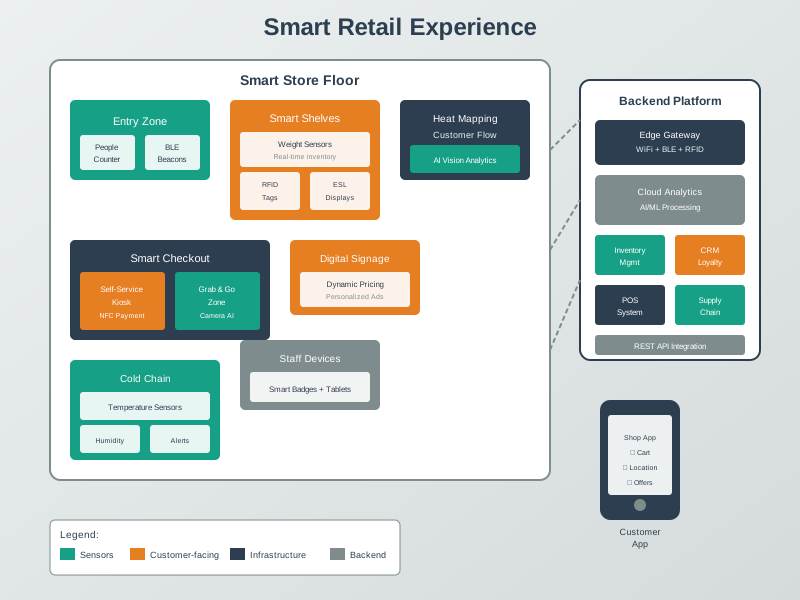
- Cameras, weight sensors, people counters, thermal sensors, and refrigeration probes may feed an edge gateway before data is sent to a cloud, store server, or retail operations platform.
- The integration plan should say which system is authoritative for each fact.
- ERP or WMS may be authoritative for replenishment and purchase orders.
Major section
Connect Store Sensors to Retail Systems (continued)
For smart shelves, pick a small set of high-velocity SKUs, record baseline out-of-stock duration, define the replenishment threshold, and measure whether tasks are accepted and completed faster.
- For customer analytics: prefer aggregate people counts, dwell zones, queue length, and heat maps; use loyalty, app, Wi-Fi, BLE, or video identity only with consent, data minimization, retention limits, and visible disclosure.
- A planogram tool may be authoritative for intended shelf placement.
- A task-management app may be authoritative for associate work.
Major section
Retail Data Boundaries
Retail IoT joins operational data with commercial systems, so the data model needs strong boundaries.
- MQTT, HTTPS APIs, Kafka-style streams, EPCIS event repositories, and warehouse tables can all appear in the same program.
- The design task is not choosing a fashionable pipe; it is keeping event meaning stable as data moves from a sensor to a store action.
Major section
Retail Data Boundaries (continued)
A shelf event might become an associate task, while the same SKU and shelf zone also feed a forecasting model.
- The edge gateway gives events a common form.
- It also holds them during an outage.
- Those tools need a clear item ID, place, source, and update time before they create a task or forecast.
Major section
Retail Data Boundaries (continued)
RFID read rates depend on antenna placement, tag orientation, item material, reader power, and anti-collision behavior.
- Weight sensors drift and need tare values, restock windows, and calibration checks.
- Computer vision needs lighting, occlusion handling, model confidence, and rules for human review.
- Refrigeration alerts need hysteresis and defrost-cycle awareness so staff are not flooded with false alarms.

Major section
Checkpoint: Store Action Boundary · The Five Pillars of Retail IoT
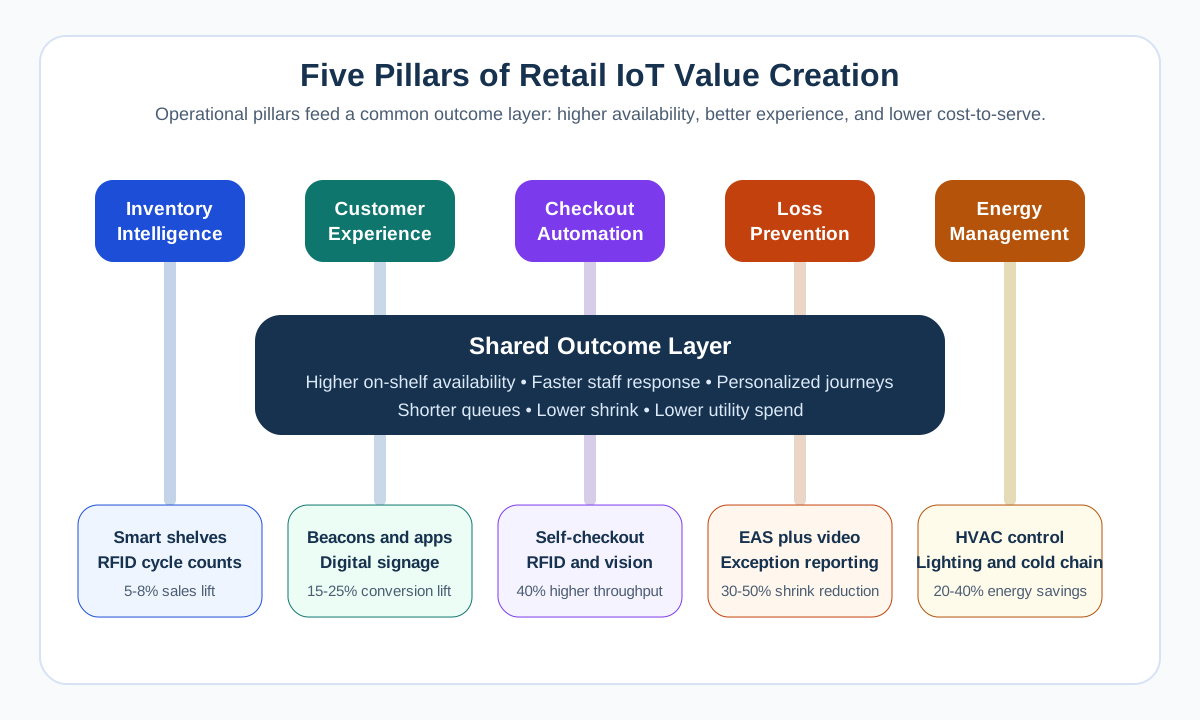
Smart shelves and RFID aim to reduce stockouts; beacons and apps shape offers; checkout tools reduce queue pressure; correlated video, RFID, and POS evidence target shrink; occupancy and lighting controls lower energy cost while protecting comfort.
- The value and ROI ranges are typical examples, not promises.
Deck summary
Key takeaways
A worker sees a warning, checks the stock room, and either refills the shelf or corrects a bad count.
- This small loop does not prove profit, fairness, or customer acceptance across a whole chain.
- A useful offer does not prove consent.
- Smart sensors can tell the store workers right away when something runs out, so they can put more on the shelf before you even get there!".
- These receive wireless updates so the store can change thousands of prices in minutes rather than sending employees to swap labels by hand.
Retrieval practice
Recall check 1 of 4

Ada says: answer from memory, then check your reasoning.
Q1What makes a retail IoT use case well-scoped?
Show answer
Answer: D Retail IoT is strongest when it improves a concrete operation or experience with appropriate privacy boundaries.
Retrieval practice
Recall check 2 of 4
Ada says: answer from memory, then check your reasoning.
Q2A shelf holds untagged packaged goods. Staff need to detect an empty shelf position and shorten restock time. Which pilot fits?
Show answer
Answer: B Weight sensing can detect the stock change here; calibration, a restock owner, and empty-duration evidence test whether it helps.
Retrieval practice
Recall check 3 of 4
Ada says: answer from memory, then check your reasoning.
Q3A store wants to use aisle beacons for offers. Which boundary should it set first?
Show answer
Answer: D Proximity data about shoppers needs consent, a useful purpose, and a stated retention rule.
Retrieval practice
Recall check 4 of 4
Ada says: answer from memory, then check your reasoning.
Q4A store compares RFID and computer-vision checkout pilots. Which evaluation can justify a choice?
Show answer
Answer: B A technology choice needs recognition evidence and the exceptions shoppers and staff must handle, not speed alone.
Print reference
Answers
Answer key.
- D · Retail IoT is strongest when it improves a concrete operation or experience with appropriate privacy boundaries.
- B · Weight sensing can detect the stock change here; calibration, a restock owner, and empty-duration evidence test whether it helps.
- D · Proximity data about shoppers needs consent, a useful purpose, and a stated retention rule.
- B · A technology choice needs recognition evidence and the exceptions shoppers and staff must handle, not speed alone.