Applications & Use Cases · Study deck

IoT Domain Requirements: Data, Regulation, and Selection

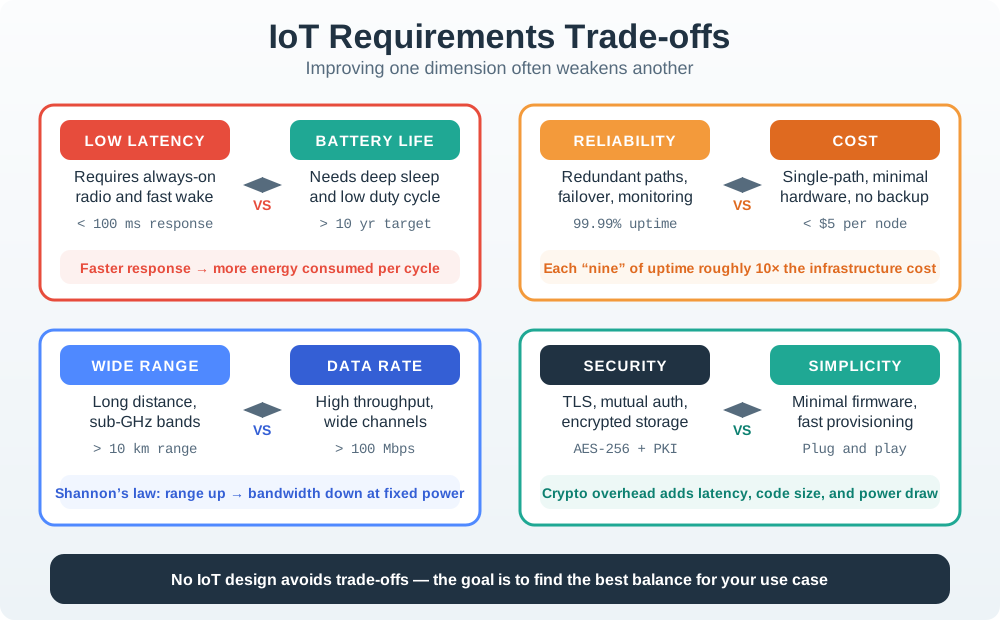
A device meets its response and battery targets, but its data volume can still overload the chosen path and regulation can delay the whole project.

Blueprint Bina is your guide for this deck.

applicationdomainsrequirements
Blueprint Bina, the module guide, in a scene from this chapter.
iotclass.org

After studying this chapter

Learning objectives

You will be able to:

  • size an IoT data path from volume and timing evidence
  • include regulatory cost and delay in requirements
  • select domain technology with explicit trade-offs
  • Explain: A device meets its response and battery targets, but its data volume can still overload the chosen path and regulation can delay the whole project.
iotclass.org

Major section

Start With the Story
A device meets its response and battery targets, but its data volume can still overload the chosen path and regulation can delay the whole project.

  • The team now needs to size storage and processing, account for compliance work, and choose technology from the full requirement set.
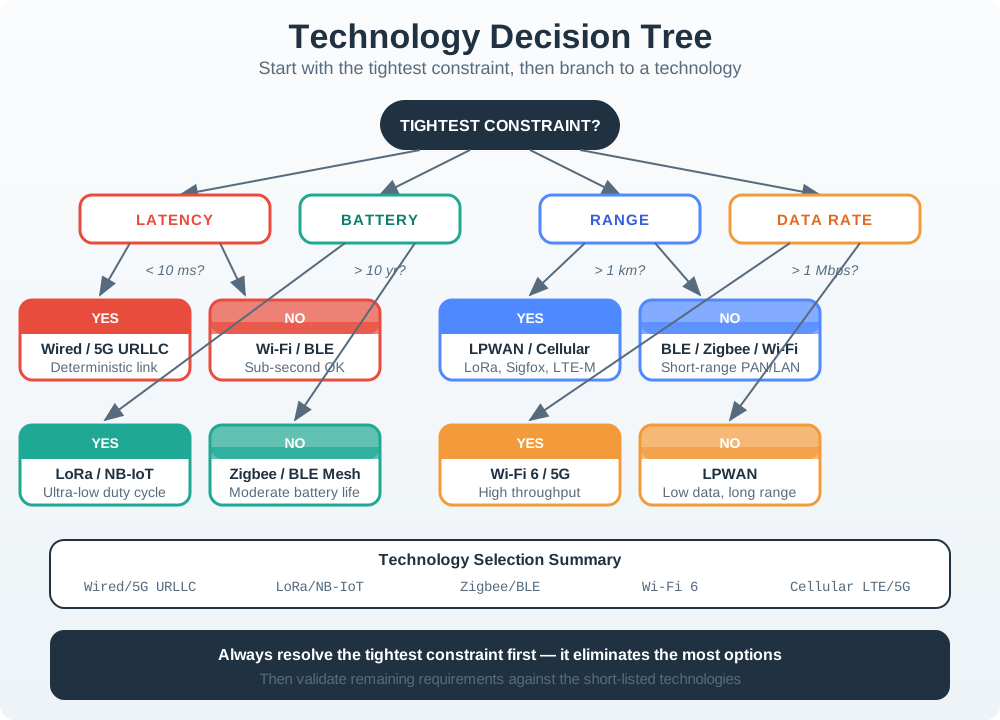
IoT technology selection decision tree guiding choices based on latency, power, scale, and data volume requirements
iotclass.org

Major section

One-Size IoT Pitfall

The Myth: "I can use Wi-Fi for everything" or "LoRaWAN solves all IoT problems".

  • The Truth: Every domain has 3-5 viable technology options based on specific constraints.
IoT technology selection decision tree guiding choices based on latency, power, scale, and data volume requirements
iotclass.org

Major section

Domain Requirements Pitfalls

A system averaging 200 ms may spike to 2-5 seconds under load -- catastrophic for industrial safety.

  • System-level accuracy must account for the entire measurement chain, not just the sensor datasheet.
  • Replacing 5,000 batteries per year at $15 each (battery + labor) costs $75,000 annually.
IoT technology selection decision tree guiding choices based on latency, power, scale, and data volume requirements
iotclass.org

Major section

Parking Sensor Battery-Replacement Math

Total savings over 10 years are $1,150,000 - $600,000 = $550,000.

  • The lifetime savings from choosing the right power architecture are $550,000 / 10,000 = $55 per sensor.
IoT technology selection decision tree guiding choices based on latency, power, scale, and data volume requirements
iotclass.org

Major section

Checkpoint: Selection and Trade-Offs

Pitfall 4: Assuming Regulations Won't Change: IoT privacy regulations are evolving rapidly.

  • The EU AI Act (2024), updated GDPR enforcement, and new US state privacy laws mean a consumer product launched today may face medical-device-level compliance requirements within 3-5 years.
IoT technology selection decision tree guiding choices based on latency, power, scale, and data volume requirements
iotclass.org

Major section

LoRaWAN vs NB-IoT TCO

They must choose between LoRaWAN (private network) and NB-IoT (carrier network).

  • Step 2: Annual Operating Costs (Years 1-5).
  • At scale, LoRaWAN advantage increases to $7.4M (41% lower TCO).
  • Key Takeaway: Per-device costs look attractive (NB-IoT $3/month seems cheap), but multiply by device count and time period to reveal true TCO.

Numbers to remember

7.4MLoRaWAN advantage increases to $7.4M (41% lower TCO).
41%LoRaWAN advantage increases to $7.4M (41% lower TCO).
IoT technology selection decision tree guiding choices based on latency, power, scale, and data volume requirements
iotclass.org

Major section

In 60 Seconds

Understanding what each domain actually needs prevents the common mistake of force-fitting a favorite technology into an incompatible use case.

  • This chapter covers domain selection, explaining the core concepts, practical design decisions, and common pitfalls that IoT practitioners need to build effective, reliable connected systems.
IoT technology selection decision tree guiding choices based on latency, power, scale, and data volume requirements
iotclass.org

Deck summary

Key takeaways

A device meets its response and battery targets, but its data volume can still overload the chosen path and regulation can delay the whole project.

  • The Myth: "I can use Wi-Fi for everything" or "LoRaWAN solves all IoT problems".
  • A system averaging 200 ms may spike to 2-5 seconds under load -- catastrophic for industrial safety.
  • Total savings over 10 years are $1,150,000 - $600,000 = $550,000.
  • Pitfall 4: Assuming Regulations Won't Change: IoT privacy regulations are evolving rapidly.
iotclass.org

Retrieval practice

Recall check 1 of 2

Blueprint Bina says: answer from memory, then check your reasoning.

Q1A startup wants to deploy 10,000 environmental sensors across a national park with 10-year battery life. Which requirement will force them to accept higher latency?

AReliability - more frequent transmissions drain batteries faster
BPower - low-power radios like LoRaWAN transmit slowly but last 10+ years on battery
CScale - more devices require more bandwidth, forcing slower transmission
DRegulation - environmental sensors must transmit infrequently by law
Show answer

Answer: B

iotclass.org

Retrieval practice

Recall check 2 of 2

Blueprint Bina says: answer from memory, then check your reasoning.

Q2Place each requirement artifact where it belongs so you can move from an IoT idea to a bounded design and evidence that proves it fits.

AMeasurable Service Outcome
BRequirement Envelope
CValidation Evidence
Show answer

Answer: A Requirements form a traceable argument: name a measurable service outcome, turn it into a domain-specific envelope of constraints and trade-offs, then collect evidence against that envelope.

Q3Complete the smart home automation rule engine:

Avalue = sensor_readings.get(self.sensor)
Bvalue = sensor_readings[self.sensor]
Cvalue = sensor_readings.find(self.sensor)
Dvalue = self.sensor.read()
Show answer

Answer: A dict.get() safely retrieves sensor values. Using callable conditions (lambda) allows flexible rule definitions.

iotclass.org

Print reference

Answers

Answer key.

  1. B
  2. A · Requirements form a traceable argument: name a measurable service outcome, turn it into a domain-specific envelope of constraints and trade-offs, then collect evidence against that envelope.
  3. A · dict.get() safely retrieves sensor values. Using callable conditions (lambda) allows flexible rule definitions.
iotclass.org