Smart Places and Infrastructure · Study deck
Domain Requirements Contracts
Latency means the wait between an event and a useful result.
Ada is your guide for this deck.

After studying this chapter
Learning objectives
You will be able to:
- Explain why domain requirements are measurable operating constraints, not technology preferences.
- Translate healthcare, agriculture, industrial, transport, retail, and smart-home needs into requirement envelopes.
- Compare candidate radios, protocols, platforms, and governance controls against pass/fail boundaries.
- Define latency, reliability, power, security, data, lifecycle, and integration budgets for an IoT system.
Major section
Start With the Story
They may use the same kind of sensing part, but the harm from a late or wrong reading is not the same.
- Latency means the wait between an event and a useful result.
- A need such as "low latency" is too vague to test.
- This Overview uses clear pass or fail limits to frame the choice.
Major section
Start With the Story (continued)
A clear rule says who must act, how long they may wait, and what the system must do if the result is late.
- Their power, records, alarms, care, and backup plans must match their real jobs.
- A requirement envelope is the full set of limits a design must meet.
- A radio or cloud service is a candidate only if it fits all those limits together.
- Under the Hood turns its parts into linked budgets and message states.
Major section
Requirements Constraints
A domain requirement is not a preference for a fashionable sensor, radio, cloud, or dashboard.
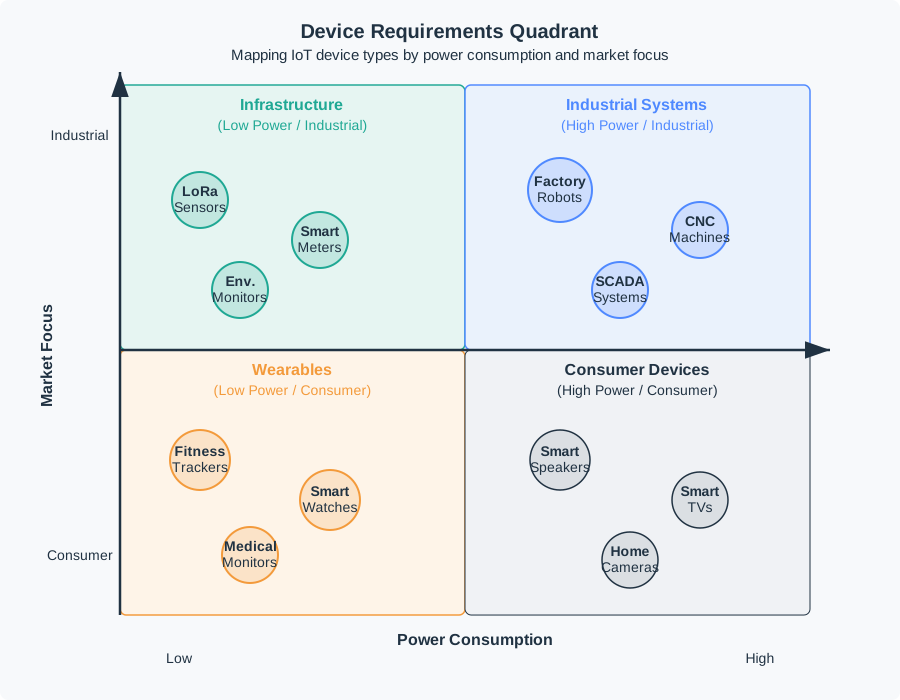
- LoRa sensors and smart meters sit in the low-power industrial corner, so their design starts from battery life.
- That much is easy to accept and easy to over-read.
- Six written limits make it a requirement.
Major section
Requirements Constraints (continued)
The panel on the right is the corrective, listing time limit, power source, device count, what data to keep, which rules apply and how to fail safely.
- Both may use a thermistor, but their acceptable latency, connectivity, calibration evidence, battery replacement, and data retention are different.
- A requirements comparison should also include the people and systems around the device.
- A city air-quality node may need public-space permissions, calibration visits, publication rules, and a way to explain uncertainty.
Major section
Measurable Domain Envelopes
A safety-critical machine-control loop should not depend on a distant cloud rule engine when deterministic local control is needed.
- A useful requirements comparison gives every candidate technology a pass/fail boundary.
- For a remote soil-moisture node, the envelope may include a 15-minute sampling interval, five-year battery target, LoRaWAN Class A uplink, IP67 enclosure, local rainfall context, and seasonal service visit.
- The practitioner review should end with a traceable decision record.
Major section
Budgets and Interfaces
An alert interface should distinguish raw threshold crossing from validated event, suppressed event, escalated event, and operator acknowledgement.
- Latency is divided across sensor sampling, filtering, edge inference, radio access, gateway processing, broker routing, database write, alert rule, and human or actuator response.
- Those budgets should be represented in interfaces, not only in architecture diagrams.
- Implementation details vary by stack.
Major section
Budgets and Interfaces (continued)
Reliability is divided across device hardware, firmware watchdogs, network coverage, broker availability, cloud region design, alert escalation, and field replacement.
- A telemetry event should carry units, timestamp source, sequence or message id, firmware version, calibration state, quality flags, and enough asset or user context to support the domain decision.
- A command interface should separate requested, accepted, dispatched, acknowledged, applied, failed, and timed-out states.
- The hidden cost of poor requirements is usually paid during operations.
Major section
Budgets and Interfaces (continued)
Without these states, the system cannot explain whether it acted late, acted twice, or failed to act.
- A technology is a candidate only when it fits all of the budgets at the same time.
- A radio that meets the range target but cannot meet the latency, power, provisioning, or regulatory budget is not a domain fit.
- MQTT topics may need tenant, site, device, and capability boundaries so authorization can be enforced without brittle string parsing.
Major section
Budgets and Interfaces (continued)
OPC UA nodes may need units, engineering ranges, quality status, and references to the physical asset.
- HL7 FHIR integrations may need device, observation, encounter, and patient identity handled with clinical safety checks.
- A LoRaWAN payload decoder may need to preserve battery voltage, frame counter, spreading factor, RSSI, SNR, and decoder version so field failures can be diagnosed later.
- If the team does not budget for certificate rotation, calibration expiry, alert fatigue, firmware rollback, gateway replacement, schema versioning, or decommissioning, the first successful pilot becomes hard to scale.
Deck summary
Key takeaways
They may use the same kind of sensing part, but the harm from a late or wrong reading is not the same.
- A clear rule says who must act, how long they may wait, and what the system must do if the result is late.
- A domain requirement is not a preference for a fashionable sensor, radio, cloud, or dashboard.
- The panel on the right is the corrective, listing time limit, power source, device count, what data to keep, which rules apply and how to fail safely.
- A safety-critical machine-control loop should not depend on a distant cloud rule engine when deterministic local control is needed.
Retrieval practice
Recall check 1 of 3

Ada says: answer from memory, then check your reasoning.
Q1This chapter contrasts 'We need temperature monitoring' with 'We need a calibrated temperature record that proves vaccine storage stayed within policy, alerts a responsible person before excursion, and survives an audit.' Both may use the same thermistor. What actually makes the second version a domain requirement rather than a feature wish?
Show answer
Answer: D see answers page
Retrieval practice
Recall check 2 of 3
Ada says: answer from memory, then check your reasoning.
Q2Per this chapter's example envelopes, which pairing of requirements does it give for a remote soil-moisture node?
Show answer
Answer: A For a remote soil-moisture node, the envelope may include a 15-minute sampling interval, five-year battery target, LoRaWAN Class A uplink, IP67 enclosure, local rainfall context, and seasonal service visit.
Retrieval practice
Recall check 3 of 3
Ada says: answer from memory, then check your reasoning.
Q3What makes a domain requirement envelope more useful than a generic technology preference?
Show answer
Answer: B see answers page
Print reference
Answers 1 of 3
Answer key.
- D · The chapter's own contrast: 'We need temperature monitoring' is too broad to design, while the vaccine-storage version is a requirement because it names the calibrated evidence, the alerting timing, and the audit survival -- 'Both may use a thermistor, but their acceptable latency, connectivity, calibration evidence, battery replacement, and data retention are different.'.
Print reference
Answers 2 of 3
Answer key.
- A · For a remote soil-moisture node, the envelope may include a 15-minute sampling interval, five-year battery target, LoRaWAN Class A uplink, IP67 enclosure, local rainfall context, and seasonal service visit.
Print reference
Answers 3 of 3
Answer key.
- B · A domain requirement envelope turns a domain's operating context into measurable pass/fail budgets across latency, reliability, power, security, data, lifecycle, governance, integration, validation, and fallback behavior -- criteria a team can actually test a technology choice against, rather than a generic preference for one radio or platform that ignores how requirements differ by domain.