Applications & Use Cases · Study deck
IoT Application Domains: Requirements and Navigation
Two domains can use similar sensors and still need very different systems because one decision can wait minutes while another cannot.
Blueprint Bina is your guide for this deck.

After studying this chapter
Learning objectives
You will be able to:
- Explain: A smart agriculture deployment may need 1 soil moisture sensor per hectare (readings every 30 minutes), while a factory vibration monitoring system needs sensors on every critical bearing (readings at 10 kHz).
- Explain: Its diagram makes Choose the Domain Chapter That Fits the Context and: Requirements explicit within decision flowchart for selecting the most relevant iot application domain chapter based on your project context.
- Explain: Misconception 4: "Consumer IoT experience transfers directly to industrial or healthcare IoT.": Reality: Consumer IoT (smart home, wearables) tolerates occasional failures gracefully -- a missed smart light command is an inconvenience.
Major section
Latency Drives Architecture
This explains why autonomous vehicles need edge computing (local <10 ms), while agriculture uses cloud platforms with LoRaWAN (hours acceptable).
- A 10 ms response window is therefore about 0.28 m of travel before the vehicle can react, which is critical for collision avoidance.
- Architecture gap:: Six hours is 21,600 seconds.
- Compared with a 10 ms vehicle response window, that is a 2,160,000x difference in latency tolerance.
Major section
IoT Domain Misconceptions
Adding unnecessary sensors increases cost, power consumption, network congestion, and data storage without improving outcomes.
- Misconception 1: "All IoT applications are basically the same -- just sensors sending data to the cloud.": Reality: Requirements vary by orders of magnitude.
- An autonomous vehicle processes gigabytes per day with sub-10 ms latency, while a smart parking sensor transmits a few bytes per hour and tolerates minutes of delay.
- The regulatory, reliability, and safety requirements across domains are fundamentally different.
Major section
IoT Domain Misconceptions (continued)
Misconception 3: "Cloud connectivity is required for all IoT applications.": Reality: Many domains operate effectively with edge-only or local processing.
- Misconception 2: "More sensors always means a better IoT system.": Reality: Sensor density must match the domain's spatial and temporal resolution needs.
- Industrial control systems often require deterministic sub-millisecond response that cloud round-trips cannot guarantee.
- The connectivity model must match the domain's latency, reliability, and coverage requirements.
Major section
IoT Domain Misconceptions (continued)
A smart agriculture deployment may need 1 soil moisture sensor per hectare (readings every 30 minutes), while a factory vibration monitoring system needs sensors on every critical bearing (readings at 10 kHz).
- Agricultural sensors in remote areas may use store-and-forward with satellite backhaul on a daily schedule.
- Misconception 4: "Consumer IoT experience transfers directly to industrial or healthcare IoT.": Reality: Consumer IoT (smart home, wearables) tolerates occasional failures gracefully -- a missed smart light command is an inconvenience.
- Industrial IoT demands 99.99% reliability where failures cause production losses of thousands of dollars per minute.
Major section
Chapter Series Overview
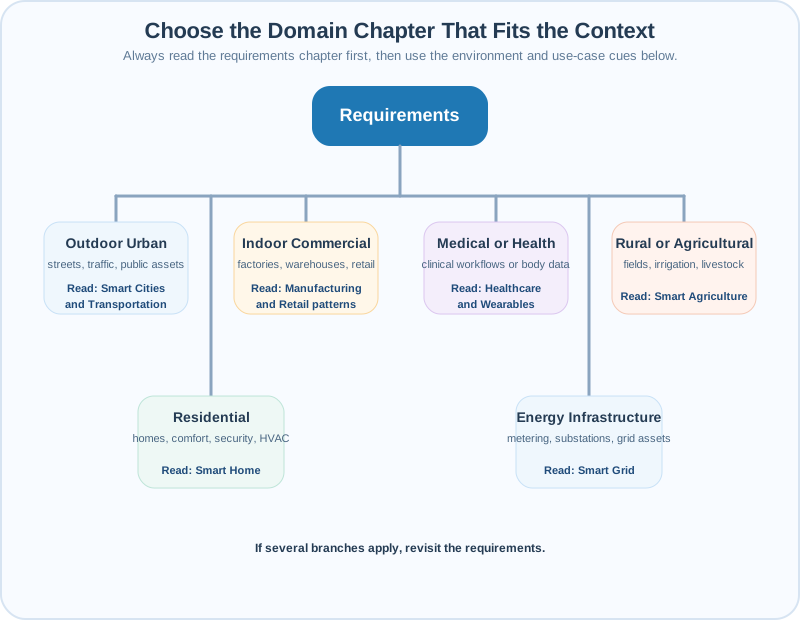
Its diagram makes Choose the Domain Chapter That Fits the Context and: Requirements explicit within decision flowchart for selecting the most relevant iot application domain chapter based on your project context.
- Together those labels make decision flowchart for selecting the most relevant iot application domain chapter based on your project context testable.
Major section
Start With the Problem
Key Takeaway: The most successful IoT deployments start with a quantified operational problem, derive technical requirements from that problem, and only then select appropriate technologies.
- Analyzed 24 months of unplanned downtime costs.
- Daily reporting sufficient (no need for sub-ms latency).
- Simple edge FFT + alert-when-anomaly detected (no need for complex AI).
Deck summary
Key takeaways
This explains why autonomous vehicles need edge computing (local <10 ms), while agriculture uses cloud platforms with LoRaWAN (hours acceptable).
- Adding unnecessary sensors increases cost, power consumption, network congestion, and data storage without improving outcomes.
- Misconception 3: "Cloud connectivity is required for all IoT applications.": Reality: Many domains operate effectively with edge-only or local processing.
- A smart agriculture deployment may need 1 soil moisture sensor per hectare (readings every 30 minutes), while a factory vibration monitoring system needs sensors on every critical bearing (readings at 10 kHz).
Retrieval practice
Recall check 1 of 5

Blueprint Bina says: answer from memory, then check your reasoning.
Q1A startup is building an IoT system that monitors soil moisture on farms and automatically triggers irrigation. Which of the Five Pillars of IoT Impact does this application belong to?
Show answer
Answer: B Correct!
Retrieval practice
Recall check 2 of 5

Blueprint Bina says: answer from memory, then check your reasoning.
Q2You are designing an IoT system for two clients: Client A needs autonomous vehicle collision avoidance, and Client B needs smart city parking occupancy detection. What is the MOST critical difference in their technical requirements?
Show answer
Answer: B Correct!
Retrieval practice
Recall check 3 of 5

Blueprint Bina says: answer from memory, then check your reasoning.
Q3A hospital wants to use the same predictive maintenance algorithms that a manufacturing company uses to monitor factory equipment. The hospital would apply these algorithms to MRI machines and ventilators. This is an example of:
Show answer
Answer: B Correct!
Retrieval practice
Recall check 4 of 5

Blueprint Bina says: answer from memory, then check your reasoning.
Q4A city manager asks: 'We have $200,000 for IoT. Should we deploy smart parking OR smart waste management first?' Based on the chapter's domain taxonomy, what is the BEST reasoning for choosing one over the other?
Show answer
Answer: C Correct!
Retrieval practice
Recall check 5 of 5

Blueprint Bina says: answer from memory, then check your reasoning.
Q5Place each design responsibility where it lives so you can explain why two IoT domains with similar sensors can require different architectures.
Show answer
Answer: A Application domains reshape architecture because the physical outcome defines the evidence, domain constraints shape its communication path, and decision logic gives the delivered data operational meaning.
Q6Complete the healthcare IoT vital signs aggregator:
Show answer
Answer: A Negative slicing [-window_size:] takes the last N elements for a moving average.
Print reference
Answers
Answer key.
- B · Correct!
- B · Correct!
- B · Correct!
- C · Correct!
- A · Application domains reshape architecture because the physical outcome defines the evidence, domain constraints shape its communication path, and decision logic gives the delivered data operational meaning.
- A · Negative slicing [-window_size:] takes the last N elements for a moving average.