Connected Health and Wearables · Study deck
Healthcare IoT: Value, Alerts, and Adoption
A clinical device can produce a trustworthy reading, but that does not prove the service is affordable or that staff can act on every alert.
Ada is your guide for this deck.
After studying this chapter
Learning objectives
You will be able to:
- price a healthcare IoT service from clinical value
- calculate alert and remote-monitoring operating costs
- evaluate adoption, privacy, and connected-device risks
- Explain: A device that reduces readmissions, prevents missed medication doses, or saves nurse review time can support a stronger price than a device sold only as hardware.
Major section
Price by Clinical Value
A device that reduces readmissions, prevents missed medication doses, or saves nurse review time can support a stronger price than a device sold only as hardware.
- Value-based pricing can fit healthcare IoT only when the value claim is measurable and clinically owned.
- But the claim must survive evidence review.
- The price is defensible when the buyer can trace the fee to avoided clinical or operational cost.
Major section
Remote Monitoring Operating Cost Check
They break even when the program can review the right patients, suppress noise, and fund the staff and integration work needed to act on the data.
- A monitoring program is viable when the payment path covers device cost, support cost, and clinician review time while keeping alert volume inside the workflow budget.
- Tiny conversion-rate math from consumer freemium products is the wrong model for clinical IoT.
- Healthcare monitoring programs do not break even because the app has many users.
Major section
Healthcare IoT Adoption Challenges
EHR integration gap: many IoT devices do not connect to Electronic Health Records, creating data silos where doctors cannot see patient-collected data.
- Data security concerns: HIPAA compliance, breach liability, and ransomware risks make hospitals cautious about adding connected devices.
- Missing integration-first mindset: startups often build impressive gadgets rather than clinical tools, so products do not fit real workflows.
- False positive problem: consumer devices can generate anxiety-inducing alerts, overwhelming doctors with worried-but-healthy patients.
Major section
Neonatal ICU Alert Thresholds
Scenario: A Level IV NICU is implementing an IoT-based early warning system to detect clinical deterioration in extremely preterm infants (<28 weeks gestational age).
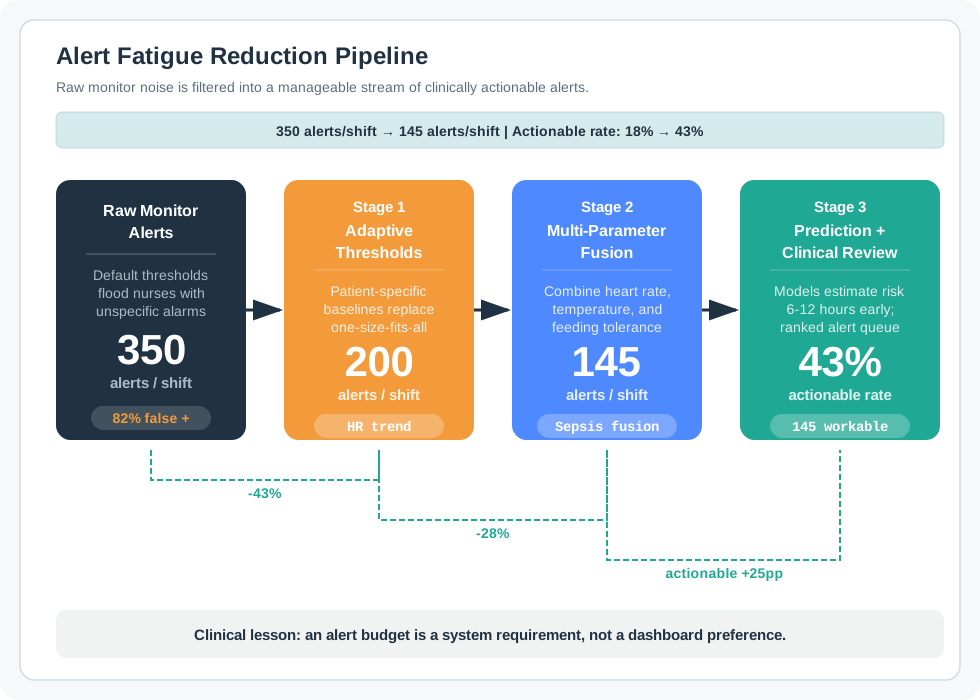
- Problem: 82% of current alerts are false positives or clinically insignificant.
- Key Insight: Healthcare IoT alert systems must be designed with explicit alert fatigue budgets.
- A NICU nurse cannot meaningfully respond to 350 alerts per shift - the system must intelligently filter and prioritize.
Major section
Checkpoint: Alert Fatigue
With the alert path under control, the last design layer is scale.
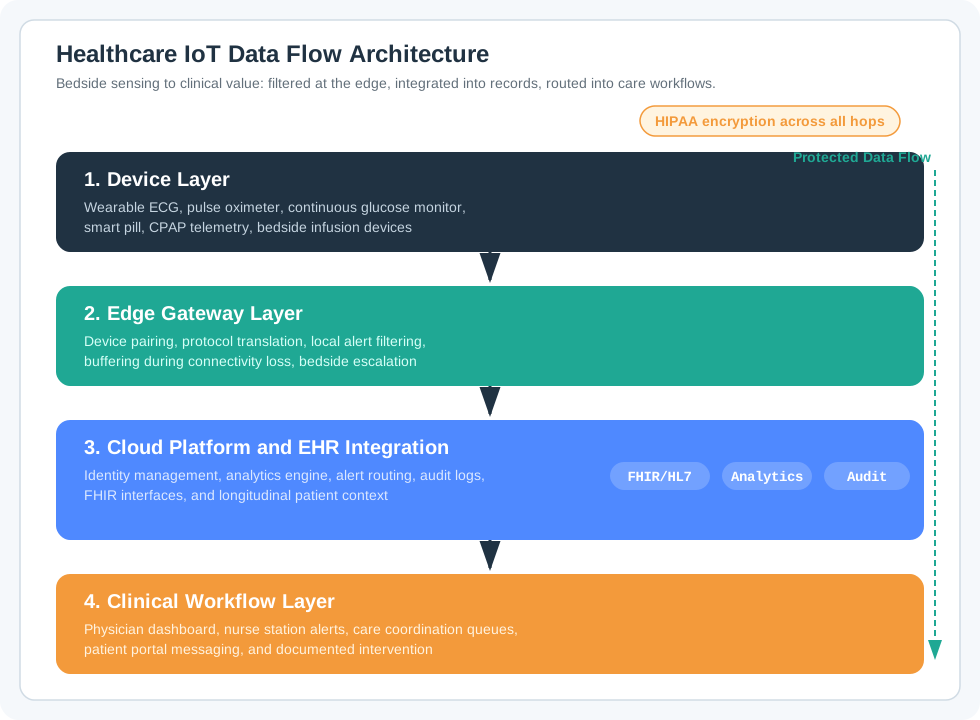
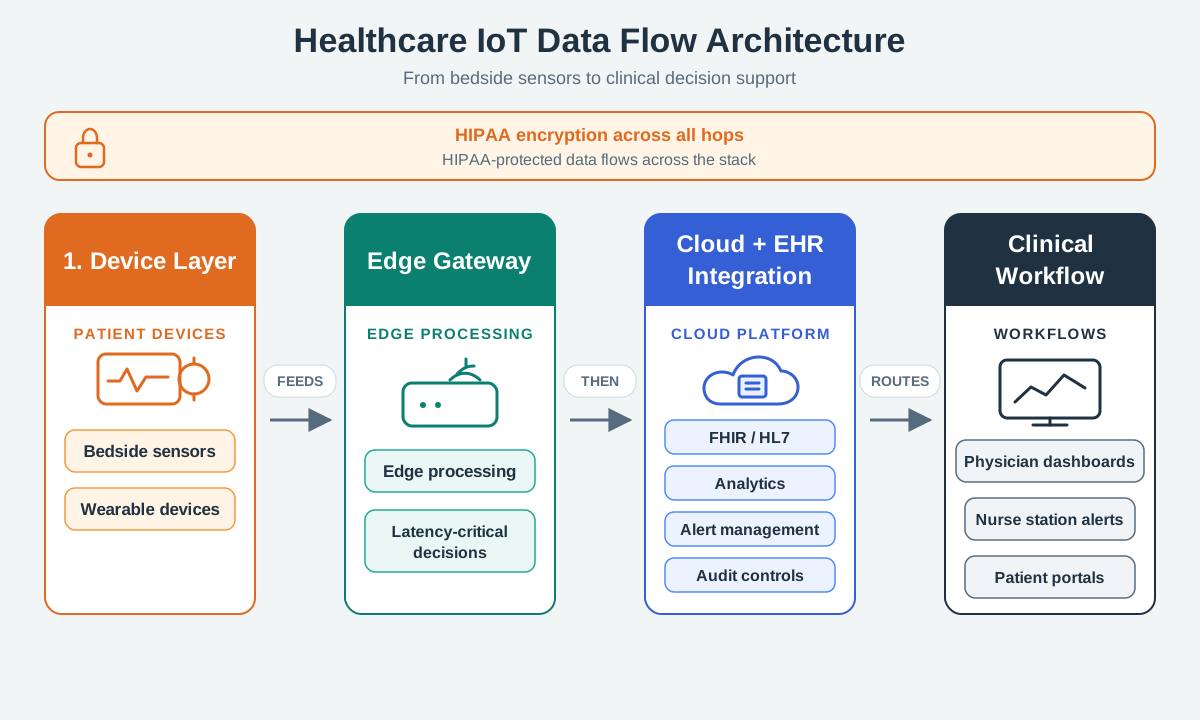
- That gateway is the first place to normalize signals and make latency-critical decisions without waiting for the cloud.
- The cloud layer then integrates observations with the EHR through FHIR or HL7, applies alert rules, and keeps audit controls.
- Protection must continue across every hop, but the purpose of the path is clinical action; a secure reading that never reaches the right workflow still fails.
Major section
Philips HealthSuite Platform Shift
The Business Transformation: Philips announced native FHIR support for healthcare-data integration through HealthSuite.
- The announcement describes an integration capability; it does not establish the specific commercial or clinical outcomes listed in unsupported secondary figures.
- Integration-first approach: HealthSuite announced native FHIR support for healthcare-data integration; each deployment still needs evidence about its connected systems and workflow outcomes.
- Interoperability gaps: Despite HL7 FHIR support, integrations with specific EHR systems may require custom middleware and deployment-specific validation.
Major section
Philips HealthSuite Platform Shift (continued)
Edge processing for latency-critical decisions: Local processing can keep time-sensitive analysis near patient monitors while sending trend data to cloud services.
- Cybersecurity incidents: Multiple CVEs discovered in patient monitoring firmware, including one (CVE-2021-39244) that could allow unauthorized modification of monitoring parameters.
- Key Lesson: Healthcare IoT success requires solving the "last mile" problem -- connecting device data to the EHR system where clinicians actually make decisions.
- The best sensor in the world is worthless if its data sits in a standalone app that nobody checks.
Major section
Connected Medical Devices
Connected CPAP machines: Resmed AirView can relay therapy data for clinician review and remote follow-up. (Resmed AirView) Do not state device counts, compliance accuracy, or visit reductions without dated studies.
- Predictive alerts warn before dangerous glucose levels are reached.
- At the centre sits a small moulded carrier.
- The hard engineering is the part the patient never sees.

Major section
Connected Medical Devices (continued)
Flexible heart sensor sheath: A sensor-laden flexible sheath wrapped around the heart can monitor irregular rhythm, pH changes during restricted blood supply, and temperature fluctuations caused by localized burns.
- This form factor shows how one connected medical device can observe electrical, chemical, and thermal changes at the organ surface.
- Most of the device is that pad, and its only job is to stay on skin, so wear time and skin tolerance are design limits before any software question.
- Rising from it is a filament thinner than a hair, and that thread is the only part which reaches tissue.
Major section
Summary
Clinical validation: Accuracy criteria depend on the measurement and intended use; products need evidence against applicable requirements rather than a universal consumer-versus-clinical threshold.
- Regulatory Pathway: Determine classification, submission route, evidence, and post-market obligations for the product’s intended use and product code.
- Ingestible Sensors: Ingestible sensors can record some ingestion events, but improved adherence or savings have not been established for ABILIFY MYCITE.
- The "Worried Well" Problem: False-positive consumer alerts can drive unnecessary clinical follow-up; quantify the effect only for a documented population.
Major section
Concept Relationships: Healthcare IoT
Clinical accuracy and regulatory pathway: accuracy criteria and submission requirements depend on the measurement, intended use, and product code; validate the product and scope estimates to the applicable pathway.
- EHR integration relates to clinical workflow: devices that write directly to Electronic Health Records deliver more clinical value than standalone devices.
- The worried-well problem relates to unnecessary follow-up: false-positive consumer alerts can drive clinical follow-up; quantify the effect only for a documented population.
- Cross-module connection: Healthcare IoT requires BLE wearables (Module 4), edge AI for alert filtering (Module 5), and risk-based health-data security (Module 7).
Deck summary
Key takeaways
A device that reduces readmissions, prevents missed medication doses, or saves nurse review time can support a stronger price than a device sold only as hardware.
- They break even when the program can review the right patients, suppress noise, and fund the staff and integration work needed to act on the data.
- EHR integration gap: many IoT devices do not connect to Electronic Health Records, creating data silos where doctors cannot see patient-collected data.
- Scenario: A Level IV NICU is implementing an IoT-based early warning system to detect clinical deterioration in extremely preterm infants (<28 weeks gestational age).
Retrieval practice
Recall check

Ada says: answer from memory, then check your reasoning.
Q1A hospital considers a connected monitor that sends health data to a vendor. What must its adoption review include?
Show answer
Answer: B The service must be safe to operate and acceptable to patients and staff.
Q2A startup wants to repurpose its consumer fitness tracker (heart rate accuracy +/- 12 BPM) as a clinical cardiac monitor. What is the PRIMARY barrier to this transition?
Show answer
Answer: B A device must be validated against requirements for its intended clinical use; no single accuracy threshold applies to every measurement.
Q3How can an ingestible medication sensor detect some ingestion events?
Show answer
Answer: A The ingestible sensor contains copper, magnesium, and silicon.
Q4The 'worried well' problem in healthcare IoT refers to which phenomenon?
Show answer
Answer: C The 'worried well' describes healthy consumers whose device alerts can lead to unnecessary clinical follow-up.
Q5Complete the healthcare alert triage checker:
Show answer
Answer: B Healthcare alert triage should suppress stale, unmatched, unconsented, or low-confidence events and page clinicians only for confirmed urgent or critical patient events.
Q6A remote-care pilot has 40 patients, two alerts per patient per week, five clinician minutes per alert at $60/hour, plus $100/week device support and $50/week integration. What is the weekly operating cost?
Show answer
Answer: D 40 × 2 × 5 = 400 minutes = 6⅔ hours; review costs $400, then $100 + $50 gives $550/week.
Print reference
Answers 1 of 2
Answer key.
- B · The service must be safe to operate and acceptable to patients and staff.
- B · A device must be validated against requirements for its intended clinical use; no single accuracy threshold applies to every measurement.
- A · The ingestible sensor contains copper, magnesium, and silicon.
- C · The 'worried well' describes healthy consumers whose device alerts can lead to unnecessary clinical follow-up.
Print reference
Answers 2 of 2
Answer key.
- B · Healthcare alert triage should suppress stale, unmatched, unconsented, or low-confidence events and page clinicians only for confirmed urgent or critical patient events.
- D · 40 × 2 × 5 = 400 minutes = 6⅔ hours; review costs $400, then $100 + $50 gives $550/week.