Smart Places and Infrastructure · Study deck
Smart Agriculture: Irrigation Systems and Evidence
This first route starts with the agronomic decision, builds the field loop and precision-agriculture stack, and tests irrigation evidence.
Ada is your guide for this deck.

After studying this chapter
Learning objectives
You will be able to:
- Explain: Livestock Biometric Monitoring: Ear-tag, collar, leg-band, or rumen-bolus sensors measuring temperature, activity, location, and rumination so health changes can be detected earlier than manual observation alone.
- Explain: LoRaWAN Gateway: Long-range wireless receiver that can cover large fields when gateway height, antenna placement, terrain, payload size, and duty-cycle limits support the link budget.
- Explain: Sensor reports volumetric water content (VWC), the percentage of total soil volume occupied by water; at saturation VWC is approximately the soil's porosity, not 100% VWC.
- Explain: Example reading: Sensor #23 reports 28% VWC at 2:45 PM.
Major section
Overview · Choose Whether to Water the Dry Patch
The dry patch does not describe the whole field.
- This first route starts with the agronomic decision, builds the field loop and precision-agriculture stack, and tests irrigation evidence.
- The grower must choose whether to water now, wait, or inspect the field.
- These records connect the watering decision to its physical result.
Major section
Key Concepts
Precision Agriculture: Site-specific crop management using sensor data to vary inputs by field zone rather than treating the whole field uniformly.
- Livestock Biometric Monitoring: Ear-tag, collar, leg-band, or rumen-bolus sensors measuring temperature, activity, location, and rumination so health changes can be detected earlier than manual observation alone.
- LoRaWAN Gateway: Long-range wireless receiver that can cover large fields when gateway height, antenna placement, terrain, payload size, and duty-cycle limits support the link budget.
- Frost Protection System: Network of microclimate sensors and heating/irrigation actuators that activates before ground temperature reaches the crop damage threshold.
Major section
MVU: Minimum Viable Understanding · For Beginners: Smart Agriculture
Precision Over Uniform: Smart agriculture uses site-specific sensor data to treat each field zone individually.
- Water, fertiliser, and yield outcomes depend on crop value, baseline practice, soil variability, irrigation method, and whether the farm actually changes its operating decisions.
- Temperature becomes more useful when it is interpreted with activity, rumination, location, and recent heat stress.
- Smart agriculture means using small electronic sensors placed in fields and on animals to collect information like soil moisture, temperature, and animal health.
Major section
For Kids: Meet the Sensor Squad! · Smart Agriculture Planner
Smart farming is like giving plants and animals their own doctors and weathermen who watch over them 24/7!
- But this morning, she had five new helpers - the Sensor Squad had arrived at Sunny Acres Farm!
- They need at least 55 degrees to be happy." Farmer Emma had no idea - the air felt warm, but underground was different!
- The coolest sensor was the Moisture Monitor (Thermo's cousin).
Major section
Agronomic Decision First
The sensor is not the product by itself.
- The product is the decision loop that connects field conditions to timely action.
- For livestock, it includes animal identity, normal baseline, tag or bolus health data, activity change, location, and a veterinary workflow that makes the alert actionable.
- The beginner mistake is to treat agriculture IoT as a hardware shopping list.

Major section
Agronomic Decision First (continued)
Soil texture, root depth, and crop stage give that number agronomic meaning before LoRaWAN carries it through the gateway.
- Cloud analysis adds weather, and the dashboard presents a recommendation with an operator override.
- A command then opens a zone valve, but the loop is not closed until valve state and flow confirm that water moved.
- Field identity, calibration context, and action evidence must survive every boundary or a correct reading can still irrigate the wrong place.
Major section
Design Field Loop First · Agriculture Data Needs Context
Design each data path around the farm action it supports.
- That map determines whether LoRaWAN, NB-IoT/LTE-M, BLE tags through readers, Wi-Fi, private cellular, or satellite backhaul is the right fit.
- A practitioner should also map the season.
- Commissioning should produce evidence, not just installed devices.
Major section
Phoebe's Field Notes: One Dielectric Constant, Two Jobs In This Field · Moisture Maya's Math Bridge: Water in Probe and Radio Path
The mathematical gist: The vineyard's far corner is 471.7 m away.
- At 915 MHz free-space loss is 85.1 dB, while a vegetated path exponent of 2.8 raises the model to 106.5 dB and leaves 46.5 dB from a 153 dB link budget.
Major section
Checkpoint: Farm Decision Loop · The Evolution of Precision Agriculture
Agriculture has evolved through distinct technology phases, each building on the previous.
- IoT represents a transformational leap - not just incremental improvement.
- Present: weather stations, soil sensors, and plant monitors provide real-time environmental data, but raw streams can overwhelm farmers.
- Connected sensors provide real-time visibility but can overwhelm.
Major section
Smart Vineyard Irrigation
Each sensor measures volumetric water content (VWC) every 15 minutes.
- Sensor reports volumetric water content (VWC), the percentage of total soil volume occupied by water; at saturation VWC is approximately the soil's porosity, not 100% VWC.
- Example reading: Sensor #23 reports 28% VWC at 2:45 PM.
- Sensors use LoRaWAN to send readings to gateway in equipment shed.
Major section
Smart Vineyard Irrigation (continued)
Gateway receives 4,800 messages/day (50 sensors × 96 messages).
- Cloud platform receives aggregated data every hour (not every 15 min).
- At 6 AM, system sends command to Zone 3 solenoid valve: "Open for 45 minutes".
- Key Insight: The system loops continuously — actuation affects sensors, sensors inform next actuation.
Major section
Precision Agriculture IoT Stack
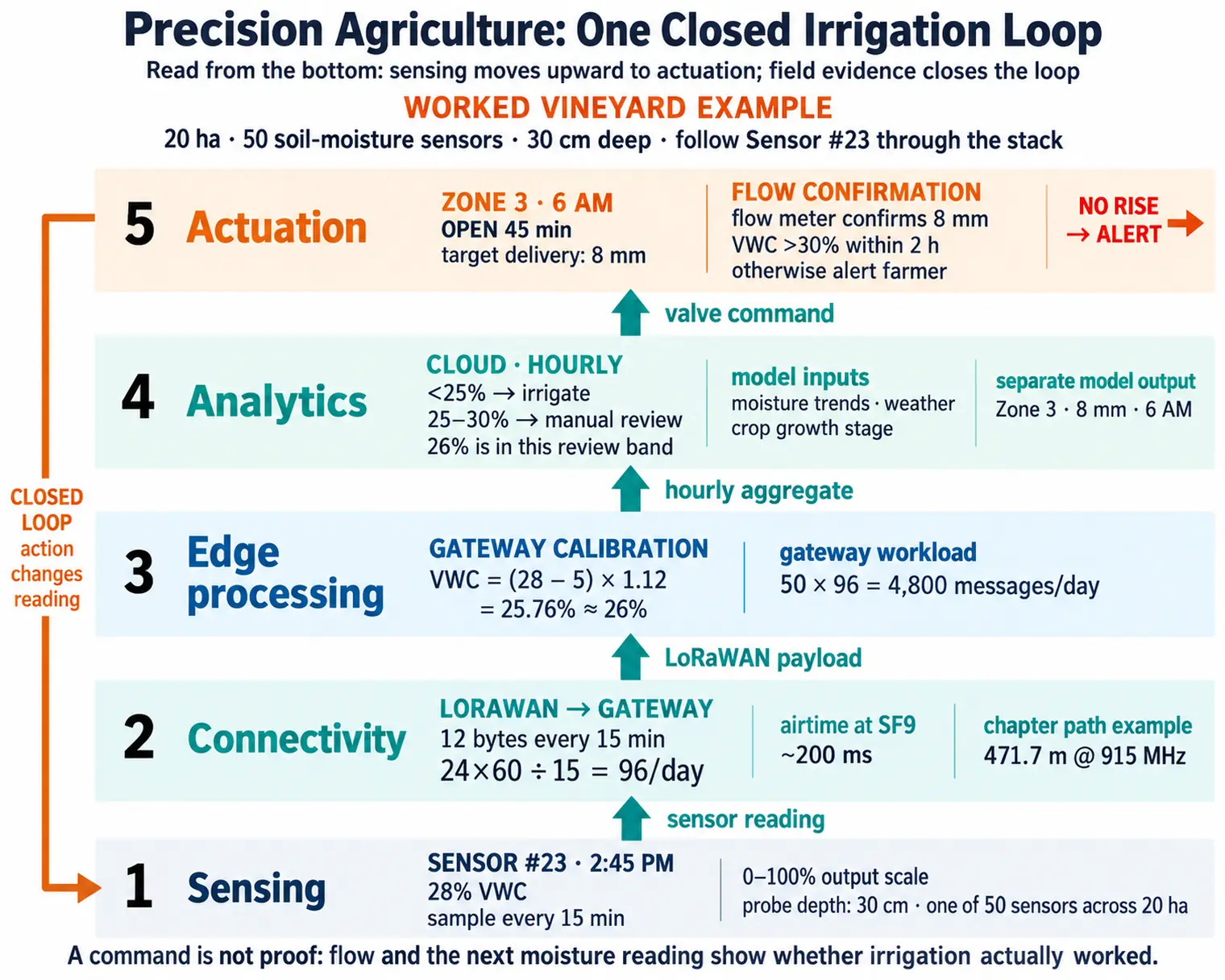
Sensing: soil-moisture probes, sap-flow sensors, and weather stations show when and where irrigation is needed.
- Analytics: edge and cloud models can predict yield risk or disease pressure when they keep calibration and field context.
- Actuation: variable-rate irrigation and drone spraying apply inputs only where the farm has evidence to act.
Major section
Precision Agriculture IoT Stack (continued)
Precision irrigation can reduce avoidable watering when the baseline system over-irrigates or misses field-zone differences.
- Integration: farm-management software brings sensor, equipment, and operating records into one decision surface.
- For larger farms, the integration layer is often a context platform rather than a single dashboard.
- The arrow that closes the loop is the important one.
Major section
Precision Agriculture IoT Stack (continued)
The sensing layer gathers soil moisture, weather, canopy images and livestock data, so the record starts with field context rather than a dashboard.
- Analytics sits above that, where gateway filters drop noise and cloud models estimate irrigation, disease and frost risk.
- Every action changes the next set of readings, so the farm has to judge the stack by what the following week measures.
- Variable-rate fertiliser and pesticide programs can reduce input waste when maps, calibration, and application equipment are trustworthy.
- Yield benefits depend on crop stress, weather, disease pressure, soil variability, and whether the farm changes operations in time.
Deck summary
Key takeaways
The dry patch does not describe the whole field.
- Precision Agriculture: Site-specific crop management using sensor data to vary inputs by field zone rather than treating the whole field uniformly.
- Precision Over Uniform: Smart agriculture uses site-specific sensor data to treat each field zone individually.
- Smart farming is like giving plants and animals their own doctors and weathermen who watch over them 24/7!
- The sensor is not the product by itself.
Retrieval practice
Recall check 1 of 3

Ada says: answer from memory, then check your reasoning.
Q1A farm has soil readings but workers keep the same irrigation schedule. What should the team establish to show operational value?
Show answer
Answer: C The chapter ties value to changed irrigation or treatment and its outcome.
Retrieval practice
Recall check 2 of 3
Ada says: answer from memory, then check your reasoning.
Q2The vineyard record schedules irrigation and requires flow confirmation. What follow-up would help expose a valve or installation fault?
Show answer
Answer: D The record pairs the command with a measured response and an alert if that response is missing.
Retrieval practice
Recall check 3 of 3
Ada says: answer from memory, then check your reasoning.
Q3A farm wants a reviewable path from soil readings to valve commands. Which design gives each step a role?
Show answer
Answer: B Each stage turns field evidence into an action with a clear boundary.
Print reference
Answers
Answer key.
- C · The chapter ties value to changed irrigation or treatment and its outcome.
- D · The record pairs the command with a measured response and an alert if that response is missing.
- B · Each stage turns field evidence into an action with a clear boundary.