Applications & Use Cases · Study deck

Smart Agriculture: Deployment and Resilience

An irrigation pilot saves water on a well-covered test block, but a full farm adds failed probes, radio shadows, livestock movement, frost risk, and changing soil.

Blueprint Bina is your guide for this deck.

applicationdomainsagriculture
Blueprint Bina, the module guide, in a scene from this chapter.
iotclass.org

After studying this chapter

Learning objectives

You will be able to:

  • diagnose sensor and connectivity failures in field deployments
  • design livestock and frost alert decisions from stated evidence
  • select calibration, coverage, and recovery controls for a farm system
  • Explain: Scenario: A 500-head dairy operation in Wisconsin is configuring rumen bolus temperature thresholds to detect illness early while minimizing false alerts that waste veterinary time.
iotclass.org

Major section

Livestock Alert Thresholds

Scenario: A 500-head dairy operation in Wisconsin is configuring rumen bolus temperature thresholds to detect illness early while minimizing false alerts that waste veterinary time.

  • The annual value should be calculated from local labour, veterinary, treatment, milk-production, and herd-management data.
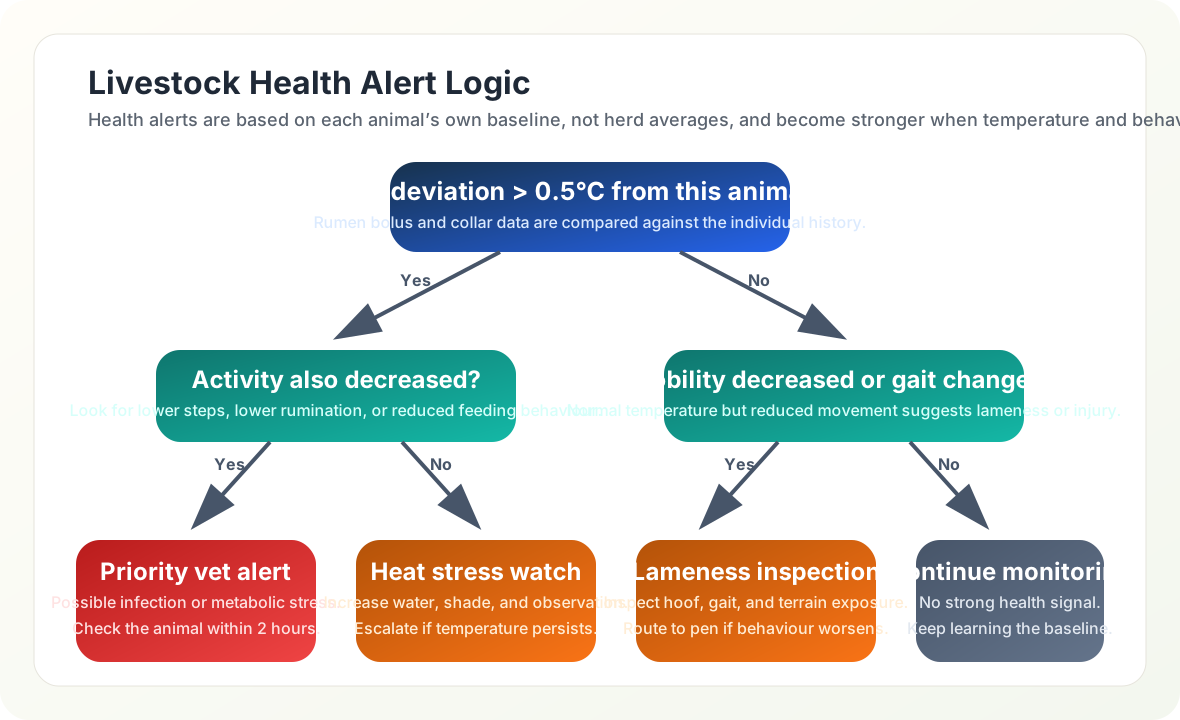
  • Key Insight: Livestock IoT systems require per-animal baseline calibration, not herd-level thresholds.
  • A temperature that indicates fever in one cow may be normal for another.

Why it matters

Result: Custom threshold configuration reduces false alerts in the scenario and can surface health changes earlier than visual observation when the farm validates the alert against veterinary outcomes.

iotclass.org

Major section

Livestock Monitoring Technologies
Sensor Types:: An ear tag can combine GPS, temperature, and accelerometer readings for location, activity, and identification.

  • A collar can add microphones to GPS and motion sensing to infer grazing behaviour, rumination, and oestrus.
  • The correct form factor depends on the signal, attachment lifetime, animal handling, and maintenance plan.
Livestock Health Alert Decision Tree - How IoT sensor data drives veterinary response prioritization
iotclass.org

Major section

Connectivity for Agricultural IoT

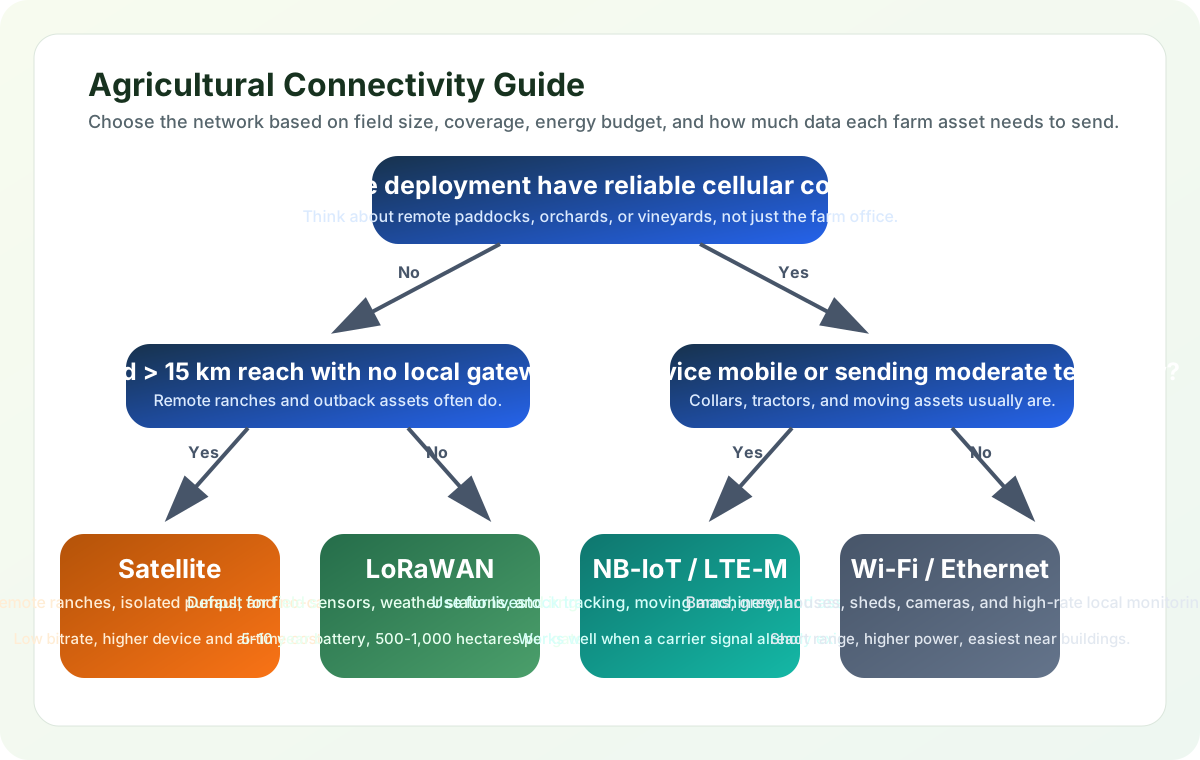
LoRaWAN: 2-15 km range, 5-10 year battery targets, and 0.3-50 kbps data rates make it a strong fit for soil sensors and weather stations.

  • Sigfox: 10-50 km range and 100 bps payloads fit simple status sensors where a Sigfox network is available.

Numbers to remember

1-10 kbps1-10 kbps links can serve remote ranches
Agricultural IoT Connectivity Selection Guide - Choosing the right wireless technology based on deployment requirements
iotclass.org

Major section

Connectivity for Agricultural IoT (continued)

NB-IoT: cellular-coverage range, 5-10 year battery targets, and roughly 100 kbps service can support livestock tracking where carriers cover the farm.

  • Satellite: global reach and 1-10 kbps links can serve remote ranches, but message frequency, terminal cost, and battery life need careful design.
  • Starting supplies one named condition; the question of whether the deployment area has cellular supplies the necessary comparison for agricultural iot connectivity selection guide - choosing the right wireless technology based on deployment requirements.
  • Together those labels make agricultural iot connectivity selection guide - choosing the right wireless technology based on deployment requirements testable.
iotclass.org

Major section

Concept Relationships: Smart Agriculture

Soil moisture monitoring relates water savings to sensor calibration: irrigation decisions require soil-specific calibration curves for clay, sand, loam, organic matter, and salinity effects.

  • LoRaWAN fit relates long range to battery life: large fields may favor LoRaWAN over Wi-Fi when payloads are small, reporting intervals are sparse, and gateway placement is strong.
  • Variable-rate application relates sensor density to crop value: higher-value crops can justify denser sensor grids, while lower-margin commodity crops usually need simpler instrumentation.
  • Livestock health sensors relate early detection to false alarms: temperature, activity, and rumination sensors require per-animal baselines and staff workflow tuning to avoid alert fatigue.
iotclass.org

Deck summary

Key takeaways

Scenario: A 500-head dairy operation in Wisconsin is configuring rumen bolus temperature thresholds to detect illness early while minimizing false alerts that waste veterinary time.

  • Sensor Types:: An ear tag can combine GPS, temperature, and accelerometer readings for location, activity, and identification.
  • LoRaWAN: 2-15 km range, 5-10 year battery targets, and 0.3-50 kbps data rates make it a strong fit for soil sensors and weather stations.
  • NB-IoT: cellular-coverage range, 5-10 year battery targets, and roughly 100 kbps service can support livestock tracking where carriers cover the farm.
iotclass.org

Retrieval practice

Recall check 1 of 5

Blueprint Bina says: answer from memory, then check your reasoning.

Q1A vineyard manager is deploying soil moisture sensors across a 40-hectare field with 3 distinct soil types. Using this chapter's minimum planning baseline of five sensors per soil zone, how many sensors are required before adjusting for topographic variation?

A3 sensors - one per soil zone is sufficient
B9 sensors - 3 per zone gives adequate coverage
C15 sensors - applying the scenario's 5-per-zone planning baseline
D40 sensors - 1 per hectare is the standard density
Show answer

Answer: C The scenario's planning arithmetic is 3 zones x 5 sensors = 15.

iotclass.org

Retrieval practice

Recall check 2 of 5

Blueprint Bina says: answer from memory, then check your reasoning.

Q2A dairy farm is configuring rumen bolus temperature alerts. Cow #234 has a baseline temperature of 38.8°C and Cow #456 has a baseline of 39.2°C. Using individual adaptive thresholds (baseline + 0.5°C for 3+ hours), at what temperature would Cow #234 trigger an alert?

A38.8°C - any reading at the baseline should trigger concern
B39.3°C - baseline (38.8°C) plus 0.5°C deviation threshold
C39.5°C - the standard clinical fever threshold for all cattle
D39.7°C - using Cow #456's baseline plus 0.5°C as the herd standard
Show answer

Answer: B Correct!

iotclass.org

Retrieval practice

Recall check 3 of 5

Blueprint Bina says: answer from memory, then check your reasoning.

Q3A farmer needs to deploy 200 soil moisture sensors across a 500-hectare remote wheat field with no cellular coverage. Sensors transmit a 12-byte moisture reading once per hour. Which connectivity technology is MOST appropriate?

AWi-Fi mesh network - best for large deployments with many sensors
BNB-IoT - designed for low-power IoT applications
CLoRaWAN with self-deployed gateway - long range and no carrier contract
DSatellite IoT - only option without cellular coverage
Show answer

Answer: C Correct!

iotclass.org

Retrieval practice

Recall check 4 of 5

Blueprint Bina says: answer from memory, then check your reasoning.

Q4A citrus grower's IoT frost protection system reduced false alarm activation from 40% to 16% of frost events. Wind machines cost $85/hour each with 30 machines running 30 hours per season unnecessarily due to false alarms. What are the approximate annual wind machine fuel savings from reducing false activations?

A$25,500 - savings from the 24% false alarm reduction
B$45,900 - savings proportional to the 60% reduction in false alarms
C$76,500 - total wind machine fuel costs eliminated
D$108,588 - total system benefits including all categories
Show answer

Answer: B Correct!

iotclass.org

Retrieval practice

Recall check 5 of 5

Blueprint Bina says: answer from memory, then check your reasoning.

Q5Place each farm-loop responsibility where it lives so you can trace whether a bad irrigation decision came from sensing, context transfer, or actuation logic.

AField Sensing
BFarm Gateway
CIrrigation Decision and Actuation
Show answer

Answer: A A defensible farm loop separates calibrated field evidence, contextual transport, and the policy-controlled action so a grower can diagnose errors without guessing which boundary failed.

Q6Complete the smart agriculture soil moisture tracker:

Aself.history.append(moisture_pct)
Bself.history.add(moisture_pct)
Cself.history += moisture_pct
Dself.history.insert(moisture_pct)
Show answer

Answer: A Threshold-based irrigation control is a core smart agriculture pattern.

iotclass.org

Print reference

Answers

Answer key.

  1. C · The scenario's planning arithmetic is 3 zones x 5 sensors = 15.
  2. B · Correct!
  3. C · Correct!
  4. B · Correct!
  5. A · A defensible farm loop separates calibrated field evidence, contextual transport, and the policy-controlled action so a grower can diagnose errors without guessing which boundary failed.
  6. A · Threshold-based irrigation control is a core smart agriculture pattern.
iotclass.org