Capstone & Resources · Study deck
IoT Quick Reference: Terms and Hardware
This first reference route covers vocabulary, protocols, sensors, and pin-level hardware facts.
Sammy is your guide for this deck.

After studying this chapter
Learning objectives
You will be able to:
- Explain: For an SX1276 or RFM95 LoRa design, it may record regional channel plan, antenna gain, spreading factor, duty-cycle limit, RSSI/SNR target, and the field test that will validate the link budget.
- Explain: The visual progression is the habit to use throughout this appendix: a table row is not a permanent truth but a cue to ask which decision is being made now.
- Explain: IEEE 802.11 and IEEE 802.15.4 define radio and MAC behavior, but they do not decide antenna placement, enclosure losses, channel congestion, power policy, or application recovery.
Major section
In 60 Seconds
A fast answer can create a slow failure when its limits are missing.
- A protocol means an agreed set of rules for exchanging information.
- This check validates one use of a reference, not the whole design.
- This appendix is a quick-reference companion for IoT terminology, protocol comparisons, sensor specifications, ESP32 pin assignments, common unit conversions, engineering formulas, and standards links.
Major section
Start With The Evidence Note
A table can remind you that a pin is input-only, a protocol uses a certain transport, or a battery formula needs current and time.
- The project still needs an evidence note that says where the value came from, which design decision depends on it, and what check would catch a wrong assumption.
- A sensor row becomes useful only after you attach calibration, warm-up, mounting, airflow, supply voltage, and drift.
- A formula becomes useful only after you write the units and compare the estimate with a measurement.
- That habit keeps quick facts from turning into hidden design risks.
Major section
Convert Lookup Into Evidence
A BME280 or SHT31 row should lead to interface wiring, address setting, enclosure airflow, sampling interval, self-heating, and calibration expectations.
- When you use this appendix during a build, convert the lookup into a short evidence card before the value enters a capstone report, firmware constant, schematic, or dashboard.
- CoAP comes from RFC 7252, but retransmission timers, confirmable messages, DTLS, OSCORE, proxy behavior, and UDP loss still need project-level review.
- For formulas, keep inputs and units visible.
Major section
Convert Lookup Into Evidence (continued)
ESP32 pin references are only safe after the board schematic, boot strapping pins, input-only pins, ADC limitations, I2C pull-ups, and peripheral conflicts are checked.
- A PMS5003 particulate sensor row should lead to airflow, warm-up, cleaning, and replacement planning rather than a single accuracy claim.
- A link-budget estimate should name transmit power, antenna gain, receiver sensitivity, path-loss model, installation height, cable loss, regional limit, and field RSSI/SNR target.
- A battery estimate should include active current, sleep current, wake interval, radio burst length, regulator quiescent current, battery chemistry, temperature, self-discharge, and end-of-life margin.

Major section
Specifications Leave Implementation Gaps
A sensor datasheet may quote accuracy under controlled calibration conditions while your enclosure creates heat, dust, condensation, vibration, or airflow constraints.
- Under the hood, many appendix facts come from standards or datasheets that deliberately stop at an interface boundary.
- IEEE 802.11 and IEEE 802.15.4 define radio and MAC behavior, but they do not decide antenna placement, enclosure losses, channel congestion, power policy, or application recovery.
- A standard may guarantee packet structure but not deployment reliability.
Major section
Specifications Leave Implementation Gaps (continued)
Battery-life math is arithmetic; chemistry, temperature, peak current, regulator efficiency, self-discharge, and aging determine whether the deployed device lasts.
- A microcontroller technical reference manual can describe ADC resolution, touch channels, UARTs, SPI controllers, I2C controllers, boot pins, and absolute maximum ratings.
- Free-space path loss assumes a simplified propagation model; indoor multipath, body absorption, metal cabinets, antenna orientation, and duty-cycle restrictions change the result.
- A formula may be correct while the inputs are fantasy.
Major section
Specifications Leave Implementation Gaps (continued)
Ohm's law and voltage dividers are exact circuit relationships, but resistor tolerance, ADC input impedance, noise, leakage, and temperature drift determine whether the measurement is usable.
- The deep skill is to write down where the reference guarantee stops.
- A datasheet may guarantee a limit under specified conditions but not your enclosure.
- A table may compare protocols but not choose one for your threat model or power budget.
Major section
Deep Dive: Reference Facts Need Engineering Context
A quick reference helps when you already know the concept and need a fast lookup.
- It should not turn a table value into a design decision by itself.
- A LoRaWAN range figure, ESP32 pin note, DHT22 accuracy value, MQTT QoS label, or battery-life formula becomes useful only after the project context is named.
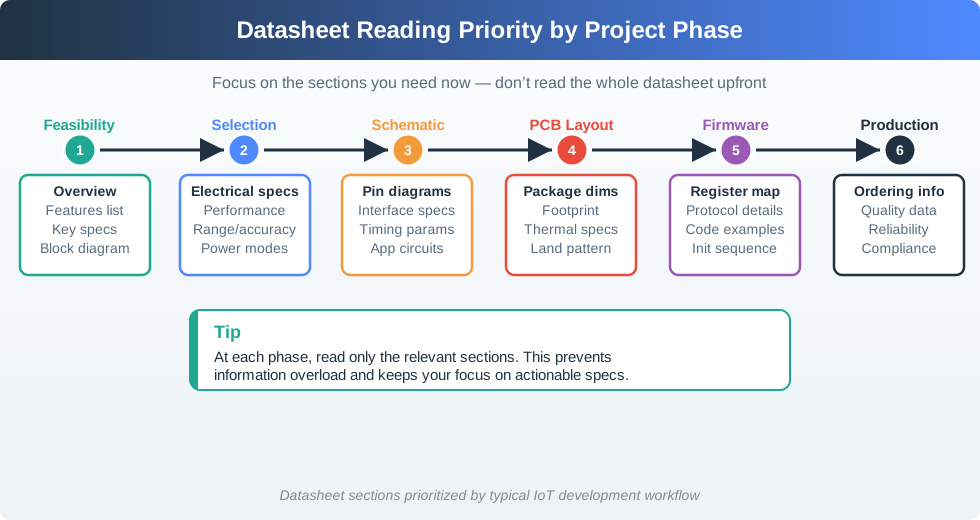
Major section
Deep Dive: Reference Facts Need Engineering Context (continued)
The point is not to slow down every lookup.
- The visual progression is the habit to use throughout this appendix: a table row is not a permanent truth but a cue to ask which decision is being made now.
- A BLE range row may support a first shortlist, but it cannot replace an on-site RSSI check.
- The point is to stop unreviewed reference facts from becoming hidden design commitments.
Major section
Deep Dive: Reference Facts Need Engineering Context (continued)
A BME280 current value may start a battery estimate, but it must be combined with sampling interval, regulator quiescent current, radio transmit current, and sleep leakage.
- ESP32 GPIO 34-39 are input-only, so a wiring plan should mark them as sensor inputs rather than relay outputs.
- For an SHT31, DS18B20, or PMS5003 selection, it may record accuracy, interface, warm-up, airflow, enclosure, and replacement risk.
- Every compressed value also has a revision problem.
Major section
Deep Dive: Reference Facts Need Engineering Context (continued)
For an SX1276 or RFM95 LoRa design, it may record regional channel plan, antenna gain, spreading factor, duty-cycle limit, RSSI/SNR target, and the field test that will validate the link budget.
- Wireless range depends on frequency, transmit power, antenna gain, receiver sensitivity, path loss, walls, interference, installation height, and duty-cycle limits.
- Sensor accuracy depends on calibration, temperature range, supply voltage, self-heating, drift, sampling interval, and mounting.
- Current draw depends on active state, sleep state, radio burst length, regulator quiescent current, and firmware timing.
- CoAP confirmable messages use ACK and retransmission timers over UDP.
Major section
Deep Dive: Reference Facts Need Engineering Context (continued)
I2C depends on pull-up resistors, bus capacitance, address conflicts, and clock speed.
- ESP32 boot pins can affect startup if external circuitry pulls them to the wrong state.
- Vendor breakout boards may differ from the underlying chip datasheet because of regulator choice, level shifting, pull-up values, address jumpers, or board-layout limits.
- That separation lets a future maintainer update one layer without guessing which assumptions were inherited from a table.
Major section
Deep Dive: Reference Facts Need Engineering Context (continued)
Library defaults may differ from a protocol specification because a driver chooses a timeout, retry count, payload size, keep-alive interval, or power mode.
- Regional rules may change what looks like a simple wireless comparison: LoRaWAN channel plans, transmit power, dwell time, and duty-cycle behavior are not the same in every region.
- For that reason, a final capstone evidence packet should cite the exact reference revision and the observed project value when a number matters.
- Fact reused: the exact protocol limit, sensor range, formula, pin assignment, or conversion you plan to use.
Major section
Deep Dive: Reference Facts Need Engineering Context (continued)
Good records distinguish IEEE or IETF normative behavior from a vendor application note, a forum example, a library default, and a measurement from the team's device.
- Source location: the appendix section and, when exact behavior matters, the external standard or data sheet you will verify against.
- Units and boundary: the unit, valid range, rounding rule, and any condition that changes the value.
- Acceptance test: the bench test, calculation, or review step that proves the value is safe to use in your design.
- MQTT QoS 1 belongs with idempotent command handling because duplicates can occur.
Major section
Key Concepts
Bill of materials (BOM): A structured list of hardware components, quantities, and costs used for procurement planning and project budgeting.
- Protocol comparison matrix: A side-by-side comparison of communication protocols across range, data rate, power, topology, and typical use cases.
- Worked example: A solved problem that shows inputs, method, intermediate steps, and final answer so the reasoning is visible.
- Standards reference: A pointer to IEEE, IETF, alliance, or vendor documents that should be checked for exact protocol requirements.
Deck summary
Key takeaways
A fast answer can create a slow failure when its limits are missing.
- A table can remind you that a pin is input-only, a protocol uses a certain transport, or a battery formula needs current and time.
- A BME280 or SHT31 row should lead to interface wiring, address setting, enclosure airflow, sampling interval, self-heating, and calibration expectations.
- ESP32 pin references are only safe after the board schematic, boot strapping pins, input-only pins, ADC limitations, I2C pull-ups, and peripheral conflicts are checked.
- A sensor datasheet may quote accuracy under controlled calibration conditions while your enclosure creates heat, dust, condensation, vibration, or airflow constraints.
Retrieval practice
Recall check

Test Tessa says: answer from memory, then check your reasoning.
Q1You are designing an IoT sensor node and need a communication bus that connects a BME280 temperature sensor AND a BH1750 light sensor to a single ESP32 using the fewest wires. Which interface should you select?
Show answer
Answer: D I2C uses only SDA and SCL, and both the BME280 and BH1750 have configurable I2C addresses, allowing them to share the same bus with just two wires total.
Print reference
Answers
Answer key.
- D · I2C uses only SDA and SCL, and both the BME280 and BH1750 have configurable I2C addresses, allowing them to share the same bus with just two wires total.