Capstone & Resources · Study deck

IoT Quick Reference: Conversions and Standards

A design note now has the right component and protocol names, but its numbers still need consistent units and formulas.

Test Tessa is your guide for this deck.

appendix-conversions-formulas-standards
Test Tessa, the module guide, in a scene from this chapter.
iotclass.org

After studying this chapter

Learning objectives

You will be able to:

  • Explain: The board view reminds you that the selected address depends on how the breakout exposes and wires SDO; it cannot be inferred from the sensor name alone.
  • Explain: Scenario: Your capstone project has a BME280 temperature, humidity, and pressure sensor plus a BH1750 light sensor, both using I2C.
  • Explain: These tables do not make design decisions for you; they help you ask the right questions before consulting detailed chapters.
  • Explain: The appendix does not teach when to apply these formulas; it assumes you have already learned the underlying principles.
iotclass.org

Major section

Worked Example: Using the Appendix to Resolve a Missing I2C Device

Scenario: Your capstone project has a BME280 temperature, humidity, and pressure sensor plus a BH1750 light sensor, both using I2C.

  • The board view reminds you that the selected address depends on how the breakout exposes and wires SDO; it cannot be inferred from the sensor name alone.

Why it matters

The photograph is useful here because the debugging question is about a physical board configuration, not an abstract I2C rule.

A BME280 breakout like the one in this scenario; the appendix gives two possible addresses, selected by the SDO wiring.
iotclass.org

Major section

Worked Example: Using the Appendix to Resolve a Missing I2C Device (continued)

That observation sends the investigation back to wiring, power, bus scan, and board documentation before firmware is rewritten.

  • Problem identified: The possible addresses are different, so an address conflict is unlikely.
  • The next check is wiring and bus assignment.
  • Quick lookups save time during prototyping when they are used with a clear diagnostic sequence.
iotclass.org

Major section

Common Mistake: Using Appendix as Primary Learning Resource

The result is memorized definitions without enough context for design decisions.

  • Key insight: The appendix is a map, not a guidebook.
  • It helps you navigate once you know the terrain; it does not teach the underlying engineering by itself.
iotclass.org

Major section

Concept Relationships

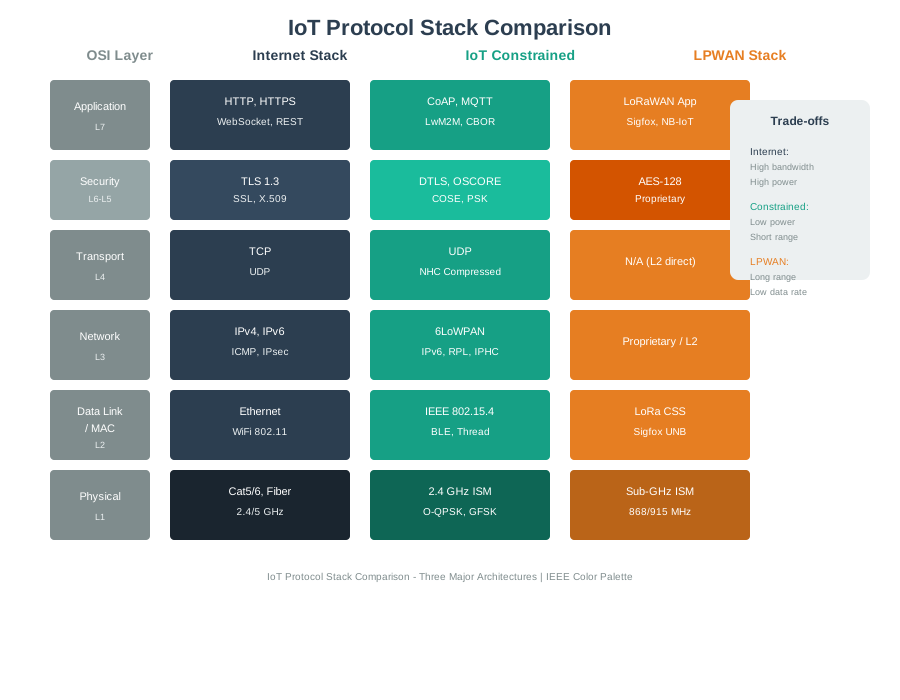
The appendix does not introduce new concepts; it consolidates them for quick reference.

  • Understanding this mapping helps you find authoritative documentation.
  • These tables do not make design decisions for you; they help you ask the right questions before consulting detailed chapters.
  • The appendix does not teach when to apply these formulas; it assumes you have already learned the underlying principles.

Why it matters

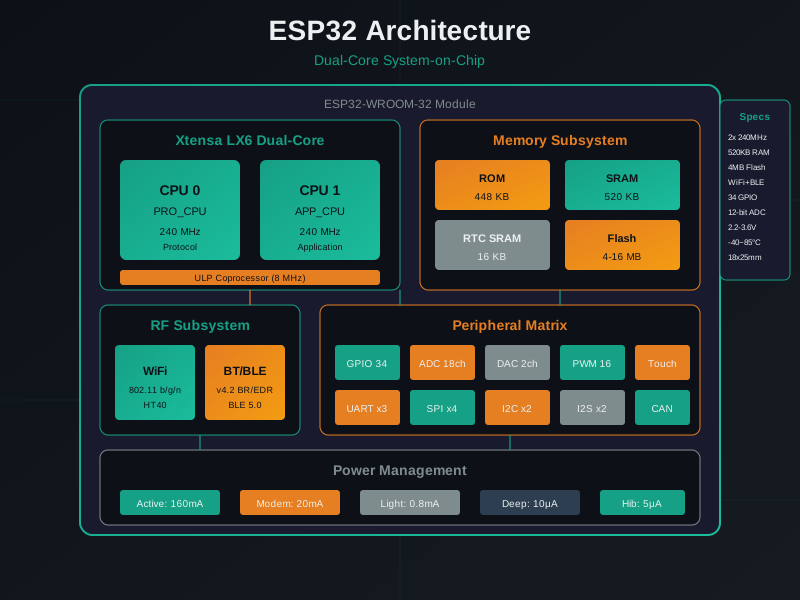
Pin reference prevents hardware mistakes: ESP32 GPIO tables show which pins have ADC, DAC, and touch capabilities, default I2C/SPI assignments, and boot-mode restrictions.

iotclass.org

Deck summary

Key takeaways

Scenario: Your capstone project has a BME280 temperature, humidity, and pressure sensor plus a BH1750 light sensor, both using I2C.

  • That observation sends the investigation back to wiring, power, bus scan, and board documentation before firmware is rewritten.
  • The result is memorized definitions without enough context for design decisions.
  • The appendix does not introduce new concepts; it consolidates them for quick reference.
iotclass.org

Retrieval practice

Recall check 1 of 4

Test Tessa says: answer from memory, then check your reasoning.

Q1Place each capstone activity where it lives so you can trace a project decision from scope to field evidence.

AProject Scoping
BSystem Design
CImplementation & Testing
DDeployment & Evaluation
Show answer

Answer: A Place the four activities across intent, engineered proof, and field evidence so you can defend how a capstone decision reached its conclusion.

Q2Complete the IoT project configuration scaffold:

Aconfig = {'project': project_name, 'sensors': sensors, 'cloud': {'endpoint': cloud_endpoint, 'protocol': 'MQTT'}}
Bconfig = json.dumps(project_name, sensors)
Cconfig = {'name': project_name}
Dconfig = [project_name, sensors, cloud_endpoint]
Show answer

Answer: A json.dumps() with indent=2 produces human-readable JSON. Nested dicts represent the hierarchical IoT project structure.

iotclass.org

Retrieval practice

Recall check 2 of 4

Test Tessa says: answer from memory, then check your reasoning.

Q31. Which standards body is most directly associated with IEEE 802.11 (Wi-Fi) and IEEE 802.15.4?

AIETF
BIEEE
CLoRa Alliance
DBluetooth SIG
Show answer

Answer: B IEEE publishes the 802 family of networking standards, including 802.11 (Wi-Fi) and 802.15.4 (LR-WPAN used by Zigbee/Thread).

Q42. RFC 7252 specifies which IoT application protocol?

ACoAP (Constrained Application Protocol)
BMQTT publish/subscribe messaging
CTLS 1.3 transport security
DHTTP/2 web stream multiplexing
Show answer

Answer: A RFC 7252 defines CoAP, a lightweight REST-like application protocol designed for constrained devices and networks.

iotclass.org

Retrieval practice

Recall check 3 of 4

Test Tessa says: answer from memory, then check your reasoning.

Q53. If you need a quick comparison of wireless and application protocols while making design decisions, this appendix is best used as:

Aa replacement for detailed chapters when design trade-offs are unclear
Ba source of production-ready firmware drivers and tested libraries
Ca certification checklist for regulatory approval and field release
Da quick reference for key protocol facts during study or design
Show answer

Answer: D The appendix is meant to accelerate recall with tables, glossaries, and formulas; the main chapters provide deeper explanations and context.

iotclass.org

Retrieval practice

Recall check 4 of 4

Test Tessa says: answer from memory, then check your reasoning.

Q64. RFCs for protocols like CoAP, RPL, and 6LoWPAN are published by:

ABluetooth SIG
BLoRa Alliance
CIETF
DIEEE
Show answer

Answer: C The IETF publishes RFCs (Request for Comments) for many internet protocols, including key IoT-related specifications like CoAP and RPL.

iotclass.org

Print reference

Answers 1 of 2

Answer key.

  1. A · Place the four activities across intent, engineered proof, and field evidence so you can defend how a capstone decision reached its conclusion.
  2. A · json.dumps() with indent=2 produces human-readable JSON. Nested dicts represent the hierarchical IoT project structure.
  3. B · IEEE publishes the 802 family of networking standards, including 802.11 (Wi-Fi) and 802.15.4 (LR-WPAN used by Zigbee/Thread).
  4. A · RFC 7252 defines CoAP, a lightweight REST-like application protocol designed for constrained devices and networks.
iotclass.org

Print reference

Answers 2 of 2

Answer key.

  1. D · The appendix is meant to accelerate recall with tables, glossaries, and formulas; the main chapters provide deeper explanations and context.
  2. C · The IETF publishes RFCs (Request for Comments) for many internet protocols, including key IoT-related specifications like CoAP and RPL.
iotclass.org